As an interior design director who has specified materials for automotive OEM interiors and commercial furniture lines, I can tell you this: orange is the hardest color in leather manufacturing. Not because it’s difficult to make once — but because it’s impossible to match twice. Orange pigments have the highest spectral sensitivity of any common leather color. A 2-nanometer shift in wavelength between batches creates a visible mismatch that your customer will notice the moment two upholstery panels sit side by side.
The B2B market for orange leather is growing — driven by automotive interior customization (BMW M Series orange Nappa, Honda XRV orange-black interiors, luxury MPV VIP seating), commercial furniture (burnt orange sectionals for hospitality), and fashion accessories. But every buyer I’ve spoken with has the same complaint: the first batch was perfect, the second batch was a different orange.
The color science problem: Orange leather fails batch-to-batch consistency more than any other color because orange pigments are highly sensitive to curing temperature, UV exposure during production, and base material chemistry. Silicone leather solves this through Pantone-matched formulation with Delta E ≤1.0 — meaning the human eye cannot detect color difference between any two batches, ever.
Why Orange Is the Hardest Leather Color to Match
Three factors make orange leather uniquely challenging for B2B production:
1. Pigment Sensitivity to Curing Temperature
Orange pigments — particularly diazo and benzimidazolone-based compounds — shift hue with temperature variations as small as 5°C during the curing process. A coating line running at 155°C produces a noticeably different orange than the same line at 160°C. For PVC leather, where plasticizer content also affects pigment dispersion, the variation is even wider. Silicone leather’s curing process is more tightly controlled (±2°C in multi-zone ovens), and the silicone polymer matrix stabilizes pigments more effectively than PU or PVC.
2. UV-Induced Color Shift During Storage
Orange is the color most affected by UV-induced fading and yellowing. PU and PVC leather can show visible color shift within 200–400 hours of UV exposure — meaning a warehouse batch stored near a window or under fluorescent lighting may arrive a different shade than what was approved. Silicone leather’s UV resistance (1,000+ hours with no fading) ensures the orange you approve is the orange you receive — even months later.
3. Base Material Chemistry Interference
The underlying substrate chemistry affects how orange pigments appear. Chrome-tanned leather has a blue-grey undertone that shifts orange toward a duller, muddier tone. PU leather’s solvent residue can cause yellowing that shifts orange toward amber. Silicone’s neutral, non-yellowing chemistry allows orange pigments to express at their true spectral value — producing cleaner, more vibrant oranges that match the Pantone reference.

Orange and black lychee-texture silicone leather — vibrant, consistent color achieved through controlled pigment formulation.
The 4 Orange Shades B2B Buyers Search For
Burnt Orange (#CC5500)
Deep, warm orange with brown undertones. Top choice for automotive interiors and luxury furniture. Pairs with black, cream, and charcoal. Most requested shade for MPV VIP seating.
Bright Orange (#FF7F00)
Vivid, saturated orange with no brown shift. Used in sports equipment, gaming chair accents, and fashion-forward automotive trim. Requires high-purity pigments and precise UV stabilization.
Rust Orange (#B7410E)
Deep, earthy orange-red. Popular in hospitality furniture and commercial interiors. Pairs with dark wood, brass, and warm neutrals. Closest to natural leather tones.
Caramel/Light Orange (#E08E45)
Soft, warm orange-amber. Used in residential furniture, baby and children’s products. Requires FDA and EN 71 compliance for skin-contact applications — silicone leather is inherently compliant.
B2B Orange Leather: Material Comparison
| Property | Genuine Orange Leather | PU Orange Faux Leather | Silicone Leather (TOPSUN) |
|---|---|---|---|
| Color consistency (Delta E) | 2.0–4.0 (batch variation) | 1.5–3.0 (solvent affects pigment) | ≤1.0 (Pantone matched, every batch) |
| UV color fastness | Grade 3–4 (visible fade 6 months) | Grade 3 (fade 200–400 hrs) | Grade 4–5 (no fade 1,000+ hrs) |
| Orange vibrancy | Muted by tanning undertones | Good initially, yellows over time | True to Pantone — neutral base chemistry |
| Temperature sensitivity | High — curing temp affects shade | High — solvent evaporation shifts hue | Low — controlled ±2°C curing |
| Batch-to-batch repeatability | Poor — natural variation | Moderate — depends on solvent batch | Excellent — formulation-controlled |
| Custom Pantone matching | Limited — hide accepts dye variably | Possible but inconsistent | Unlimited — Delta E ≤1.0 guaranteed |

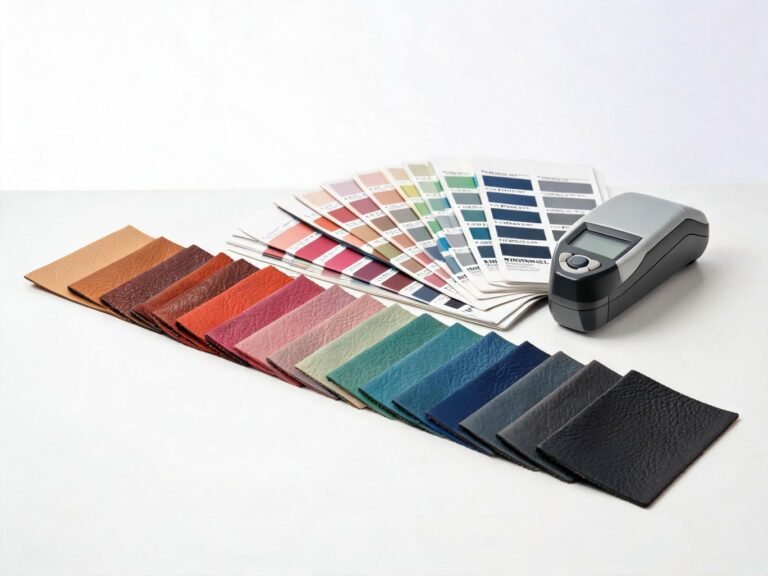
Full-color silicone leather swatch rack — custom orange shades Pantone-matched with Delta E ≤1.0 across all batches.
How to Specify Orange Leather for B2B Production
If you’re sourcing orange leather for automotive interiors, furniture, or consumer products, follow this specification process to eliminate color matching failures:
- Provide a physical reference, not a digital file. Pantone numbers help, but screens render orange differently from physical materials. Mail a physical swatch to your supplier. TOPSUN accepts physical references and formulates a Pantone match within 7–10 days.
- Request Delta E measurement data. Ask the supplier to provide spectrophotometer readings (Delta E) between your reference and their match. Delta E ≤1.0 means the human eye cannot distinguish the difference. Anything above 2.0 will be visible in side-by-side comparison.
- Approve a master sample, then lock the formulation. Once you approve the master sample, the supplier should document the exact pigment formulation, curing parameters, and substrate specification. Every future batch must match the master sample — not the previous batch — to prevent color drift over time.
- Test UV stability before approving. Expose the approved sample to 200+ hours of UV (ASTM G154) before sign-off. If the orange shifts, the pigment formulation needs adjustment. Silicone leather passes 1,000+ hours without shift.
- Order a buffer batch. Orange leather is a custom color — not a stock item. Order 10–15% more than your production requirement to cover future warranty replacements. Trying to re-match orange 18 months later is the most common color-matching failure we see.

Warm-tone lychee-texture swatches — custom orange formulations with guaranteed batch consistency.
Pattern and color customization — how TOPSUN achieves Pantone-matched orange with Delta E ≤1.0 consistency.
Frequently Asked Questions
Can you match a specific orange Pantone color in silicone leather?
Yes. We accept physical Pantone references or swatches and formulate a silicone leather match within 7–10 days. Every match includes spectrophotometer Delta E measurement — we guarantee ≤1.0, meaning the human eye cannot distinguish between your reference and our production output. Once you approve the master sample, we lock the pigment formulation and curing parameters to ensure every future batch matches the master, not the previous batch. This prevents the color drift that plagues genuine leather and PU sourcing.
Will orange silicone leather fade over time like PU or genuine leather?
No. Silicone leather achieves Grade 4–5 color fastness (ISO 105-B06 and ISO 105-X12) — the highest rating. In ASTM G154 UV testing, our orange formulations show no visible color shift after 1,000+ hours of exposure. By comparison, PU leather typically shows Grade 3 fading after 200–400 hours, and genuine leather shows visible fade within 6 months of interior exposure. The Si-O polymer backbone is inherently UV-stable, so the pigment isn’t degraded by the material around it.
What’s the minimum order quantity for custom orange silicone leather?
Standard colours and textures: 500 meters MOQ. Custom Pantone-matched colours (including custom orange shades): 1,000 meters MOQ. Custom embossing patterns (requiring a new roller): 1,500 meters MOQ with 7–10 day roller production. We ship free A4 swatch samples in your specified colour so you can evaluate the match before committing to volume. Lead time for custom colour orders is 15–20 days; standard colours ship in 7–15 days.
Get Your Orange Leather Color Matched
Send us your Pantone reference or physical swatch. We’ll formulate a silicone leather match with Delta E ≤1.0 and ship free A4 samples worldwide.
Explore our color customization capabilities or see our Designer Collection for premium textures and finishes.
About TOPSUN
TOPSUN manufactures silicone leather at a 60,000+ m² facility across Dongguan, Yichang, and Xiangyang, China. We produce 500,000+ meters monthly across 10+ automated lines for 100+ brands in automotive interiors, furniture, medical, 3C electronics, and children’s products. Our color matching capability is what sets us apart: Pantone-matched colors with Delta E ≤1.0 accuracy, batch-to-batch consistency guaranteed, and 7–10 day custom formulation turnaround.
For orange leather specifically, our silicone polymer matrix stabilizes orange pigments more effectively than PU or PVC, our multi-zone curing ovens control temperature to ±2°C (eliminating the pigment shift that plagues other materials), and our UV-stable formulation maintains color fastness at Grade 4–5 for 1,000+ hours. Available in 100+ embossed textures including cowhide, lychee, pigskin, and sheepskin patterns, thickness 0.23–2.0mm, width 1350–1800mm. Certifications: ISO 10993-5, REACH, FDA 21 CFR 177.2600, EN 13733 Class 4, EN 71 toy safety — all SGS/Intertek verified.
We offer free A4 swatch samples in your specified Pantone orange, shipped worldwide via DHL/FedEx. Color customization | Texture design | Request orange swatches