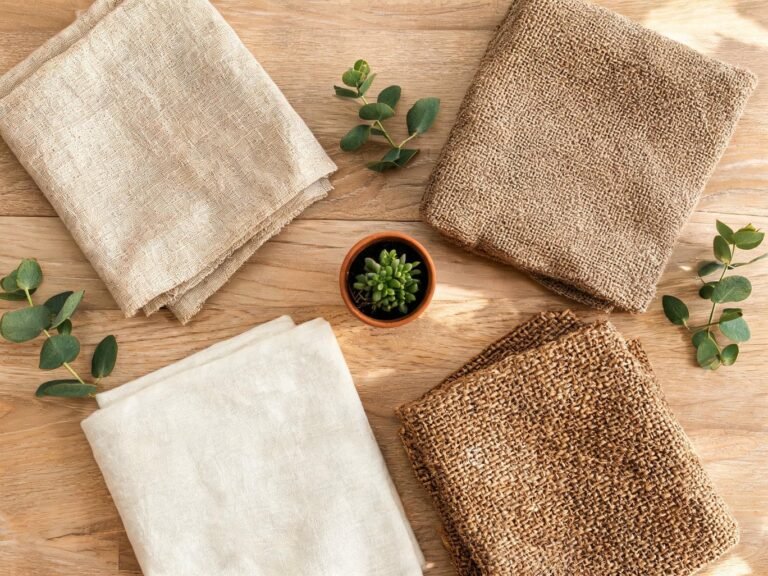
Recycled leather fabric is everywhere right now. Brands are putting it on sofas, wallets, notebook covers, and car interiors, marketing it as the sustainable answer to leather’s environmental problems. But “recycled leather” isn’t one material — it’s a marketing term that covers at least four fundamentally different product types, with wildly different performance, composition, and actual sustainability.
Some recycled leather is genuinely impressive — it diverts tannery waste from landfills, meets GRS (Global Recycled Standard) certification, and performs acceptably for its intended use. Other products labeled “recycled leather” are 80–90% synthetic binder with a tiny amount of leather dust mixed in — they peel within 2–3 years and create more waste than they save.
In this guide, we break down the four main types of recycled leather fabric from a materials engineering perspective, explain how they’re made, what they’re good for (and not good for), and what specifiers should verify before specifying recycled leather for commercial applications.
See Sustainable Material Options
The 4 Types of Recycled Leather Fabric
The recycled leather market was valued at approximately $1.85 billion in 2026, with bonded leather accounting for about 62% of total volume. But not all recycled leathers are created equal. Here’s what you’re actually getting with each type:
1. Bonded Leather (also called reconstituted leather). This is the most common — and most problematic — type of recycled leather. It’s made by shredding leather offcuts and tannery scraps into fine fibers, mixing them with polyurethane or latex binder (usually 20–30% leather fiber, 70–80% binder and coating), and spreading the mixture onto a paper or fabric backing. A printed PU surface layer is then applied to give it a leather grain appearance.
The problem: the thin PU top coat delaminates from the composite backing with repeated flexing, body heat, and UV exposure. Peeling usually starts on high-contact areas like seat cushions and armrests within 12–24 months, and progresses rapidly. Once it starts, there’s no repair. Most bonded leather furniture and accessories are discarded within 3 years — which defeats the waste-reduction purpose of recycling in the first place.

Recycled leather and synthetic leather rolls in production — material composition varies dramatically between product types
2. Composite Recycled Leather. A step up from basic bonded leather, composite recycled leather mixes ground leather fibers with synthetic polymers (usually PET or PU) and bonds the mixture to a woven or nonwoven textile substrate. The textile backing adds structural integrity, and higher leather fiber content (30–50%) gives it better feel and more authentic appearance.
Composite recycled leather is more durable than basic bonded leather — typically 3–5 years for moderate use — but it still suffers from the same fundamental delamination problem, just delayed. The leather fibers and synthetic binder don’t have the same coefficient of thermal expansion, so flexing and temperature cycling eventually cause separation at the micro level.
3. Fiber-Reinforced Recycled Leather. This newer category reinforces leather fiber composites with structural fibers (glass, carbon, or high-strength polyester) to improve tensile strength and dimensional stability. Leather fiber content varies widely (20–60%) depending on the product. Fiber-reinforced recycled leather is the fastest-growing segment of the recycled leather market, projected to grow at a higher CAGR than basic bonded leather.
4. Bio-Based Recycled Composites. The newest and least common category uses leather waste fibers combined with bio-based binders derived from plants, algae, or mycelium instead of petroleum-based PU. The environmental profile is theoretically better — fewer fossil fuel inputs, potentially biodegradable — but performance is still a work in progress. Most bio-based recycled leathers have service lives of 1–3 years and limited water resistance.
Engineering reality: The less leather fiber a recycled leather product contains, the less it performs like leather — and the more it performs like whatever binder it uses. A product that’s 80% PU binder and 20% leather dust will peel and crack like PU leather, because that’s fundamentally what it is.
Performance Comparison: Recycled Leather vs. Alternatives
When evaluating recycled leather for a specific application, you need to know how it actually performs — not just what percentage of recycled content it has. Here’s how the main recycled leather types stack up against other leather alternatives on key performance metrics:
| Property | Bonded Leather | Composite Recycled | Silicone Leather |
|---|---|---|---|
| Leather Fiber Content | 10–30% | 30–50% | 0% (synthetic) |
| Typical Service Life | 1–3 years | 3–5 years | 10+ years |
| Abrasion (Martindale) | 20,000–40,000 cycles | 40,000–80,000 cycles | 200,000+ cycles |
| Flex Resistance | 10,000–20,000 cycles | 30,000–50,000 cycles | 50,000–100,000 cycles |
| Water Resistance | Poor — absorbs moisture | Moderate | Excellent — non-porous |
| End-of-Life Recyclability | Difficult — mixed materials | Difficult — mixed materials | 100% — separable layers |
| VOC Emissions | Moderate — PU binder | Low–Moderate | Zero |
The key insight from a materials standpoint: recycled leather’s main sustainability claim — waste diversion — is partially undermined by its short service life. A bonded leather sofa that lasts 2 years and then goes to landfill (because the mixed PU-leather composition can’t be recycled again) doesn’t necessarily deliver a net environmental benefit compared to a longer-lasting material that doesn’t use recycled content but lasts 5–10x longer.

Physical testing laboratory — verifying tensile strength, flex resistance, and abrasion performance of recycled leather materials
Recycled Leather Certifications: What’s Actually Worth Paying For
Certifications are how buyers separate genuine recycled content from greenwashing. But not all certifications are equally rigorous. Here’s what to look for and what to be skeptical of:
GRS (Global Recycled Standard). The gold standard for recycled content verification. GRS certifies the percentage of recycled material in the final product (minimum 20% recycled content), tracks the material through the supply chain via chain-of-custody requirements, and includes social and environmental criteria for processing facilities. If a recycled leather product is GRS-certified, you can trust the recycled content number. If it’s not, the “recycled” claim is essentially self-reported.
LWG (Leather Working Group) certification. LWG certifies tanneries for environmental performance — water use, energy consumption, chemical management, waste disposal. It’s not specifically a recycled leather certification, but if recycled leather is made from scraps of LWG-certified leather, that tells you the original leather was produced in a more environmentally responsible facility.

Sustainable furniture — recycled and plant-based leathers are increasingly used in eco-conscious furniture collections
What to be skeptical of:
- Unverified “recycled content” claims. Any supplier can say “100% recycled leather.” Without third-party certification like GRS, there’s no way to verify — and there’s a lot of variation in what “recycled leather” actually means (10% leather fiber vs. 80% leather fiber are very different products).
- “Eco-leather” and “green leather.” These are marketing terms with no standard definition. A product can call itself eco-leather and still be 90% PU with phthalate plasticizers. Always look for specific certifications and test data, not vague adjectives.
- “Biodegradable” claims for PU-bound recycled leather. If a product is 70% polyurethane binder, it’s not meaningfully biodegradable — the PU portion will persist in the environment just like any other plastic. True biodegradable recycled leather would need to use natural binders (latex, plant-based polymers), and even then, biodegradability in industrial composting conditions is very different from biodegradability in a landfill.
See how silicone leather’s eco-certifications and recyclability compare to recycled and bonded leather materials
When Recycled Leather Makes Sense (and When It Doesn’t)
Recycled leather fabric isn’t good or bad — it’s appropriate for some applications and inappropriate for others. Here’s how we advise clients to think about it:
Good applications for recycled leather:
- Low-wear accessories. Notebook covers, phone cases, small wallet components, and decorative items that don’t see heavy flexing or abrasion. These products have short replacement cycles anyway, so the 2–3 year lifespan of bonded leather is acceptable.
- Marketing and promotional items. Where sustainability messaging is part of the product’s purpose and lifespan is intentionally short (event swag, limited-edition collaborations), recycled leather checks the eco-box at a reasonable price.
- Backing and substrate layers. Using recycled leather fiber as a backing layer (not the wear surface) in multi-layer constructions can reduce overall material footprint without exposing the recycled layer to wear.

Material sample selection — choosing the right material type for each application is key to both performance and sustainability
Applications where recycled leather usually doesn’t make sense:
- High-traffic seating. Restaurant booths, office chairs, theater seating, and sofa upholstery all experience heavy flexing, abrasion, and body contact. Bonded and composite recycled leathers will peel and delaminate within 1–3 years in these applications, creating waste and replacement costs that undermine the sustainability benefit.
- Outdoor and marine applications. Moisture, UV exposure, and temperature swings accelerate recycled leather degradation. For outdoor use, materials inherently designed for weather resistance — like silicone leather with 1,000+ hours UV resistance — deliver far better longevity and thus better long-term environmental performance.
- Healthcare and food service. The porous structure of most recycled leathers harbors bacteria and makes thorough sanitization difficult. Non-porous materials like silicone leather that withstand bleach and alcohol disinfectants are better choices for hygiene-critical environments.
The sustainability calculation always comes back to the same question: how many years of useful service are you getting per unit of environmental impact? A material with 100% recycled content that lasts 2 years is not necessarily more sustainable than a material with 0% recycled content that lasts 15 years. Durability is the most underrated sustainability feature in the leather industry.
Frequently Asked Questions
Is recycled leather actually leather?
It depends on how you define “leather” and how much leather fiber the product contains. Bonded leather typically has 10–30% leather fiber mixed with 70–90% synthetic binder — it contains leather but isn’t leather in the traditional sense. Some jurisdictions have labeling requirements about when products can be marketed as “leather,” but enforcement is inconsistent. Always check the actual composition percentages and GRS certification rather than relying on marketing labels.
Can recycled leather furniture be recycled again at end of life?
Most recycled leather products are difficult to recycle a second time because they’re composites of leather fibers, synthetic binders, and fabric backings that can’t be easily separated. This is the dirty secret of “recycled” leather — it’s usually a one-way ticket from tannery waste to landfill after the product wears out. Materials with separable layers, like silicone leather where the silicone coating can be separated from the fabric substrate, offer better end-of-life recyclability because each component can be processed independently.
Recycled Leather Is a Tool, Not a Panacea
Recycled leather fabric is a legitimate and valuable material when used in the right applications. Diverting tannery waste from landfills is a good thing, and GRS-certified recycled leather products deliver genuine circular economy benefits for low-wear, short-lifecycle products like accessories and packaging.
But it’s not the right answer for every sustainability challenge. For high-traffic upholstery, outdoor furniture, healthcare applications, and any product where durability matters, the longer service life and consistent performance of materials like silicone leather often deliver better real-world environmental outcomes — fewer replacements, less total waste, and lower lifecycle carbon emissions.
The smartest sustainability strategies don’t pick one material and declare victory — they match the right material to each application based on actual performance requirements and full lifecycle analysis. Sometimes that’s recycled leather. Sometimes it’s silicone leather. Often, it’s both — used in different parts of the same product line for different purposes.
Get Material Selection Guidance
About TOPSUN
TOPSUN produces fully recyclable silicone leather for furniture, automotive, and industrial applications — engineered for 10+ year service life with zero VOC emissions and separable end-of-life layers for closed-loop recycling.
REACH compliant, ISO 10993 biocompatible, 100% recyclable at end of life, zero plasticizers, zero solvents, GRS-compatible supply chain for fabric backing components.