The automotive leather material landscape is changing faster than at any point in the last 50 years — and electric vehicles are the reason. As EVs dominate new model development, the material requirements for interior upholstery are shifting in ways that traditional leather and standard PU simply weren’t designed to handle.
It’s not just about aesthetics or luxury anymore. Modern EV programs demand materials that are lighter (for range), lower in VOC emissions (for cabin air quality in sealed EV cabins), more heat-resistant (for glass roofs and extreme cabin temperatures), and more durable under sustained thermal cycling. Traditional automotive leather — while premium-feeling — struggles with several of these requirements.
This article breaks down the five key test areas where traditional automotive leather materials are falling short in EV applications, compares the performance of genuine leather, PU, PVC, and silicone leather against modern automotive standards, and explains what OEM and Tier 1 material engineers should be specifying for next-generation interiors.
The 5 Automotive Material Tests Where Traditional Leather Struggles in EVs
Automotive interior materials have always faced harsh conditions — UV exposure, temperature swings, abrasion from entry and exit, body oils, and cleaning chemicals. But EVs are amplifying several of these stressors to levels that traditional leather and standard PU weren’t engineered for.
1. Extreme cabin temperature cycling. EVs with panoramic glass roofs — a popular design trend driven by the absence of a sunroof motor in the roof — let in far more solar heat than traditional steel roofs. Cabin temperatures can reach 70–85°C on a sunny day, and the seat surface itself can exceed 65°C. At these temperatures, genuine leather loses moisture rapidly, leading to drying and cracking. PU coatings can soften, reducing abrasion resistance. The thermal cycling between extreme daytime heat and cool nights also accelerates fatigue at the molecular level.
2. VOC and fogging emissions (VDA 278). Because EV cabins are more tightly sealed for aerodynamic efficiency and noise reduction, VOC emissions from interior materials accumulate more than in ICE vehicles. VDA 278 — the German automotive standard for VOC and fogging testing — sets limits on both volatile and condensable emissions. Genuine leather emits natural organic compounds and tanning residues; PU leather can emit residual monomers and solvents. Premium OEMs are pushing for ever-lower VOC limits, and materials that were acceptable 5 years ago may not pass today’s EV interior standards.

Material testing laboratory — verifying automotive leather performance against OEM standards for temperature resistance, VOC, and abrasion
3. Weight reduction for range. Every kilogram matters in an EV — more weight means shorter range, larger batteries, and higher cost. Genuine leather is relatively heavy (typically 1.2–1.8 kg/m² depending on hide thickness). Synthetic alternatives like PU and silicone leather come in lighter (0.6–1.0 kg/m²), which adds up across a full interior program. For a midsize EV, switching from leather to a lighter synthetic alternative can save 3–5 kg of total vehicle weight — meaningful for range and battery sizing.
4. Light fastness under glass (SAE J2412). More glass area means more UV exposure for interior materials. And in EVs with minimalist interior designs, there are fewer surfaces creating shadow. Red and tan leathers — popular in premium EV interiors — are particularly vulnerable to UV fading, with measurable color shift (Delta E > 3.5) in as little as 12–22 months of real-world use in sunny climates. Light fastness requirements that were acceptable for traditional cars are no longer sufficient for glass-roof EVs.
5. Sustained abrasion under heated/cooled seats. Heated and ventilated seats are standard in most EVs. The combination of thermal cycling (hot-cold-hot on a daily commute) with the mechanical abrasion from seat entry/exit accelerates wear on both genuine leather and PU. At elevated temperatures, the leather’s natural oils evaporate faster, making it brittle. PU coatings can soften at high temperatures, reducing their abrasion resistance. Materials that pass standard room-temperature abrasion tests may fail much faster under real-world heated-seat conditions.
Engineer’s note: The shift to EVs isn’t just adding new requirements — it’s combining existing requirements in ways that compound stress. A material that passes heat resistance alone, or abrasion resistance alone, may fail when both are applied simultaneously — which is exactly what happens in an EV seat with a heater and a glass roof overhead.
Automotive Leather Materials Compared: Genuine vs. PU vs. PVC vs. Silicone
Let’s look at how the four main automotive upholstery material types stack up against the key performance parameters for modern EV interiors. This is based on typical OEM-grade materials, not budget consumer alternatives:
| Parameter | Genuine Top-Grain Leather | PU Leather (Automotive Grade) | Silicone Leather |
|---|---|---|---|
| Temperature Range | -20°C to 80°C | -30°C to 90°C | -40°C to 250°C |
| VOC (VDA 278) | Moderate — natural emissions | Low–Moderate — residual monomers | Very Low — zero VOC |
| Abrasion (SAE J2450) | 28,000–35,000 cycles | 32,000–40,000 cycles | 100,000+ cycles |
| Light Fastness (SAE J2412) | Grade 3–4 (red: Grade 2–3) | Grade 3–4 | Grade 4–5 (1,000+ hrs) |
| Flammability (FMVSS 302) | Passes | Passes (with FR additives) | Passes (self-extinguishing) |
| Weight (approx.) | 1.2–1.8 kg/m² | 0.7–1.0 kg/m² | 0.8–1.1 kg/m² |
| Cost per m² | $20–$50+ | $8–$20 | $15–$30 |
| Service Life (Automotive) | 10–15 years (with care) | 5–8 years | 10+ years |
The data shows that silicone leather closes the performance gap between genuine leather and PU — and in several categories (temperature resistance, abrasion, light fastness, VOC), it outperforms both. For EV programs where cabin air quality, weight savings, and long-term durability are high priorities, silicone leather is increasingly the material of choice for premium trim levels.

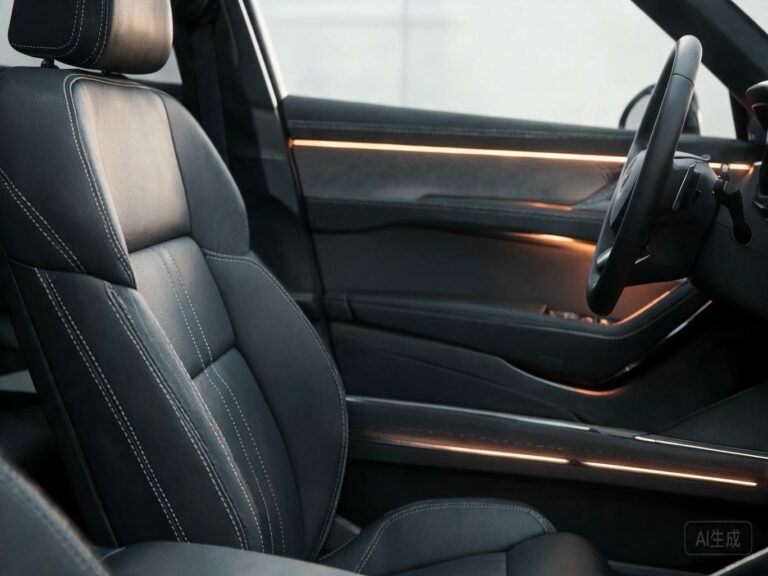
Black leather sample for automotive interiors — consistent color and texture across production runs is critical for OEM programs
Why More EV OEMs Are Switching to Silicone Leather Interiors
The trend toward synthetic and alternative leather materials in EV interiors isn’t just about cost — it’s about meeting a new set of engineering requirements that traditional materials weren’t designed for. Here are the specific reasons silicone leather is gaining traction in automotive programs:
Superior heat resistance for glass-roof cabins. Silicone leather’s operating range extends to 250°C — far above what any car cabin will reach. But the real advantage isn’t just the upper limit — it’s the material’s stability at normal automotive operating temperatures. Unlike PU, which softens at high temperatures and loses abrasion resistance, silicone leather maintains its physical properties consistently across the entire automotive temperature range. That means the abrasion resistance you measure at 23°C in the lab is the same abrasion resistance you get at 70°C in a parked car in Phoenix.
Zero VOC for better cabin air quality. Silicone leather is produced with a solvent-free process, resulting in essentially zero VOC emissions. For EVs with tightly sealed cabins and advanced air quality systems, this is a major advantage — no chemical smell on delivery, no fogging on the windshield from condensable emissions, and better compliance with increasingly strict VDA 278 and ISO 12219 standards.

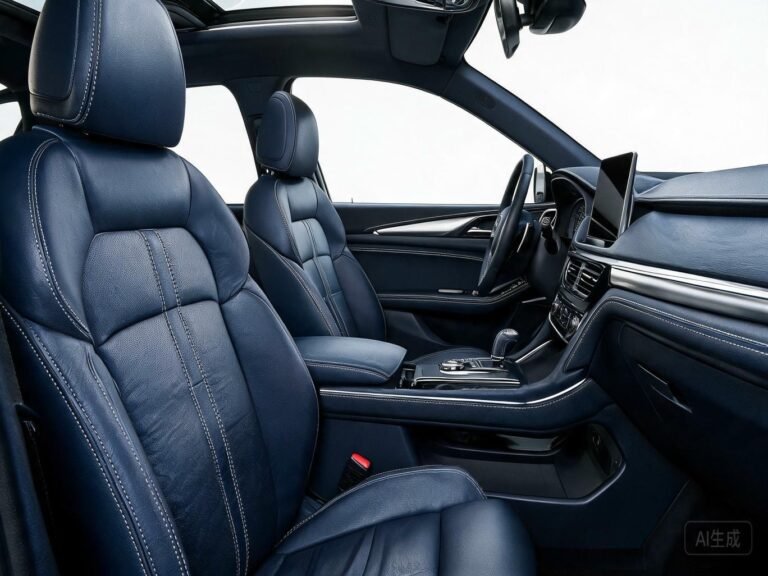
Premium automotive interior — modern EV cabins demand materials that handle extreme temperatures, low VOC, and sustained durability
UV stability for light interiors. White, beige, and tan interiors are increasingly popular in EVs — they make the cabin feel more spacious and airy. But light-colored genuine leather and PU stain easily and fade under UV exposure. Silicone leather’s non-porous surface resists staining (jeans dye, coffee, sunscreen), and the pigment-in-matrix color technology maintains color accuracy even after 1,000+ hours of UV exposure. For EVs with glass roofs and light interior themes, this is a game-changer.
Vegan and sustainable positioning. Many EV brands position themselves as forward-thinking and environmentally conscious — and genuine leather doesn’t always align with that brand identity. Silicone leather is 100% vegan, contains no animal products, and has a strong sustainability story (zero VOC, long service life, recyclable at end of life) that resonates with EV buyers who care about the environmental impact of their vehicle’s entire supply chain.
Talk to Our Automotive Engineers
Automotive certification overview — see how silicone leather meets FMVSS 302, VDA 278, and other key automotive standards
What to Verify When Qualifying Automotive Upholstery Materials
If you’re evaluating materials for an automotive interior program — whether for a full EV platform or a mid-cycle refresh — here’s what we recommend putting on your qualification checklist:

Automotive-grade quality control — material qualification for OEM programs requires rigorous testing across multiple parameters
- Flammability (FMVSS 302 / ECE R118). Table stakes for any automotive interior material. Require test reports from accredited labs. Pay attention to whether the material achieves compliance through inherent properties (like silicone’s char-forming behavior) or through chemical FR additives that can migrate over time.
- VOC and fogging (VDA 278 / ISO 12219-4). Get both VOC (volatile organic compounds) and Fog (condensable compounds) numbers. For premium EV programs, target VOC ≤ 50 µgC/g and Fog ≤ 100 µg/g — and make sure the numbers reflect the material after thermal aging, not just when new.
- Abrasion resistance (SAE J2450 / ISO 5470). Don’t just check the number of cycles — check the test conditions. Room-temperature abrasion data is less relevant for EV seats that reach 60–70°C. Ask for abrasion data at elevated temperatures (60–80°C) to simulate real-world heated-seat conditions.
- Light fastness (SAE J2412 / ISO 105-B06). Especially critical for light colors and red shades in vehicles with glass roofs. Require a minimum of 500 hours with Delta E ≤ 3.0. For premium programs, target 1,000+ hours with Delta E ≤ 2.0.
- Thermal cycling and heat aging. How does the material perform after 1,000 hours at 100°C? After 100 thermal cycles from -40°C to 100°C? Tensile strength retention, elongation at break, and surface appearance after heat aging are all important.
- Stain and chemical resistance. Test with real automotive contaminants: sunscreen, coffee, soda, jeans dye, hand lotion, and the cleaning chemicals your dealership service departments will actually use. A material that looks great when new but stains permanently from a single coffee spill is a warranty claim waiting to happen.
- Supply chain and production capacity. Can your supplier meet your production volume requirements with consistent quality? What’s their batch-to-batch color consistency (Delta E)? What’s their failure rate in PPAP (Production Part Approval Process) submissions?
Frequently Asked Questions
Is genuine leather still used in premium car interiors?
Yes — genuine leather (especially Nappa and semi-aniline) is still widely used in premium and luxury vehicle interiors, and many buyers specifically seek it out for its natural feel and patina character. However, the trend is clearly toward more synthetic and alternative materials, particularly in EV brands. Several EV makers now offer vegan leather or synthetic leather as standard or premium options, and some are moving away from genuine leather entirely for sustainability and animal welfare reasons. The market is segmenting — genuine leather for traditional luxury buyers, high-performance synthetics for tech-forward EV buyers.
What’s the difference between automotive-grade and furniture-grade synthetic leather?
Automotive-grade materials must pass a much stricter set of tests: FMVSS 302 flammability, VDA 278 VOC/fogging, SAE J2412 light fastness at higher irradiance levels, thermal cycling from -40°C to 100°C+, and often OEM-specific standards for things like sweat resistance, sunscreen resistance, and seam strength. Furniture-grade materials are tested to furniture standards (like BS 5852 for flame, ISO 12947 for abrasion) which are generally less demanding than automotive specifications. Using furniture-grade material in a car will almost certainly result in premature failure — fading, cracking, or outgassing — within a few years.
The Automotive Leather Material Shift Is Accelerating
Electric vehicles aren’t just changing the powertrain — they’re rewriting the requirements for every material in the car. Automotive leather material that was perfectly adequate for ICE vehicles is increasingly falling short on the five key metrics that matter most for EVs: temperature resistance, VOC emissions, weight, UV stability, and durability under combined thermal-mechanical stress.
Silicone leather is emerging as a strong candidate for next-generation automotive interiors because it addresses all five of these challenges while maintaining a premium look and feel that buyers expect. It’s not the right choice for every program — genuine leather still has strong brand equity in the luxury segment, and PU leather is hard to beat on cost for mid-trim levels. But for EV programs prioritizing cabin air quality, durability, and sustainable positioning, silicone leather should be on your material qualification list.
At TOPSUN, we work directly with OEMs and Tier 1 suppliers on automotive silicone leather development, from initial material specification through PPAP and production ramp. Our engineering team can provide full test data packs and custom formulation support to meet your specific program requirements.
About TOPSUN
TOPSUN develops and manufactures automotive-grade silicone leather for EV interiors, seat upholstery, door panels, and steering wheel covers — engineered to meet the strictest thermal, emissions, and durability standards for next-generation vehicles.
FMVSS 302 compliant, VDA 278 low VOC, 1,000+ hours UV resistance, -40°C to 250°C temperature range, OEM/ODM development support, PPAP-capable production, IATF 16949 aligned quality systems.