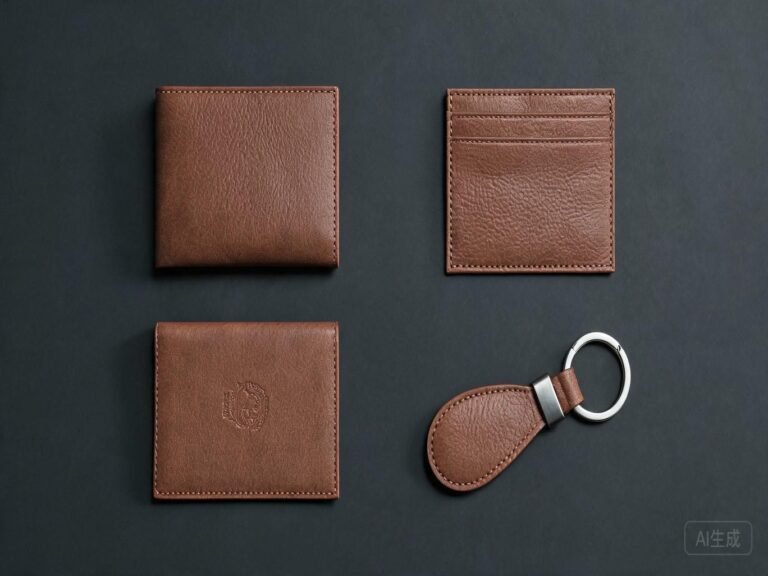
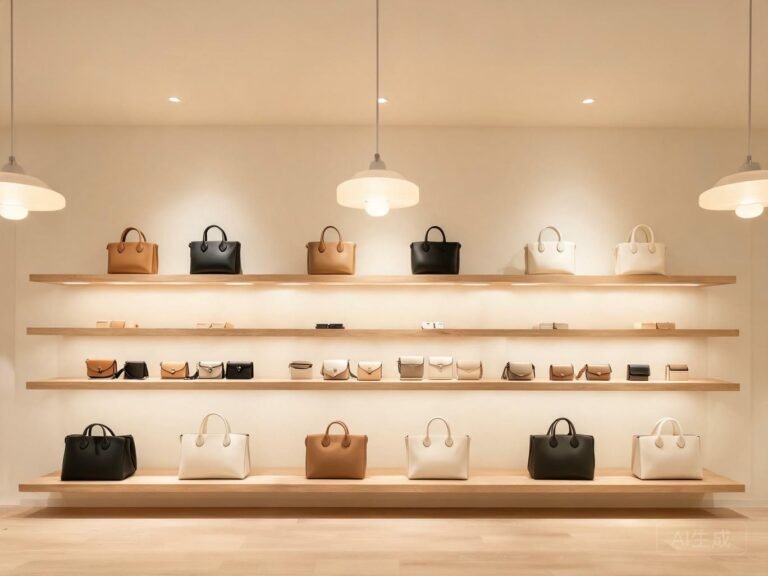
When you’re sourcing 50,000 wallet exteriors, the per-meter price difference between PU and silicone leather looks like the main cost variable. It isn’t. The real money hides in waste rate, die-cut tolerance, and how many units come back under warranty after the PU starts cracking at 18 months. We’ve run the numbers on small leather items across multiple production runs — and the per-unit math tells a very different story than the per-meter price tag.
The Hidden Costs in Small Leather Items Manufacturing
Most procurement teams compare materials by price per meter. That’s the visible cost. The hidden costs — the ones that quietly erode margin on every order of small leather items — fall into three buckets:
- Waste rate. PU and PVC leather have natural grain variation and backing irregularities that cause die-cut rejects. Industry average waste for genuine leather small goods runs 12–18%. For PU, it’s 8–12%. Silicone leather’s consistent surface and uniform backing bring waste rates down to 3–5% — because every square meter yields more usable cuts.
- Thickness inconsistency. If your spec calls for 1.2mm wallet exteriors and the supplier delivers 1.0mm in some areas and 1.4mm in others, your die-cut machine either tears the thin spots or jams on the thick ones. Each inconsistency event costs setup time, rejected sheets, and operator intervention.
- Warranty claims. PU wallets typically show edge cracking, peeling, or color transfer within 18–24 months. If your brand offers a 2-year warranty, that replacement cost hits your P&L. Silicone leather’s 10+ year service life means the warranty period passes without a claim — an advantage we’ve documented across wallet material comparisons with multiple clients.

Silicone leather sample strips in metallic finishes — uniform thickness enables higher die-cut yield for small leather goods.
Thickness and Die-Cut Tolerance: What Actually Matters
For small leather items, thickness is the single most critical specification. A wallet exterior needs 1.2–1.5mm for structure. Card slots need 0.8–1.0mm to stack without bulk. Phone cases need 0.5–0.8mm for a slim profile. Get any of these wrong and the assembled product feels off — too floppy, too stiff, or too thick to close properly.
The industry standard tolerance is ±0.15mm. That means a 1.0mm spec can arrive anywhere from 0.85mm to 1.15mm — a 30% swing that affects every die-cut piece. TOPSUN’s automated coating line holds tolerance to ±0.05mm by maintaining consistent silicone viscosity, line speed, and curing temperature throughout the run. We’ve measured this across silicone leather production batches, and the consistency holds from start to finish of each roll.
For ultra-thin applications — phone cases, wearable straps, earbuds covers — TOPSUN’s Ultra Thin Collection goes down to 0.23mm. At that thickness, traditional PU becomes structurally unreliable because the plasticizer layer is too thin to maintain flexibility. Silicone at 0.23mm retains its full elongation at break (≥250%) because the material’s flexibility is intrinsic to the polymer, not dependent on added plasticizers that migrate and degrade over time.

Flexibility testing confirms ultra-thin silicone leather maintains structural integrity at 0.23mm for small accessories.
Why Silicone Outperforms for Small Leather Items
The economics shift further when you factor in the full production cycle. Here’s a cost comparison based on our production data across multiple client runs for wallet exteriors and card holders:
| Cost Factor | PU Leather | Silicone Leather |
|---|---|---|
| Waste rate during die-cutting | 8–12% | 3–5% |
| Thickness tolerance | ±0.15mm | ±0.05mm |
| Die-cut yield improvement | Baseline | +20–30% |
| Warranty claim rate (24 mo) | 8–15% | <1% |
| Service life | 3–5 years | 10+ years |
| 5-year replacement cycles | 1–2 | 0 |
The waste rate alone changes the math. If you’re cutting 8 wallet exteriors per square meter from PU with 10% waste, you get 7.2 usable units. From silicone with 4% waste, you get 7.7 — that’s nearly an extra wallet per square meter, across a 50,000-unit order that’s 6,250 extra units of sellable product.
Bottom line: Silicone leather costs more per meter but yields more per cut and fails less over time. For high-volume small leather items, the effective per-unit cost gap narrows to single digits — and the lifetime cost favors silicone.

Scratch resistance testing — critical spec for wallet exteriors and phone cases subjected to daily pocket friction.
Vegan Positioning and Compliance
For brands marketing small leather items as vegan or eco-conscious, the material compliance story matters as much as the cost math. PU leather contains solvents and plasticizers. PVC contains phthalates. Both face increasing regulatory pressure under REACH and upcoming EU restrictions on PVC usage.
Silicone leather is PVC-free, phthalate-free, BPA-free, and DMF-free. TOPSUN’s material is FDA 21 CFR 177.2600 food-contact compliant and ISO 10993-5 biocompatibility certified — meaning it’s safe for direct and prolonged skin contact, which matters for wearable straps, watch bands, and phone cases held against the face during calls. For brands targeting fashion accessories and 3C electronics with vegan certification claims, this compliance profile opens doors that PU and PVC simply can’t pass through.
Plant-based alternatives like apple leather and Piñatex offer sustainability storytelling but typically last 2–3 years versus silicone’s 10+. For a small leather goods brand, that durability gap translates directly into brand reputation — a wallet that peels at 18 months generates a one-star review; one that holds its finish for a decade generates a repeat customer.

Silicone leather applied to 3C accessories — phone cases, earbuds covers, and wearable straps benefit from ultra-thin profiles.
How silicone leather reduces per-unit cost for small leather goods through lower waste and higher die-cut yield.
Frequently Asked Questions
What thickness of silicone leather is best for wallet exteriors?
1.0–1.5mm provides the right balance of structure and flexibility for wallet exteriors. For internal card slots, 0.8–1.0mm reduces bulk while maintaining durability. TOPSUN’s Classic Collection covers 0.8–2.0mm for structured small goods, and the Ultra Thin Collection goes down to 0.23mm for the slimmest accessories like phone cases and wearable straps.
Does silicone leather meet vegan certification requirements for marketing?
Yes. TOPSUN’s silicone leather is 100% animal-free, PVC-free, phthalate-free, and solvent-free. It qualifies for PETA-approved vegan certification positioning and meets ISO 10993-5 biocompatibility and FDA 21 CFR 177.2600 food-contact standards for skin-contact safety — a compliance profile PU and PVC cannot match.
The Real Cost Is in the Lifecycle
Small leather items live or die on per-unit economics. The material that costs 40% more per meter can actually cost less per finished unit when you account for waste rate, die-cut yield, and warranty exposure. For procurement teams sourcing wallets, card holders, phone cases, and wearable accessories, silicone leather changes the cost equation — not on the invoice, but in the P&L where it matters.
About TOPSUN
TOPSUN supplies ultra-thin silicone leather for small leather items including wallets, card holders, phone cases, and wearable accessories across 3C and fashion supply chains.
Ultra-thin 0.23mm collection for precision die-cutting · FDA food-contact compliance · ISO 10993-5 biocompatibility certification · 100+ embossed texture options · ±0.05mm thickness tolerance