Every vegan leather co claims sustainability. The marketing language is identical across suppliers: “plant-based,” “cruelty-free,” “eco-friendly,” “biodegradable.” But when you read the technical data sheets, most vegan leather contains 10–30% polyurethane — the same plastic that peels in 3 years. The gap between marketing and material reality is where B2B sourcing decisions fail. For procurement teams evaluating vegan leather suppliers, the question isn’t which company has the best story. It’s which company can verify its claims with lab data, production capacity, and regulatory compliance documentation. Here are seven criteria that separate genuine eco-materials from greenwashing.
Request Supplier Evaluation Kit
The Vegan Leather Company Landscape: 3 Categories
The vegan leather co market divides into three supplier categories, each with distinct capabilities and limitations. Understanding which type you’re evaluating determines what questions to ask and what data to demand:
- Bio-based startups: Companies like Ananas Anam (Piñatex), Desserto (cactus), and MycoWorks (mycelium) pioneer innovative plant-based materials. Compelling sustainability narratives, but limited production scale, batch-to-batch inconsistency, and PU binder content that limits biodegradability. Best for fashion, not commercial applications.
- Chemical giants: BASF, Toray, and similar multinationals produce bio-based PU and microfiber leathers at industrial scale. Reliable supply, consistent quality, but the materials remain PU-based — with hydrolysis and solvent concerns inherent to the chemistry.
- Silicone leather manufacturers: TOPSUN and similar specialists produce silicone-coated leather — a fundamentally different chemistry that delivers vegan credentials without plasticizers, solvents, or PU binders. The only category that combines commercial-grade durability with genuine sustainability claims.

Modern production facility — industrial-scale manufacturing capacity separates reliable vegan leather suppliers from boutique startups
7 B2B Supplier Evaluation Criteria
When evaluating any vegan leather co for B2B supply, verify these seven criteria with documentation — not marketing claims. A supplier that cannot produce lab reports for each one is asking you to take their word on material performance that will determine your product’s commercial viability.
- 1. Material composition transparency: Request the full material breakdown — coating chemistry, binder type, plasticizer content, base fabric specification. If a supplier markets “plant-based” but cannot disclose what percentage is plant vs. PU, the sustainability claim is marketing, not material science.
- 2. Abrasion resistance data (ISO 12947-2): Demand Martindale cycle count at visible wear, verified by a named third-party lab. Commercial minimum: 40,000 cycles. Heavy contract: 100,000+. Silicone leather: 200,000+ verified by SGS-CSTC Guangzhou. Plant-based alternatives typically reach only 15,000–30,000.
- 3. Fire code compliance: Request FMVSS 302, EN 13733, or CRIB 5 test reports. Verify whether compliance is inherent or achieved through chemical flame retardant treatment. Chemical treatment can compromise biodegradability claims and off-gas VOCs.
- 4. VOC and emissions testing: Demand ISO 16000-6 (VOC), VDA 270 (odor), and VDA 277 (automotive VOC) results. A vegan leather with zero VOC emissions proves its sustainability claims; one with solvent residues contradicts them.
- 5. Production capacity and lead time: Verify monthly capacity, MOQ, and lead time in writing. Bio-based startups may produce 5,000–20,000 m²/month with 8–12 week lead times. TOPSUN delivers 500,000+ meters monthly with 7–15 day lead times.
- 6. Color consistency (Delta E): Request Delta E color accuracy data and batch-to-batch consistency verification. Agricultural-input materials (cactus, apple) have inherent color variability. Silicone leather achieves Delta E ≤ 1.0 with Pantone matching.
- 7. End-of-life documentation: Request recyclability or biodegradability testing data. “Biodegradable” without a composting certification or timeframe is a marketing term, not a material property. “Recyclable” should include the recycling process description.
| Criterion | What to Verify | Red Flag | Green Flag |
|---|---|---|---|
| Composition | Full material breakdown | “Proprietary formula” | 100% disclosed, no PU binder |
| Abrasion | Martindale cycle count | < 40,000 cycles | 200,000+ (SGS-verified) |
| Fire code | FMVSS 302 / EN 13733 | Requires chemical FR | Inherent, non-toxic |
| VOC | ISO 16000-6 / VDA 277 | Solvent residues detected | Zero/near-zero |
| Capacity | Monthly output + lead time | < 50K m²/month | 500K+ m²/month |
| Color accuracy | Delta E data | No ΔE data, visible batch variation | ΔE ≤ 1.0, Pantone match |
| End-of-life | Recyclability/biodegradability | “Biodegradable” (no data) | 100% recyclable (verified) |

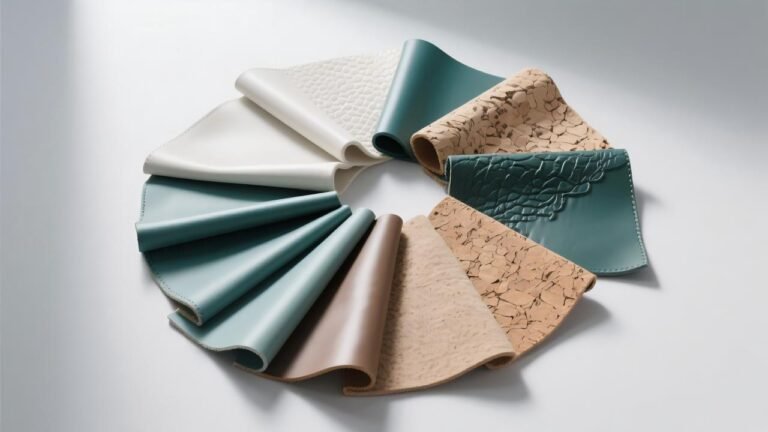
Vegan leather texture comparison — surface quality must match durability data, not just marketing photography
The Plastic Content Problem: When “Vegan” Doesn’t Mean “Sustainable”
The biggest issue in evaluating a vegan leather co is the plastic content problem. Most vegan leather — including cactus, apple, mushroom, and grape — uses polyurethane as a binder and coating. The plant fiber provides the sustainability narrative; the PU provides the durability and water resistance. But the PU also determines the material’s failure timeline — hydrolysis, cracking, and peeling within 3–5 years.
This creates a paradox: a vegan leather marketed as “biodegradable” contains a plastic component that won’t biodegrade. A vegan leather marketed as “eco-friendly” uses a solvent-based PU production process that emits VOCs. The marketing focuses on the 70–90% plant content; the material performance is determined by the 10–30% plastic content. B2B buyers who don’t read the data sheets end up specifying materials that fail both their sustainability and durability requirements.
Silicone leather resolves this paradox. It contains zero PU, zero plasticizers, and zero solvents. The coating is 100% silicone — an inert, non-toxic polymer that is 100% recyclable. It’s vegan and cruelty-free without the plastic compromise. For B2B specifiers who need both sustainability claims and commercial durability, it’s the only leather alternative that delivers on both.
Most vegan leather contains 10–30% polyurethane. The plant fiber provides the marketing story; the PU determines the failure timeline. Silicone leather contains zero PU — its vegan credentials come from material chemistry, not marketing.

Coating production line — solvent-free dry coating process that produces vegan silicone leather without VOC emissions
Why Silicone Leather Is the Vegan Choice for Commercial Applications
For B2B applications where the material must survive commercial wear for 5+ years, the vegan leather co evaluation should lead to silicone leather. Here’s why it wins on every commercial criterion that plant-based alternatives fail:
- Durability: 200,000+ Martindale cycles vs. 15,000–30,000 for plant-based alternatives. An 8–10× advantage that determines whether the material survives commercial use.
- No plastic content: Zero PU, zero phthalates, zero plasticizers. Vegan credentials from chemistry, not from a plant-based marketing narrative layered over plastic.
- Zero VOC: Solvent-free dry coating process. No DMF, no solvent residues, no off-gassing. Passes ISO 16000-6 and VDA 277 at the strictest levels.
- Fire safety: Inherently self-extinguishing (EN 13733 Class 4) without chemical flame retardant treatment that would compromise sustainability claims.
- End-of-life: 100% recyclable — ground and reprocessed into new silicone products. No microplastic shedding, no partial biodegradability caveat.
- Production scale: 500,000+ meters monthly capacity with 7–15 day lead times. Not a startup producing 10,000 m² in 12 weeks.

Vegan leather durability — commercial-grade performance data that marketing photography cannot substitute
Zero-VOC production process — how silicone leather delivers vegan credentials without solvents, plasticizers, or chemical compromises
Frequently Asked Questions
What should B2B buyers look for in a vegan leather supplier?
B2B buyers should evaluate vegan leather suppliers on seven criteria: full material composition disclosure (including PU/plasticizer content), Martindale abrasion data from a named third-party lab, fire code compliance reports (inherent vs. chemical treatment), VOC emission test results (ISO 16000-6 / VDA 277), production capacity and lead time verification, color accuracy data (Delta E), and end-of-life documentation (recyclability or biodegradability testing). A supplier that cannot produce lab reports for each criterion is asking you to accept marketing claims on faith. Request sample swatches and test them against the claimed specifications before placing volume orders.
Is silicone leather considered vegan leather?
Yes. Silicone leather is vegan and cruelty-free — no animal products are used in its production. Unlike most plant-based vegan leathers (cactus, apple, mushroom), silicone leather contains zero polyurethane binder, zero plasticizers, and zero solvents. Its vegan credentials come from the material chemistry itself — an inert, non-toxic silicone coating on a fabric base, produced through a solvent-free dry coating process. It’s also 100% recyclable, making it the only vegan leather that delivers both sustainability claims and commercial-grade durability (200,000+ Martindale cycles, 10+ year service life) without the plastic content that undermines most “eco-friendly” alternatives.
The Bottom Line for Vegan Leather Supplier Evaluation
Evaluating a vegan leather co for B2B supply requires moving past marketing language to material data. Seven criteria — composition transparency, abrasion resistance, fire compliance, VOC testing, production capacity, color accuracy, and end-of-life documentation — separate suppliers that can verify their claims from those that can’t. Most plant-based vegan leathers contain PU that determines their failure timeline. Silicone leather is the only vegan material that delivers commercial-grade durability (200K+ cycles, 10+ year lifespan) with genuine sustainability credentials (zero VOC, zero plasticizers, 100% recyclable) — verified by SGS, not claimed in a brochure. The right vegan leather supplier is the one that hands you lab reports before you ask for them.
About TOPSUN
TOPSUN is a vegan leather manufacturer producing silicone-coated leather with zero PU, zero plasticizers, and zero VOC emissions. Our materials are verified by SGS, Intertek, and FAA-approved labs — and our 500,000+ meter monthly capacity ensures the production scale B2B buyers need for commercial applications.
Vegan & cruelty-free · Zero VOC · 200K+ Martindale cycles · 100% recyclable · 500K+ m²/month · 7–15 day lead time · SGS-verified