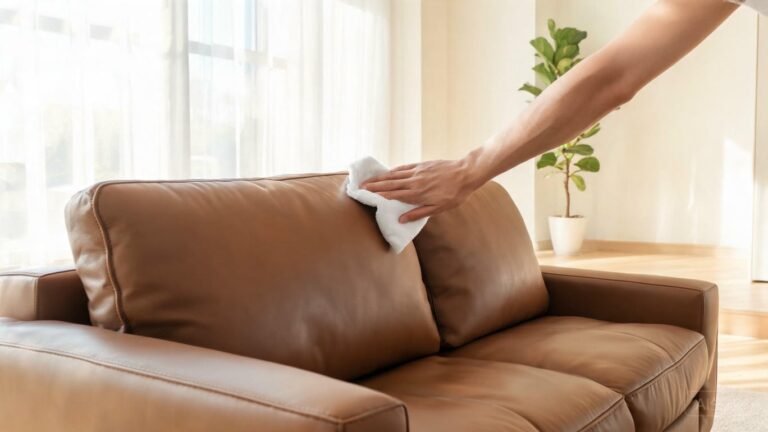
Leather furniture protection is a billion-dollar industry built on a simple premise: the material is failing, and you need to slow it down. UV sprays, stain repellents, conditioning balms, scratch repair kits — each product exists because traditional leather and synthetic alternatives degrade under real-world conditions. For B2B facilities managers overseeing 500+ pieces of upholstered furniture, the maintenance protocol isn’t just a cost center. It’s a signal that the specified material wasn’t fit for purpose. What if the furniture didn’t need protecting because it resisted threats inherently?
Request Protection-Free Sample
The 5 Threats to Leather Furniture
Every leather furniture protection product on the market targets one of five degradation pathways. Understanding these threats — and how different materials respond — is the first step in specifying furniture that doesn’t need constant defensive maintenance.
- UV degradation: The single biggest enemy of leather furniture. Direct sunlight breaks polymer chains in PU/PVC coatings and dries out natural oils in real leather. South-facing windows can fade and crack leather within 2 years. Protection requires UV-blocking window treatments and furniture rotation — treating the symptom, not the cause.
- Stain penetration: Real leather’s porous collagen structure absorbs liquids. A single coffee spill on unconditioned leather can cause permanent staining within minutes. Protection requires immediate application of leather protector sprays that create a temporary barrier — requiring reapplication every 6 months.
- Surface scratching: Real leather scratches from pet claws, belt buckles, and daily contact. PU leather’s softer surface scratches even more readily. Protection requires avoiding sharp objects and accepting that light scratches “add character” — which is a euphemism for permanent damage.
- Heat damage: Leather placed within 30cm of heat sources dries, stiffens, and cracks. Radiators, fireplaces, and even laptop heat cause localized drying. Protection means rearranging furniture layouts around heating infrastructure.
- Moisture and hydrolysis: High humidity accelerates PU coating delamination. Liquid spills penetrate real leather’s pores. PVC’s plasticizers leach out in damp environments. Protection requires dehumidification, spill response protocols, and conditioning — all reactive measures for material vulnerabilities that are inherent, not accidental.

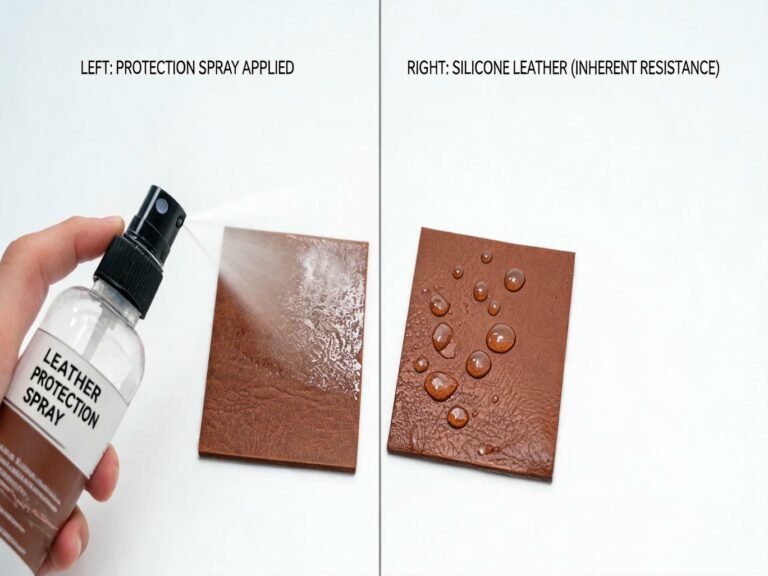
Water beading test — silicone leather’s non-porous surface repels moisture inherently, no protector spray required
Why Protection Products Exist: Material Failure as a Business Model
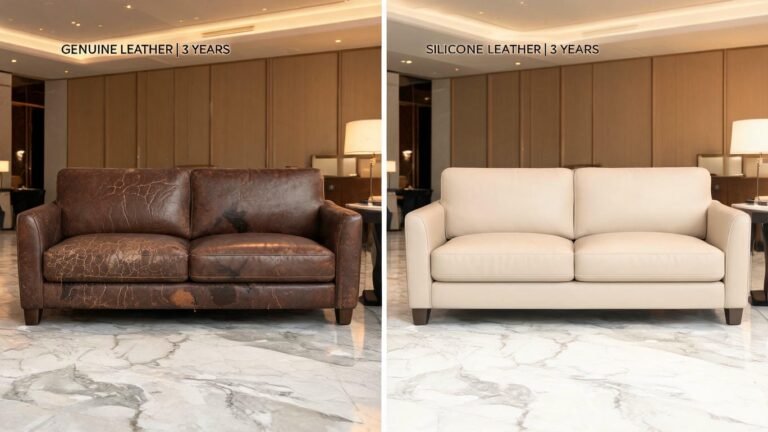
The leather furniture protection industry is a downstream consequence of material specification decisions made upstream. When a procurement team specifies PU leather for a 500-chair restaurant, they’re also committing to a maintenance protocol: quarterly conditioning, semi-annual protector spray reapplication, immediate spill response, and UV window treatments. The protection products don’t prevent failure — they delay it. The material still fails; it just takes 3 years instead of 2.
This creates a perverse incentive structure. Material suppliers benefit from degradation because it drives aftermarket product sales. Furniture manufacturers benefit because planned obsolescence drives replacement cycles. Facilities managers bear the cost — in labor hours, product purchases, and premature reupholstering. As we documented in our subscription leather service analysis, the entire maintenance economy is built on materials that need protecting.
The question B2B specifiers should ask is not “which protection product is best?” but “which material eliminates the need for protection products?” The answer changes the maintenance cost calculation from a recurring expense to a one-time material selection decision.
| Threat | Real Leather | PU Leather | Silicone Leather | Protection Needed? |
|---|---|---|---|---|
| UV exposure | Fades, dries, cracks | Cracks in 1–2 yr | 1,000+ hr no fading | Only for real/PU |
| Liquid stains | Absorbs into pores | Resists initially | Non-porous, repels | Only for real/PU |
| Scratches | Permanent marks | Surface tears | High scratch resistance | Only for real/PU |
| Heat damage | Dries, cracks near heat | Softens, warps | Stable to 250°C | Only for real/PU |
| Moisture/hydrolysis | Water stains | Delaminates | Hydrolysis-proof | Only for real/PU |

Waterproof silicone leather surface — moisture beads and wipes off without penetrating, no protector spray needed
The 3-Step Protocol for Traditional Leather Furniture Protection
If you’re specifying traditional leather or PU furniture, the leather furniture protection protocol is non-negotiable. Industry guidelines recommend a three-step maintenance cycle that, while effective, exists solely to compensate for material vulnerabilities:
- Step 1 — Apply protector spray: Immediately after purchase, apply a leather protector spray to create a temporary moisture and stain barrier. Reapply every 6 months. For commercial fleets, this means 2 full application cycles annually across every piece of furniture — at scale, that’s hundreds of labor hours.
- Step 2 — Condition every 6–12 months: Real leather requires conditioning to replace natural oils lost through evaporation and UV exposure. Without conditioning, the surface dries, stiffens, and cracks. PU leather doesn’t need conditioning — but only because it can’t absorb conditioner. It degrades through hydrolysis instead.
- Step 3 — Environmental management: Position furniture 30cm from heat sources. Install UV-blocking window treatments in sun-exposed areas. Maintain indoor humidity between 40–60%. Rotate cushions every 3 months for even UV exposure. Each measure compensates for a material weakness that better material selection would eliminate.
For a 200-key hotel with approximately 400 upholstered pieces, this protocol represents 200+ labor hours annually — before accounting for spill response, stain treatment, and premature replacement. The protection cost often exceeds the material price difference between PU and silicone leather within the first 18 months.
Leather protector sprays, conditioning balms, and UV treatments are temporary barriers applied to materials that inherently degrade. Silicone leather resists UV, stains, heat, and moisture through its molecular structure — not through applied chemicals that wear off.

Quality control station — where material durability is verified before it reaches your furniture, eliminating the need for post-installation protection
The Silicone Leather Difference: Built-In Protection vs Applied Protection
Silicone leather redefines leather furniture protection by eliminating the need for it. The protection isn’t applied — it’s engineered into the material’s molecular structure. Here’s how silicone leather addresses each of the five threats without a single spray, balm, or treatment:
- UV: Silicone polymers are inherently UV-stable. 1,000+ hours of accelerated UV testing (ASTM G154) with zero fading or yellowing. No window treatments or furniture rotation needed.
- Stains: Non-porous surface repels liquids. Coffee, wine, ink — all wipe off with water. No protector spray, no immediate spill response protocol.
- Scratches: High surface hardness (ASTM D3363 pencil hardness) resists daily contact damage. Pet claws, belt buckles, and daily use don’t leave permanent marks.
- Heat: Stable from -40°C to 250°C. No 30cm clearance rule, no furniture rearrangement around radiators. Laptops, hot mugs, and heating vents don’t damage the surface.
- Moisture: Hydrolysis-proof by chemistry. No dehumidification needed, no coating delamination, no plasticizer migration. Humidity is irrelevant.

High-temperature processing oven — silicone leather is cured at temperatures that would destroy PU and PVC coatings

Commercial furniture application — silicone leather in high-traffic hospitality environments where protection protocols are most costly
Stain resistance test: coffee, wine, ink, and food oils wiped clean from silicone leather with water only — no cleaner, no protector spray
Frequently Asked Questions
How often should leather furniture be treated with protectant?
For real leather and PU leather furniture, industry guidelines recommend applying leather protector spray every 6 months and conditioning every 6–12 months. Commercial environments with high traffic, UV exposure, or frequent spill risk may require quarterly application. For a 200-piece commercial fleet, this translates to 200+ labor hours annually — a cost that exceeds the material price difference between PU and silicone leather within 18 months. Silicone leather eliminates this protocol entirely through inherent UV, stain, and moisture resistance.
Does silicone leather furniture need any protection products?
No. Silicone leather’s protection is molecular, not applied. Its non-porous surface repels liquids (no stain protector needed), its silicone polymer backbone is UV-stable for 1,000+ hours (no UV spray needed), its surface resists scratching per ASTM D3363 (no scratch repair kit needed), and it’s stable from -40°C to 250°C (no heat clearance rules). Routine cleaning with water — or bleach/alcohol disinfectants in healthcare settings — is the only maintenance required. No protector sprays, conditioning balms, or environmental management protocols are needed.
The Bottom Line for Leather Furniture Protection
The leather furniture protection industry exists because traditional materials — real leather, PU, PVC — are inherently vulnerable to UV, stains, scratches, heat, and moisture. The protection products delay failure; they don’t prevent it. For B2B facilities managers, the question is not which protection product to buy, but whether to keep specifying materials that need protecting. Silicone leather eliminates the protection protocol entirely: its molecular structure resists all five threats without a single applied treatment. The cost of switching from PU to silicone leather is typically recovered within 18 months through eliminated maintenance labor and product costs — and the 10+ year lifespan means zero replacement cycles. The best protection product is the one you never need to buy.
Get Maintenance Protocol Guide
About TOPSUN
TOPSUN manufactures silicone-coated leather that eliminates the need for leather furniture protection products through inherent molecular resistance to UV, stains, scratches, heat, and moisture. Our materials are specified by B2B furniture manufacturers and facilities managers seeking to eliminate maintenance labor costs and replacement cycles.
1,000+ hr UV stable · Non-porous stain resistance · -40°C to 250°C · 200K+ abrasion cycles · Bleach-safe · Zero VOC · SGS-verified