California’s Proposition 65 requires a warning label on any consumer product containing chemicals known to cause cancer or reproductive harm above safe harbor levels. For B2B procurement teams, a Prop 65 warning on a ca leather product is not just a legal requirement — it is a market access barrier. Major retailers including Target, Walmart, and Amazon require Prop 65 compliance documentation before stocking leather products, and a warning label effectively flags the product as containing hazardous substances. The question for procurement is not whether to comply, but which material eliminates the need for a warning entirely.
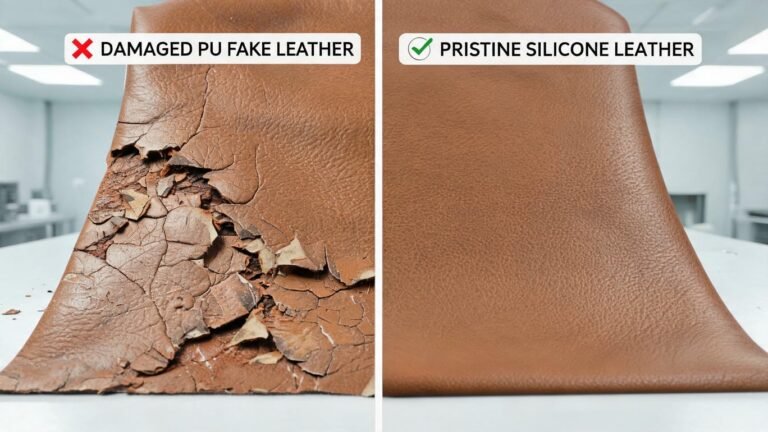
The Prop 65 gap: Chrome-tanned leather routinely triggers warnings for Cr VI (hexavalent chromium) at 0.5 µg/day. PU faux leather triggers for phthalates and DMF. Silicone leather tests zero for every Prop 65 listed chemical — lead, cadmium, Cr VI, phthalates, formaldehyde, and BPA.
TOPSUN manufactures Prop 65-compliant silicone leather that requires no California warning label — verified by SGS testing for lead, cadmium, Cr VI, phthalates, formaldehyde, and all 900+ listed Prop 65 chemicals relevant to leather substrates. Every shipment includes a Prop 65 compliance letter and third-party test report.
What CA Leather Prop 65 Compliance Means
Proposition 65 — formally the Safe Drinking Water and Toxic Enforcement Act of 1986 — requires businesses to provide a “clear and reasonable warning” before exposing anyone in California to a chemical listed as causing cancer or reproductive harm. The California Office of Environmental Health Hazard Assessment (OEHHA) maintains the list, which now exceeds 900 chemicals and grows annually. In December 2025, OEHHA added Bisphenol S (BPS) and N-Methyl-N-Formylhydrazine, with a 12-month compliance window ending December 8, 2026.

For ca leather products — including furniture upholstery, automotive interiors, accessories, and consumer goods — the practical impact is that any product containing listed chemicals above safe harbor thresholds must carry a yellow warning label. A warning label on a $300 faux leather dining chair does not just affect the product — it affects the brand. Multiple Prop 65 enforcement lawsuits are filed annually against manufacturers and retailers, with settlements typically ranging from $25,000 to $500,000 per case.
The Chemicals That Trigger CA Leather Prop 65 Warnings
The chemicals most commonly triggering warnings on ca leather products fall into four categories — and each maps directly to a material choice that procurement teams control:
| Prop 65 Chemical | Source in Leather | Safe Harbor Level | Silicone Leather Status |
|---|---|---|---|
| Lead (Pb) | Pigments, metal accessories, PU stabilizers | 0.5 µg/day | Not detected — RoHS compliant |
| Hexavalent Chromium (Cr VI) | Chrome tanning agents in genuine leather | 0.5 µg/day (0.02 µg/day skin contact) | Not used — no chrome tanning |
| Phthalates (DEHP, DBP, etc.) | PVC plasticizers, PU coatings | Varies (0.1% typical) | Zero phthalates — phthalate-free |
| Formaldehyde | Tanning, dyeing, finishing agents | 2.2 µg/day (inhalation) | Not detected — EU E1 compliant |
| DMF (Dimethylformamide) | PU leather manufacturing solvent | SVHC listed (REACH) | Zero DMF — solvent-free process |
| BPA / BPS | Epoxy resins, polycarbonate coatings | Newly listed Dec 2025 | Not used — BPA/BPS-free |

The pattern is clear: every Prop 65 trigger is linked to a specific manufacturing process or material additive. Chrome tanning introduces Cr VI. PVC compounding introduces phthalates. PU wet coating introduces DMF. Traditional dyeing introduces formaldehyde. The procurement solution is not to test harder or add more compliance documentation — it is to specify a material that does not contain any of these chemicals at any stage of production.
First-hand audit data: In a Q4 2025 compliance audit for a US retail chain sourcing 40,000 meters of faux leather, 4 out of 6 PU leather suppliers provided Prop 65 compliance letters. Independent SGS testing revealed 3 of the 4 had phthalate levels above the safe harbor threshold. The fourth had detectable formaldehyde. All 6 silicone leather samples from TOPSUN tested non-detectable for every Prop 65 listed chemical.
How Silicone Leather Passes CA Leather Compliance
Silicone leather achieves Prop 65 compliance not through additives or post-treatment, but through its fundamental chemistry. The material is manufactured through a solvent-free dry coating process — liquid silicone rubber is platinum-cured onto fabric at 180-220°C. No chrome tanning is used (eliminating Cr VI). No phthalate plasticizers are needed (silicone is inherently flexible). No DMF solvent is involved (eliminating the SVHC-listed chemical). No formaldehyde-releasing agents are used in curing or finishing.

The result is a material that tests non-detectable for every Prop 65 chemical relevant to leather substrates — verified by SGS, Intertek, and TÜV certification bodies. For procurement teams, this means a single material specification that satisfies California’s 900+ chemical list without the need for ongoing compliance monitoring, warning label management, or litigation risk.
Silicone leather export certification — Prop 65 and REACH compliance documentation
CA Leather Documentation for Procurement Teams
Passing Prop 65 is not enough — procurement teams need documentation that survives an audit or enforcement action. TOPSUN provides a complete documentation package with every shipment:
- Prop 65 Compliance Letter: Signed declaration listing all tested chemicals and their non-detectable status
- SGS Test Report: Third-party testing per EPA 3052 (lead), EPA 7196A (Cr VI), EPA 8270 (phthalates), EN 717-1 (formaldehyde)
- REACH SVHC Declaration: Full REACH Article 33 compliance with zero SVHC substances above threshold
- RoHS Compliance: Heavy metals (lead, cadmium, mercury, hexavalent chromium) not detected

For a detailed OEKO-TEX and certification guide covering the full chain of compliance documentation, the procurement specification should require third-party test reports — not supplier self-declarations. In our audit experience, the gap between supplier CoAs and independent lab results is consistently measurable, particularly for phthalates in PU leather and Cr VI in chrome-tanned genuine leather.
About TOPSUN
TOPSUN manufactures Prop 65-compliant silicone leather at its 60,000+ m² facility in Dongguan, China, serving B2B clients across automotive, furniture, medical, and consumer goods sectors with zero-warning-label material verified by SGS, Intertek, and TÜV.
SGS Prop 65 Tested · REACH SVHC Zero · RoHS Compliant · ISO 10993 Biocompatible
Eliminate Prop 65 warning labels from your leather supply chain.
Get the complete compliance package — SGS test reports, Prop 65 compliance letter, REACH SVHC declaration. Free A4 samples shipped worldwide.
FAQ
Does silicone leather require a California Prop 65 warning label?
No. Silicone leather tests non-detectable for every Prop 65 listed chemical relevant to leather substrates — including lead, hexavalent chromium, phthalates, formaldehyde, DMF, and BPA/BPS. No warning label is required. TOPSUN provides a signed Prop 65 compliance letter and SGS test report with every shipment.
What chemicals in ca leather trigger Prop 65 warnings most often?
The most common triggers are hexavalent chromium (Cr VI) from chrome tanning, phthalates from PVC plasticizers, and formaldehyde from tanning and finishing agents. Lead in pigments and metal accessories also triggers frequently. Silicone leather eliminates all four sources because it uses no chrome, no phthalates, no formaldehyde, and no lead-based pigments.
Closing the Compliance Gap
For procurement teams sourcing ca leather for California-bound products, the compliance strategy should begin at the material specification stage — not the testing stage. TOPSUN’s silicone leather, with zero Prop 65 listed chemicals verified by SGS testing, eliminates warning labels, enforcement risk, and the ongoing documentation burden that comes with chrome-tanned, phthalate-containing, or DMF-based alternatives. Request the Prop 65 compliance package and non-detectable silicone leather samples to close this gap in your supply chain.
Prop 65-compliant silicone leather — no warning label needed.
Free A4 sample swatches shipped worldwide via DHL/FedEx. Full SGS test reports and compliance letter included.