Industry data shows synthetic leather sold by the yard reduces cutting waste by 15–25% versus irregular hides, but the real procurement advantage is roll-to-roll consistency. When you source upholstery leather by the yard in continuous roll format, every yard arrives at the same thickness, the same width, and the same color. No hide grading. No belly-to-shoulder variation. No 6–12 month tanning lead times. For procurement teams managing furniture, automotive, or marine production lines, that predictability translates directly into lower landed cost per usable unit — even when the per-yard price looks higher than budget PU.
A standard 54-inch roll of silicone upholstery leather yields 82–87% usable material after pattern nesting. Genuine cowhide hides yield 55–65%. That 20+ point yield gap means you need 30% more hide material to produce the same furniture output — and you pay for the waste.
What Does “Upholstery Leather by the Yard” Actually Mean for B2B Buyers?
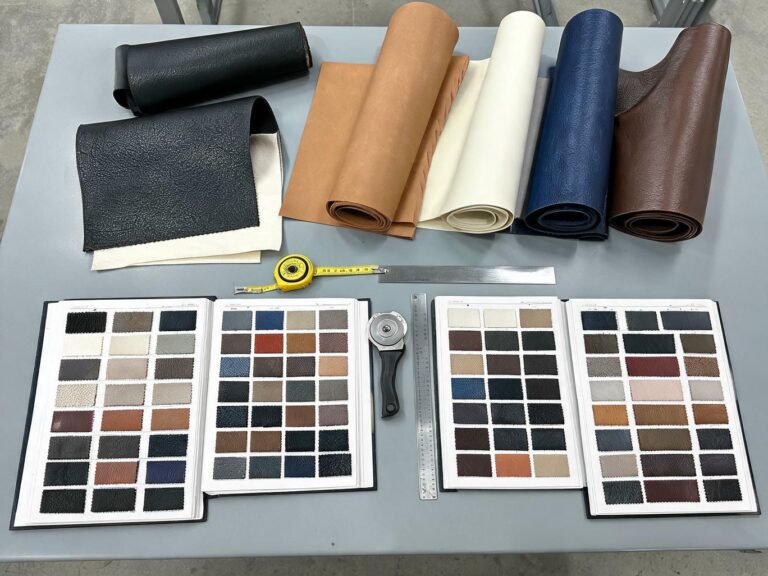
In B2B sourcing, “upholstery leather by the yard” refers to leather material — synthetic or genuine — sold in continuous roll format rather than individual hides. Synthetic rolls come in standard widths of 54 inches (137 cm) or 60 inches (152 cm), with thicknesses from 0.6 mm to 2.0 mm. Each roll typically runs 30–50 yards (27–46 meters) in length, though custom lengths are available from manufacturers who operate continuous coating lines.
The key distinction for procurement: when you buy by the yard, you are purchasing guaranteed dimensions. A 54-inch × 40-yard roll gives you exactly 60 square yards of material, every time. When you buy hides, you are purchasing irregular shapes that vary in area from 18 to 25 square feet per hide — and 15–35% of that area is unusable due to natural defects, stretch marks, and brand marks.

Upholstery Leather by the Yard: 3 Materials Compared by Yield, Cost, and Durability
Not all yard-based leather delivers the same procurement value. The table below compares the three material types most commonly sold by the yard for commercial upholstery — PU, PVC, and silicone — against genuine leather hides, using data from third-party test standards and current wholesale pricing.
| Material Type | Cost per Yard (USD) | Cutting Yield Rate | Waste % | Martindale Cycles | Roll Width |
|---|---|---|---|---|---|
| PU Faux Leather | $8 – $22 | 80 – 85% | 15 – 20% | 25,000 | 54″ / 137 cm |
| PVC Synthetic Leather | $5 – $15 | 78 – 83% | 17 – 22% | 40,000 | 54″ / 137 cm |
| Silicone Leather | $18 – $35 | 82 – 87% | 13 – 18% | 200,000+ | 54″ / 137 cm |
| Genuine Cowhide (by hide) | $25 – $100+ | 55 – 65% | 35 – 45% | 30,000 – 70,000 | Irregular (18–25 sq ft) |
Yield rates based on standard furniture pattern nesting (3-seat sofa). Martindale data per ISO 12947-2. Pricing reflects 2025–2026 FOB China wholesale ranges.
Why Yield Rate Is the Number Procurement Teams Ignore — and Shouldn’t
Most sourcing departments compare leather materials by cost per yard. That is the first mistake. The number that determines your actual production cost is cost per usable square foot after nesting — and that depends entirely on yield rate.
Here is the calculation that changes the sourcing decision:
- PU at $12/yd, 80% yield: 54″ × 1 yd = 13.5 sq ft usable. Cost per usable sq ft = $12 ÷ (13.5 × 0.80) = $1.11/sq ft
- Silicone at $25/yd, 85% yield: 54″ × 1 yd = 13.5 sq ft usable. Cost per usable sq ft = $25 ÷ (13.5 × 0.85) = $2.18/sq ft
- Genuine hide at $45/sq yd equiv, 60% yield: 13.5 sq ft × 0.60 = 8.1 sq ft usable. Cost per usable sq ft = $45 ÷ 8.1 = $5.56/sq ft
Silicone costs roughly 2x PU per usable square foot — but delivers 8x the Martindale abrasion cycles (200,000+ vs 25,000). Over a 10-year furniture lifecycle, silicone’s cost per year of service life is actually 4x lower than PU. Genuine leather, despite its prestige, costs 2.5x more than silicone per usable square foot while delivering 3–7x less abrasion resistance.
How Roll Width Affects Cutting Yield for Upholstery Production

The standard 54-inch (137 cm) roll width used by most synthetic leather manufacturers is not arbitrary — it is optimized for furniture upholstery pattern nesting. A typical 3-seat sofa requires panel cuts of 24″ × 36″ for seat cushions, 18″ × 42″ for backrests, and 12″ × 48″ for arm panels. On a 54-inch roll, these patterns nest efficiently with minimal waste between cuts.
However, for automotive seating and marine applications, narrower cuts (typically 48-inch or custom-slit widths) may improve yield further. Manufacturers with in-house slitting capability — like TOPSUN’s silicone leather production line — can deliver custom roll widths without minimum order penalties, which is a significant advantage over suppliers who only offer standard widths.
MOQ and Lead Time: Roll-Based vs Hide-Based Sourcing
Standard MOQ for synthetic upholstery leather by the yard: 500–1,000 meters. Genuine hide MOQs: often 500+ sq ft with 6–12 week tanning lead times. Silicone leather rolls from TOPSUN: 300-meter MOQ with 4–6 week production lead time from sample approval.
For procurement teams running just-in-time manufacturing, the MOQ and lead time difference between roll-based and hide-based sourcing is critical. Synthetic leather rolls are produced on continuous coating lines — once a color and texture is set up, production runs at 3,000–5,000 meters per shift. This means a 500-meter order can be completed and shipped within 4–6 weeks, including quality testing and packaging.
Genuine hide sourcing involves a fundamentally different supply chain: raw hide procurement → tanning (4–8 weeks) → finishing (2–4 weeks) → grading and selection (1–2 weeks). Total lead time: 8–14 weeks, with price volatility driven by cattle market fluctuations and regional tannery capacity.
Silicone Upholstery Leather by the Yard: Specifications That Matter for Procurement

When evaluating silicone upholstery leather by the yard for B2B production, procurement teams should verify these specifications on the technical data sheet (TDS) before placing a PO:
- Thickness: 0.6 mm – 2.0 mm (0.8 mm and 1.0 mm are standard for furniture; 1.2 mm for automotive)
- Roll width: 54″ (137 cm) standard; custom slitting available
- Martindale abrasion: ≥ 200,000 cycles (ISO 12947-2) — 8x higher than PU
- Tensile strength: ≥ 15 N/mm (warp and weft)
- Temperature resistance: -40°C to 250°C — critical for automotive and marine
- Hydrolysis resistance: ≥ Level 4 (EN 13773) — prevents material breakdown in humid environments
- VOC emissions: Solvent-free silicone coating — zero DMF, zero formaldehyde
- Certifications: ISO 10993, REACH, PAHs, FDA, FAR 25.853 for medical, automotive, and aviation compliance
- Color consistency: ΔE ≤ 1.0 between rolls — Pantone-matched with batch-to-batch repeatability
About TOPSUN: Silicone Upholstery Leather Rolls for B2B Production
TOPSUN manufactures solvent-free silicone upholstery leather in continuous roll format for furniture, automotive, and marine OEMs across 30+ countries. Our rolls come standard at 54-inch width with thicknesses from 0.6 to 2.0 mm, tested to 200,000+ Martindale cycles and certified to ISO 10993, REACH, and FAR 25.853. With in-house slitting capability, we deliver custom roll widths and lengths without MOQ penalties — giving procurement teams the yield flexibility that hide suppliers simply cannot match. Every roll ships with a full TDS and batch test report for quality traceability.
Procurement Checklist: 7 Questions to Ask Any Upholstery Leather by the Yard Supplier
- What is your roll-to-roll color consistency tolerance? (Acceptable: ΔE ≤ 1.5; TOPSUN standard: ΔE ≤ 1.0)
- Can you provide Martindale test reports per batch? (If the answer is “we test annually,” walk away)
- What is your actual production lead time from sample approval? (4–6 weeks for synthetic rolls; 8–14 weeks for genuine hides)
- Do you offer custom slitting for non-standard widths? (Critical for automotive and marine patterns)
- What is the MOQ for a custom color match? (TOPSUN: 300 meters; many suppliers: 1,000+ meters)
- Can you provide a full REACH SVHC declaration? (Non-negotiable for EU market access)
- What is your yield rate guarantee? (Most suppliers will not commit to this — TOPSUN guarantees 82%+ on standard 54″ rolls)

Upholstery Leather by the Yard: FAQ
What is the MOQ for silicone upholstery leather by the yard?
The standard MOQ at TOPSUN is 300 meters per color and thickness combination. For stock colors and standard textures, the MOQ can be reduced to 100 meters. Custom color matches require a 500-meter minimum due to formulation setup on the coating line. Lead time from sample approval is 4–6 weeks for production orders.
How does roll width affect cutting yield for furniture production?
The standard 54-inch (137 cm) roll width is optimized for furniture upholstery patterns, yielding 82–87% usable material after nesting. Narrower rolls (48-inch) can improve yield for automotive seating patterns by reducing off-cut width. Manufacturers with in-house slitting capability can deliver custom widths without additional cost, which can improve overall yield by 3–5 percentage points.
Is silicone upholstery leather more expensive than PU per yard?
Yes, silicone leather costs more per yard ($18–$35 vs $8–$22 for PU). However, when calculated on cost per usable square foot after nesting waste, and amortized over the material’s service life (200,000+ Martindale cycles vs 25,000 for PU), silicone delivers a 4x lower cost per year of service. The initial price gap closes within 18 months of commercial use.
Can I get upholstery leather by the yard in custom textures?
Yes. TOPSUN offers custom texture embossing including lychee, nappa, pebbled, smooth, and perforated patterns. Custom textures require a 500-meter MOQ and add 1–2 weeks to the production lead time. Standard textures are available with no MOQ premium.
See TOPSUN’s factory production capacity for continuous-roll silicone leather — 500,000 m/month with zero batch variation
Related resources: Silicone leather technical introduction · Full technical data sheet · Certification gallery
Request Roll Samples & Yield Calculation
Get free A4 swatch samples in your specified color and texture, plus a yield calculation tailored to your furniture or automotive patterns. Our procurement team responds within 24 hours.