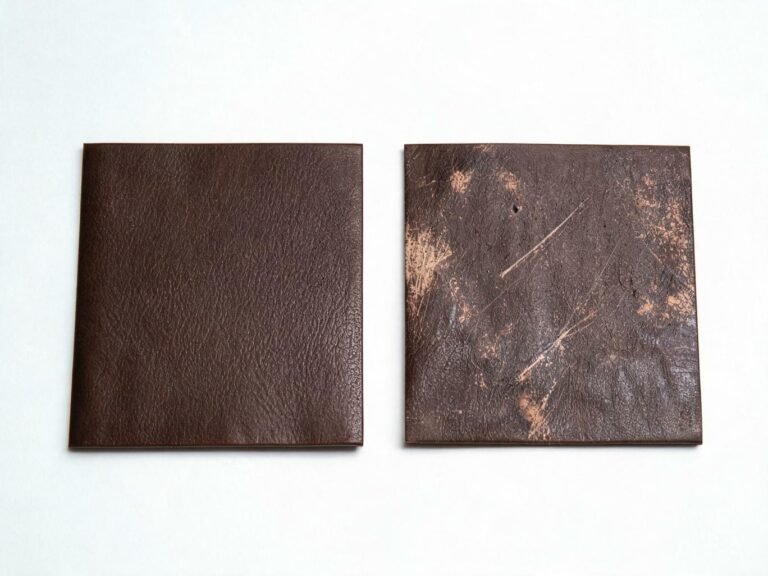
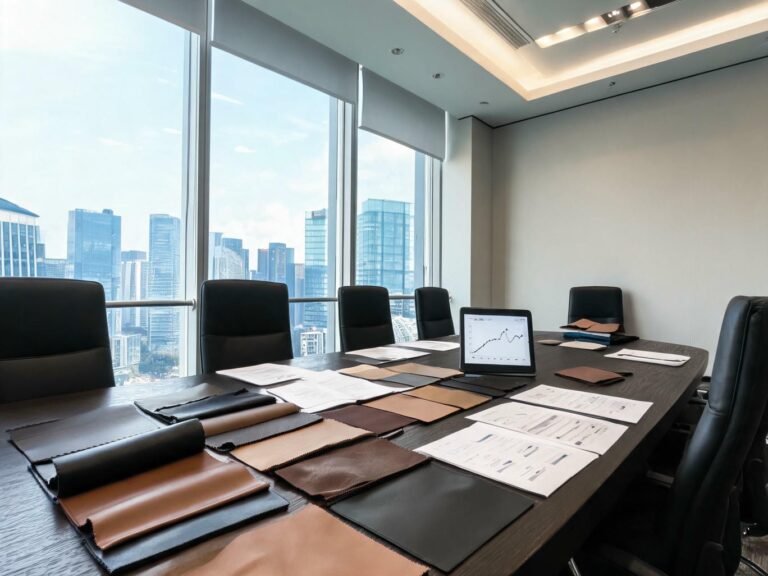
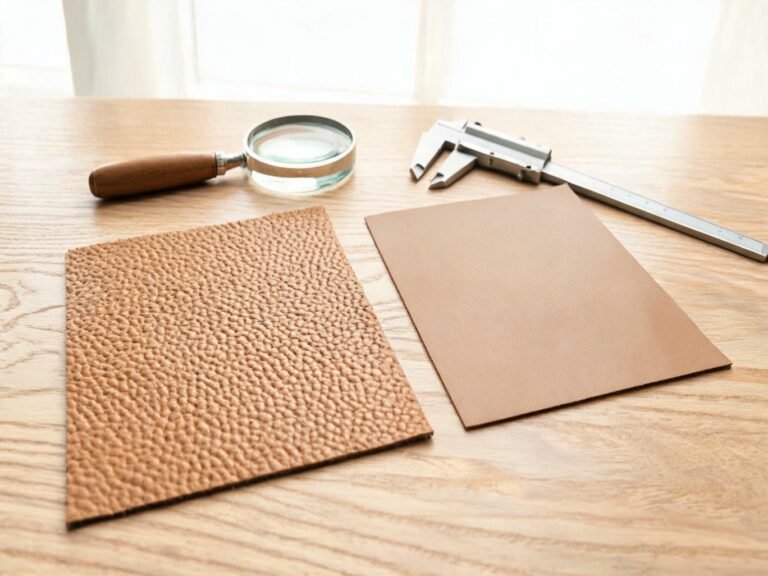
A procurement manager at a European automotive Tier 1 supplier once told us they had received three batches of “OEM-grade” leather from different vendors, all with identical spec sheets. One batch passed 60,000 Martindale cycles. Another failed at 12,000. The third delaminated during flex testing at 8,000 cycles. Same paper. Same claims. Wildly different leather performance. The gap between a spec sheet and actual material behavior is where warranty claims live — and where procurement teams either save or lose millions. Here are the seven metrics that actually matter, with the numbers you should require from any supplier before signing a purchase order.
Why Leather Performance Specs Determine Your Warranty Exposure
When you sign a supply agreement for upholstery leather, you are also signing a warranty commitment to your customer. If the material fails at year 3 but your warranty covers 5 years, you absorb the replacement cost — labor, logistics, downtime, and reputational damage. The connection between leather performance specs and warranty exposure is direct: every test number on the spec sheet maps to a failure mode you will or will not encounter in the field.
Here is the scenario we see most often. A furniture manufacturer specifies “premium PU leather” at 30,000 Martindale cycles for a commercial sofa line. Three years into production, the client reports widespread peeling on seat cushions. Investigation reveals the supplier’s 30,000-cycle claim was tested on the thickest part of the sheet — the actual production areas (stretched, seamed, and upholstered) perform at 15,000-18,000. The spec sheet was technically accurate. The leather performance was not.

Scratch resistance tester evaluating leather performance at TOPSUN’s quality control laboratory
The 7 Critical Metrics: What Numbers to Require from Suppliers
These are the seven tests that separate materials that survive commercial use from those that look good on a data sheet. When comparing silicone vs PU performance, the gap is most visible in metrics 1, 4, and 6.
| Performance Spec | Test Standard | OEM Minimum | Spec-Grade | Budget Tier |
|---|---|---|---|---|
| Martindale Abrasion | ISO 12947-2 | 50,000 | 200,000+ | 10,000-25,000 |
| Tear Strength | ISO 3376 | 20 N | 35+ N | 12-18 N |
| Flex Resistance | ISO 5402 | 20,000 cycles | 100,000+ | 8,000-15,000 |
| UV Stability | ASTM G154 | 500 hrs | 2,000+ hrs | 200-400 hrs |
| Color Fastness (Light) | ISO 105-B06 | Grade 4 | Grade 4.5 | Grade 2-3 |
| Hydrolysis Resistance | ASTM D-3980 | 6 weeks | 14+ weeks | Fails at 4-6 wks |
| Flex at Low Temp | ISO 1764-200 | 50K @ -10°C | 200K @ -30°C | 20K @ -5°C |
Source: TOPSUN SGS-verified test data, ISO standard ranges, and OEM procurement baseline requirements.
Procurement rule: If a supplier’s data sheet lists fewer than 4 of these 7 metrics, the missing numbers are missing for a reason. Request them in writing before sample evaluation.
Real-World Failure Scenarios: When Specs Look Good but Products Fail
Spec sheets tell you what a material did in a lab. They do not tell you what happens when that material meets reality. Here are three failure scenarios we have encountered firsthand in automotive interior applications and commercial furniture — and what the data should have warned us about.
Scenario 1: The peeling dashboard. A car manufacturer specified PU leather at 25,000 Martindale cycles for dashboard wrapping. The number passed internal standards. But dashboard surfaces experience continuous thermal cycling — cabin temperatures swing from -20°C overnight to 70°C in direct sun. After 18 months, the PU surface began micro-cracking along the dashboard’s curved edges. The root cause: the supplier’s abrasion test was conducted on flat samples at room temperature, never on curved surfaces under thermal stress.

Silicone leather lamination line — controlled production ensures consistent performance across every meter
Scenario 2: The cracked restaurant booth. A hospitality group ordered 200 restaurant booths upholstered in “commercial-grade” PVC leather. The spec sheet showed 30,000 Martindale cycles. By month 14, every booth showed cracking along the seat front edge — the highest-wear zone. Investigation found the supplier tested abrasion on the material’s center, not edges where factory cutting exposes the polymer layer. Lesson: always request edge-specific abrasion data, not center-only.
Scenario 3: The faded yacht cushion. Marine upholstery specified with “UV-resistant” PU leather showed visible color shift after one summer season. The supplier’s UV test was 200 hours — adequate for indoor use, inadequate for direct marine sun exposure. A material that claims UV resistance without specifying test hours is telling you nothing. For leather durability testing, always ask for the exact number of hours and the standard used.
Building Your Leather Performance Specification Sheet
Stop accepting supplier-generated spec sheets as your baseline. Build your own performance specification document with minimum thresholds for every metric above, then ask suppliers to confirm they meet or exceed each number — with current SGS test reports as proof. The silicone leather abrasion test data TOPSUN provides is a model: it lists the test standard, the cycle count, the lab name, the report number, and the test date.
For silicone leather, the numbers that matter are concrete: 200,000+ Martindale cycles (ISO 12947-2), 35+ N tear strength (ISO 3376), 100,000+ flex cycles (ISO 5402), Grade 4.5 light fastness (ISO 105-B06), and 2,000+ hours UV stability (ASTM G154). These are not aspirational targets — they are SGS-verified results from factory production batches. According to ISO 12947-2 standard documentation, Martindale testing remains the globally recognized benchmark for upholstery abrasion resistance — and the cycle count is the single most predictive metric for field durability.

Color fastness testing machine verifying Grade 4.5 light fastness on silicone leather samples
Side-by-side durability comparison: silicone leather vs PU vs PVC under standardized testing

Premium grain texture on high-performance silicone leather — maintains integrity through 200K+ abrasion cycles
Frequently Asked Questions
What Martindale cycle count is required for commercial furniture upholstery?
For commercial furniture in high-traffic environments (hotels, restaurants, offices), the minimum acceptable Martindale count is 50,000 cycles per ISO 12947-2. However, this minimum assumes moderate daily use with planned replacement at 3-5 years. For products targeting 7-10+ year lifespans — or for applications with continuous seating like cinema and transit — specify 100,000 cycles minimum. Silicone leather at 200,000+ cycles is the only synthetic material that supports 10-15 year commercial warranties without replacement.
How does leather performance change at extreme temperatures?
PU and PVC leather performance degrades sharply outside the 0-60°C range. Below -10°C, these materials become rigid and prone to cracking under flex stress. Above 70°C — common in parked vehicle interiors — plasticizers begin migrating, accelerating surface degradation. Silicone leather maintains full flexibility from -40°C to 250°C, with low-temperature flex resistance tested at 200,000 cycles at -30°C per ISO 1764-200. This thermal range is why silicone is the preferred material for automotive interiors, outdoor furniture, and marine applications.
Specs Are Your Procurement Shield
Leather performance is not about marketing language — it is about test numbers issued by accredited laboratories. The seven metrics in this guide are the minimum framework for any B2B procurement specification. When a supplier cannot produce current SGS reports covering Martindale abrasion, tensile strength, flex resistance, UV stability, color fastness, hydrolysis resistance, and low-temperature flex, you are buying on faith, not data. Silicone leather sets the benchmark at 200,000 Martindale cycles, 35+ N tear strength, and 2,000+ UV hours — verified by SGS on every production batch. That is the spec sheet that lets you offer a 10-year warranty with confidence.
About TOPSUN
TOPSUN supplies OEM-grade silicone leather with verified performance data for automotive, furniture, and medical manufacturers requiring 200,000+ Martindale cycles.
Every batch ships with SGS-verified test reports covering ISO 12947-2 abrasion, ISO 3376 tensile strength, ISO 5402 flex resistance, and ASTM G154 UV stability.