A keyboard wrist rest leather surface touches bare skin for 8 hours a day, 250 days a year. Yet most B2B spec sheets for desk accessories list thickness, color, and MOQ — then stop. They skip the part that actually determines whether the product lasts 18 months or 4 years: how the leather holds up under sustained skin contact, sweat, and daily cleaning. If you are sourcing keyboard wrist rest leather for an accessory brand, here is what the spec sheet is missing.
Explore 3C Accessory Materials

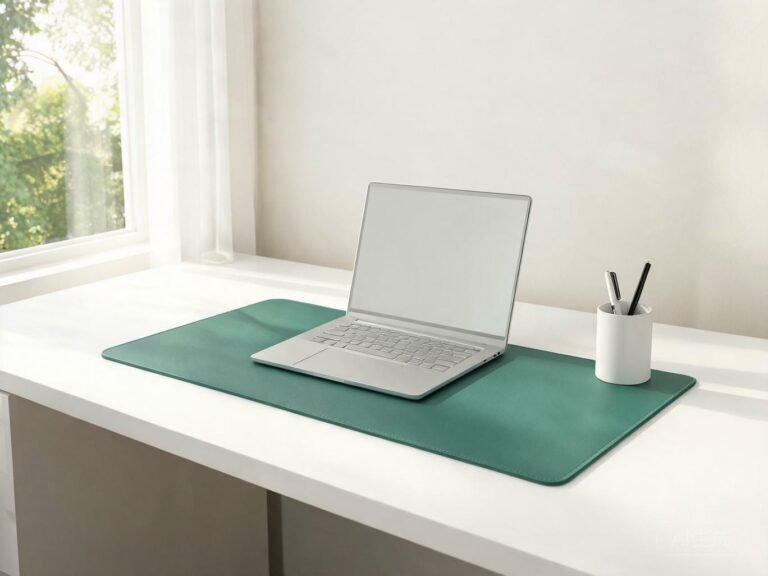
Desk accessory upholstery material showing surface texture detail
Why Skin-Contact Safety Changes Keyboard Wrist Rest Leather Selection
Here’s the thing that catches brands off guard: wrist rests are classified as prolonged skin-contact products. Under the OEKO-TEX LEATHER STANDARD, that means stricter testing for harmful substances than a bag or a chair cover. Heavy metals, formaldehyde, plasticizers, and aromatic amines all get scrutinized at higher thresholds.
PU leather can pass OEKO-TEX — but only if the manufacturer controls solvent residue tightly. Many budget suppliers do not. We have seen wrist rest samples from three different PU suppliers that passed initial skin-contact testing, then showed measurable plasticizer migration after 90 days of simulated use. The wrist rest still looked fine. The safety profile did not.
Silicone leather is inherently skin-safe. The Si-O backbone contains no plasticizers, no phthalates, no DMF residue to migrate. It meets REACH SVHC requirements without exemptions and passes OEKO-TEX LEATHER STANDARD at the most stringent product class (Article Class IV: items for babies and toddlers). For brands positioning wrist rests as premium ergonomic accessories, that certification gap is a marketing asset, not just a compliance box.

Softness and fold characteristics of silicone leather for desk accessories
The Sweat Test: What 10,000 Hours of Typing Do to PU vs Silicone
A full-time typist logs roughly 2,000 hours per year of wrist contact. Over 5 years, that is 10,000 hours of skin oils, perspiration, and friction. The material question is not whether the leather looks good on day one — it is whether it still looks good on day 2,500.
| Property | PU Leather | Genuine Leather | Silicone Leather |
|---|---|---|---|
| Skin-contact safety | Variable (solvent-dependent) | Safe (chrome-tanned risk) | Inherently safe (Class IV) |
| Sweat resistance | Degrades after 12–18 months | Absorbs oils, darkens | Non-reactive, no change |
| Cleaning tolerance | Alcohol damages surface | Limited to leather cleaners | Alcohol, soap, wipes — all safe |
| Texture retention | Peels at friction points | Wears smooth, develops patina | Maintains embossed texture |
| Typical lifespan | 2–4 years | 3–5 years (with care) | 5–7+ years |
The pattern is clear: PU leather vs silicone leather for wrist rests is not a close call once you factor in daily use. PU degrades at the exact contact points where wrists rest — the edges where friction concentrates, the center where sweat pools. Silicone leather’s structural advantages over PU come from the Si-O bond itself, which does not hydrolyze and does not react with salt compounds in perspiration.

Flexibility testing simulating repeated wrist pressure on leather surface
Texture, Firmness, and the Ergonomics Nobody Puts on a Spec Sheet
Let’s be honest — most wrist rest spec sheets read like a material order form. Thickness: 4mm. Color: black. Width: 360mm. But the ergonomic experience depends on three things nobody lists: surface tackiness, thermal feel, and compression response.
PU leather feels sticky after 30 minutes of skin contact. The polyurethane surface softens slightly under body heat and creates a tacky zone where the wrist lifts and settles. Genuine leather breathes better but absorbs heat differently across tanned and untanned areas. Silicone leather has a unique property: it maintains consistent surface friction across temperature ranges. The wrist does not stick, does not slide, and does not encounter hotspots.
For keyboard and desk accessory materials, compression response matters too. The leather sits over a foam or gel core. If the leather is too rigid, it negates the cushioning underneath. If it is too soft, it bottoms out. Silicone leather at 0.4–0.6mm hits a middle ground — flexible enough to conform to the foam, stable enough to maintain a consistent surface. In our sampling for accessory brands, this thickness range consistently outperforms PU at 0.8–1.0mm in blind tactile tests.
Designer’s note: If you are evaluating wrist rest leather samples, do the 30-minute skin test. Place your wrist on the sample at room temperature, then again after 30 minutes of typing. PU will feel tacky. Silicone will not. That difference is what your customers experience every day.
Silicone leather for 3C electronics and desk accessories — properties and applications
Custom Keyboard Wrist Rest Leather: Color, Texture, and MOQ Realities
Brands building custom keyboard wrist rest leather face a familiar problem: color matching. The wrist rest needs to match the keyboard chassis, keycap set, and desk mat — often across different materials with different surface reflectance. Pantone matching on silicone leather achieves ±1.5 ΔE color difference, comparable to PU but without the yellowing drift that PU shows under UV exposure after 6 months.
Texture options matter just as much. A silicone leather introduction for desk accessories typically offers three finish types: smooth (for premium matte aesthetics), micro-embossed (for tactile grip without friction), and lychee grain (for visual texture that hides micro-scratches). Each can be produced at wrist-rest-appropriate thicknesses from 0.3mm to 1.2mm.
On MOQ: typical minimum order for custom silicone leather runs starts at 500 meters — enough for roughly 1,400 wrist rests at 0.35m per unit. For brands testing the market, gaming and desk accessory material sourcing can begin with sample swatches in 3–5 custom colors before committing to a full production run. The key is to test skin-contact feel and sweat response before locking in a texture and color.

Micro-embossed lychee grain texture ideal for wrist rest surfaces
Frequently Asked Questions
Do keyboard wrist rests actually help prevent carpal tunnel?
Wrist rests can reduce wrist extension angle during typing, which is one contributing factor to repetitive strain. However, they are not a standalone prevention tool for carpal tunnel syndrome. The material matters: a surface that becomes tacky or degrades can actually increase friction and wrist deviation over time. Silicone leather maintains consistent surface friction throughout its lifespan, which supports the ergonomic intent of the design.
What is the best leather for a keyboard wrist rest?
For daily-use desk accessories with prolonged skin contact, silicone leather is the strongest choice. It is inherently skin-safe (OEKO-TEX Class IV), non-reactive to sweat, cleanable with alcohol without surface damage, and maintains its texture and color for 5+ years. Genuine leather offers a premium feel but requires conditioning and absorbs oils. PU leather is cost-effective but degrades at friction points within 2–4 years.
The Spec Sheet That Actually Protects Your Brand
A keyboard wrist rest leather that peels at 18 months, feels tacky after 30 minutes, or fails a skin-contact safety audit is not a material problem — it is a sourcing problem. The right spec sheet lists OEKO-TEX certification, sweat resistance data, cleaning chemical tolerance, compression response at operating thickness, and color stability under UV. Silicone leather answers all five. PU answers two. That gap is what determines whether your wrist rest ships as a premium accessory or a warranty claim.
Request Wrist Rest Material Samples
About TOPSUN
TOPSUN supplies custom silicone leather for keyboard wrist rests and 3C desk accessories, engineered for daily skin-contact safety and long-term ergonomic comfort across premium accessory brands.
Capabilities include OEKO-TEX-compliant skin-contact formulations, Pantone-matched colors at ±1.5 ΔE, micro-embossed textures for tactile grip, and low-MOQ custom production runs starting at 500 meters for accessory brands.