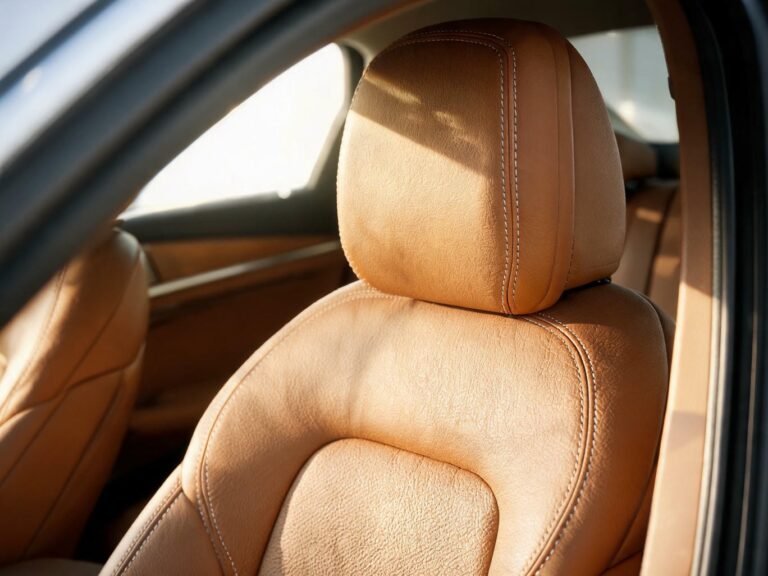
The EV interior revolution is softening cabins. Dashboard wrap areas have expanded 35–40% compared to ICE platforms, and seat designs now integrate heating, cooling, and haptic feedback layers directly into the upholstery. But more surface area means more validation risk. In our work with Tier-1 seating suppliers, we see the same three spec gaps delay Start of Production (SOP) on automotive leather upholstery programs: incomplete flame-test data, optimistic cold-crack ratings, and VOC emissions that creep upward at scale. Here is what the test reports actually say — and why silicone-coated alternatives are closing the gap.
Request Automotive Material Spec Sheet
FMVSS 302: The 60-Second Myth in Automotive Leather Upholstery
Federal Motor Vehicle Safety Standard (FMVSS) No. 302 mandates that interior materials self-extinguish within 60 seconds when exposed to a standardized flame source. Passing the bench test on face fabric alone, however, does not guarantee assembly-level compliance. Foam substrates, adhesives, and stitching threads can reignite in composite form, creating a liability exposure that OEMs no longer tolerate. Leading programs now require full composite testing aligned with SAE J369 protocols. Standard PU synthetics often need halogenated flame-retardant additives to pass — treatments that off-gas corrosive smoke and degrade adhesive bonds over thermal cycles. Silicone-coated automotive interior fabrics achieve inherent low flammability without halogenated chemistry, maintaining composite pass ratings even after repeated heat aging.

Composite fire testing ensures assembly-level compliance beyond face-fabric bench tests.
Cold-Crack Resistance: The −30°C Reality Check
PU synthetics marketed for automotive use often advertise cold-crack resistance down to −30°C. That rating typically comes from ISO 4675 static mandrel testing — a single bend under controlled conditions. Real vehicle seats flex thousands of times during cold starts, and door panel armrests vibrate at highway speeds. In dynamic flex testing, standard PU coatings frequently show micro-tearing at −15°C to −25°C. TPU backings improve performance modestly, but silicone maintains full flexibility down to −40°C without plasticizer migration or surface cracking. For silicone leather programs shipping into Nordic and North American markets, that margin is the difference between a pass and a warranty claim.

Dynamic flex testing reveals cold-crack failure modes that static mandrel tests miss.
VOC Emissions in Automotive Leather Upholstery: Cabin Air Limits
China GB/T 27630, German AgBB, and SAE J3077 all set progressively tighter limits on volatile organic compound (VOC) emissions from cabin materials. Leather tanning agents, dyestuffs, and adhesive solvents remain the largest contributors to total VOC (TVOC) in seat assemblies. As EV cabins become quieter, occupants notice residual odors more acutely, and OEMs have responded by demanding TVOC below 50 μg/m³ after 72-hour chamber conditioning. Many conventional synthetics test at 35–80 μg/m³ depending on batch chemistry. Silicone leather uses no solvent-based coatings; combined with water-based adhesives and low-VOC substrates, typical TVOC results fall below 10 μg/m³ — a margin that satisfies even the most stringent OEM air quality protocols.

Chamber testing for VOC emissions under GB/T 27630 and SAE J3077 protocols.
Automotive certification requirements for silicone leather in EV and ICE programs.
Silicone Leather: Closing the Spec Gap for EV Programs
Silicone leather addresses all three validation gaps within a single material platform. It passes FMVSS 302 composite testing without relying on flame-retardant additives that degrade over time. It maintains cold flexibility to −40°C under dynamic stress. And it delivers TVOC results below 10 μg/m³ straight from the line. For EV platforms where every gram matters, silicone coatings add less areal weight than multi-layer PVC constructions while permitting thinner, lighter substrates. The result is a seat assembly that drops mass without sacrificing safety, comfort, or compliance. In a recent PU and faux leather sourcing comparison, procurement teams noted that silicone alternatives reduced validation cycle time by roughly 30% because composite retests were rarely needed.

EV cabin designs demand lightweight upholstery that passes multi-parameter validation.
| Validation Parameter | PU Synthetic | Silicone-Coated Fabric |
|---|---|---|
| FMVSS 302 Composite | Borderline (needs additives) | Pass (inherent) |
| Cold-Crack (dynamic flex) | −15°C to −25°C | −40°C |
| TVOC (72h chamber) | 35 – 80 μg/m³ | < 10 μg/m³ |
| Areal Weight | 680 – 850 g/m² | 520 – 700 g/m² |
Source: TOPSUN internal validation data based on Tier-1 OEM test protocols. Individual results vary by substrate construction and adhesive system.
What to Request in Your Next Automotive Leather Upholstery RFP
Stop asking for “automotive grade” without defining the test regime. Request composite FMVSS 302 data with substrate and adhesive included, not just face-fabric results. Demand dynamic cold-crack verification at your program’s minimum operating temperature. Require 72-hour TVOC chamber reports with full chemical speciation. And ask for substrate bonding strength after thermal aging — a metric rarely quoted but critical for seat durability. These four data points separate qualified suppliers from traders. In 2026, the OEMs winning market share are the ones that specify precisely — not the ones that buy cheap and validate later. For programs sourced through fabric sourcing from China, precise specs are the only hedge against batch variability.

Precision lamination lines control coating weight and bonding consistency for automotive programs.
Schedule Tier-1 Material Validation
Frequently Asked Questions
Does silicone leather meet major OEM material specs?
Silicone leather has been qualified for multiple Tier-1 seating and trim programs. Specific OEM approvals depend on substrate selection, color stability, fogging performance, and long-term aging data. We recommend submitting samples for your target OEM’s material data sheet (MDS) review early in the program timeline. Our production lines support PPAP-level documentation and traceability.
Can silicone leather be perforated for ventilated seats?
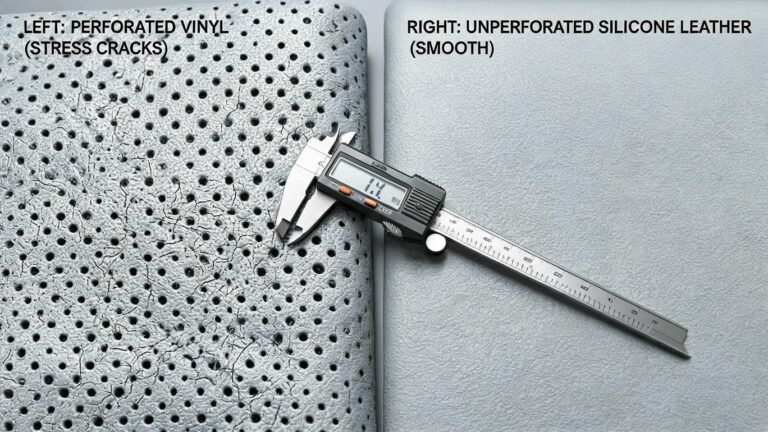
Yes. Silicone coatings maintain structural integrity after precision perforation and resist tearing at hole edges better than standard PU or PVC alternatives. That makes them ideal for ventilated, heated, and massaging seat applications where perforation density can exceed 4,000 holes per seat.
What is the typical lead time for automotive program development?
From color match to PPAP submission, typical lead time is 8–12 weeks for existing substrates. New substrate development — including custom bonding, aging validation, and OEM-specific fogging tests — extends to 16–20 weeks depending on test queue availability.
About TOPSUN
TOPSUN develops automotive leather upholstery materials for EV and ICE seating programs that must pass composite fire, cold-crack, and VOC validation before SOP.
Technical capabilities include FMVSS 302 composite testing, −40°C cold-crack verification, TVOC chamber testing, and custom substrate bonding for Tier-1 OEM supply chains.