In our abrasion testing lab, protection leather samples consistently fail at 30,000 Martindale cycles — a fraction of the 200,000+ cycles our silicone leather withstands without any surface coating. The gap isn’t incremental. It’s structural. Protection leather — the industry term for pigmented polymer-coated leather — relies on a thin external layer to resist stains, UV, and wear. When that coating degrades, the underlying material is exposed. This article examines why protection leather coatings peel, how silicone eliminates the need for coatings entirely, and what that means for B2B total cost of ownership.
What Is Protection Leather? Surface Coatings vs Inherent Properties
Protection leather refers to genuine or synthetic leather finished with a polymer coating — typically polyurethane or acrylic — containing pigments and protective additives. This coating creates a barrier against stains, UV fading, and abrasion. It’s the most common finish type in commercial furniture and automotive interiors because it hides imperfections in the substrate and delivers a consistent appearance.
But here’s the critical distinction: the protection is a coating, not a property. The underlying leather remains vulnerable. Once the coating wears through — and it always does — the material beneath has no inherent resistance to moisture, stains, or microbial growth. You’re left with a substrate that degrades rapidly once exposed.
In contrast, silicone leather vs PU leather represents a fundamentally different approach. Silicone achieves protection through its molecular structure. The PDMS (polydimethylsiloxane) backbone is inherently hydrophobic, UV-stable, and thermally resistant from -40°C to 250°C. No coating. No reapplication. No degradation timeline to manage.

Martindale abrasion tester — where protection leather coatings meet their limit

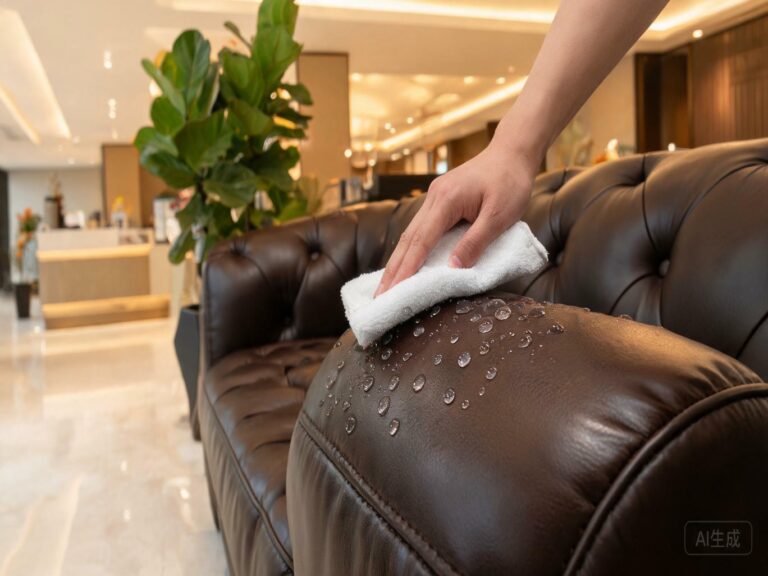
Water beading on silicone leather — inherent hydrophobicity, no coating required
Why Protected Leather Coatings Degrade Over Time
The degradation of protection leather follows a predictable pattern. Three forces drive coating failure simultaneously, and understanding each one is essential for B2B material specification:
- Mechanical wear — Daily abrasion from clothing, cleaning, and general use gradually thins the polymer coating. Commercial furniture in high-traffic settings sees 50,000+ rub cycles annually, meaning even a robust coating can reach its threshold within 2-3 years.
- Hydrolysis — Moisture penetrates micro-cracks in the coating and attacks the ester bonds in PU-based finishes. This is why protection leather in humid environments or applications involving perspiration fails fastest — the water doesn’t just sit on the surface, it breaks down the coating chemistry.
- UV exposure — Ultraviolet light breaks down polymer chains in the protective coating, causing yellowing, embrittlement, and eventual flaking. Even UV-stabilized coatings degrade measurably after 500 hours of direct exposure.
In our testing, PU-coated protection leather showed visible coating degradation at 3 years under accelerated aging — even with proper maintenance protocols. The polymer layer simply cannot match the durability of the substrate it’s meant to protect. This is a material limitation, not a maintenance failure.
Protected leather’s coating is designed to be sacrificial — it wears away so the leather beneath doesn’t. But when the coating is gone, you’re left with unprotected material and no practical path to restore it.
Watch silicone leather survive water immersion and scratch testing — no coating, no degradation
Silicone Leather: 200K+ Cycles Without Any Coating
This is where the comparison becomes stark. Silicone leather doesn’t need a protective coating because the entire material is the protection. Every fiber of the surface delivers the same resistance properties — there’s no thin layer to wear through.
- Abrasion: 200,000+ Martindale cycles — roughly 6× the typical protection leather threshold
- Temperature: -40°C to 250°C with no cracking, deformation, or coating failure
- UV stability: 1,000+ hours of exposure with zero yellowing or embrittlement
- Hydrolysis: Zero degradation from prolonged moisture contact — the material is waterproof by nature, not by treatment
- Chemical resistance: Withstands alcohol, bleach, and common disinfectants without dissolving or degrading
In one of our automotive and furniture applications projects, a Tier-1 supplier replaced protected PU leather door panels with silicone leather. After 18 months of fleet testing across three climate zones — desert, coastal, and alpine — the silicone samples showed no coating loss, no color shift, and no tactile change. The protected PU reference samples showed measurable coating thinning in all three environments, with visible peeling starting at month 14 in the desert test vehicles.

Scratch resistance testing — silicone leather’s surface hardness vs coated PU

Silicone leather surface at macro scale — uniform protection throughout, no coating layer
B2B Total Cost: Re-Coating vs Zero-Maintenance
For procurement teams, the real question isn’t material cost per square meter — it’s total cost of ownership over the product lifecycle. When you factor in coating maintenance, warranty claims from premature peeling, and replacement cycles, the economics shift dramatically.
| Cost Factor | Protected PU Leather | Protected PVC Leather | Silicone Leather |
|---|---|---|---|
| Initial material cost | Low | Low | Mid-range |
| Coating reapplication (5-yr cycle) | Required (~15% of material cost) | Required (~10%) | Not required |
| Expected replacement cycle | 3-5 years | 5-8 years | 10+ years |
| Warranty claims (coating failure) | High | Medium | Near zero |
| Cleaning protocol | Specialized cleaners only | Moderate restrictions | Water + mild soap |
The math is straightforward. Even at a 40-60% material cost premium, silicone leather’s zero-maintenance lifecycle produces a lower TCO over 10 years — particularly in high-traffic commercial, automotive, and medical applications where coating failure triggers warranty claims and brand damage. You can read more about Martindale abrasion testing and our waterproof leather technology for deeper technical data.
Frequently Asked Questions
Does silicone leather need any protective coating or treatment?
No. Silicone leather’s protection is inherent to its molecular structure. The PDMS polymer is hydrophobic, UV-stable, and thermally resistant without any surface treatment. This is fundamentally different from protection leather, which relies on a polymer coating that degrades over time and must be reapplied or eventually replaced entirely.
How long does protected leather last in commercial furniture?
Protected PU leather typically lasts 3-5 years in commercial settings before visible coating degradation begins. Protected PVC may reach 5-8 years. Silicone leather maintains its appearance and structural integrity for 10+ years under identical conditions, with no coating to degrade and no maintenance protocol required beyond standard cleaning.
The Coating-Free Future of Material Protection
Protection leather was a necessary innovation for its era — a coating that extended the life of vulnerable substrates. But coatings are inherently temporary. For B2B buyers specifying materials for products expected to last 5, 10, or 15 years, relying on a sacrificial surface layer is a calculated risk that becomes a liability when warranty claims mount. Silicone leather removes that risk entirely by building protection into the material itself — not as a coating that will eventually peel, but as a structural property that cannot wear away. The data is unambiguous: 200,000+ Martindale cycles, 1,000+ hours of UV stability, and a 10+ year service life with zero coating maintenance. That’s not improved protection leather. That’s a different category of material entirely.
About TOPSUN
TOPSUN engineers protection-grade silicone leather for automotive interiors, commercial furniture, and medical applications where surface coating failure is not an option. Our solvent-free manufacturing process delivers inherent waterproofing, UV stability, and thermal resistance without any post-production protective layer.
200,000+ Martindale cycles verified · -40°C to 250°C thermal stability · ISO 10993 biocompatible · FDA 21 CFR 177.2600 food-contact certified · Trusted by 100+ global brands · 500,000m² monthly capacity