Mycelium leather material generates headlines for cutting CO₂ emissions 94% below cowhide leather. That’s a genuine achievement — a European Commission report confirms the EU Green Claims Directive now requires third-party verification for exactly these sustainability claims. But B2B procurement teams face a harder question: can mycelium leather also survive 100,000 abrasion cycles, hold up under prolonged UV exposure, and ship at industrial scale? We compare mycelium leather material against silicone leather on the metrics that matter for sourcing decisions.
What Is Mycelium Leather Material? Structure and Manufacturing
Mycelium leather material is produced by growing fungal mycelium — the root-like vegetative structure of mushrooms — in controlled fermentation environments. The process takes 10-21 days, after which the mycelium sheet is harvested, pressed, tanned, and finished to create a leather-like substrate. Companies like MycoWorks and Ecovative have pioneered commercial-scale production, with Hermès, Adidas, and Kering all announcing partnerships.
Here’s the nuance that matters for B2B buyers: over 80% of commercial mycelium leather products use hybrid materials. A typical formulation combines 60-80% bio-base (mycelium) with 20-40% polymer binder or coating — usually PU or bio-based polyurethane. Pure mycelium sheets exist in laboratories and niche luxury products, but they haven’t reached industrial supply chains at meaningful volumes. This hybrid structure affects every performance metric we’ll examine next.

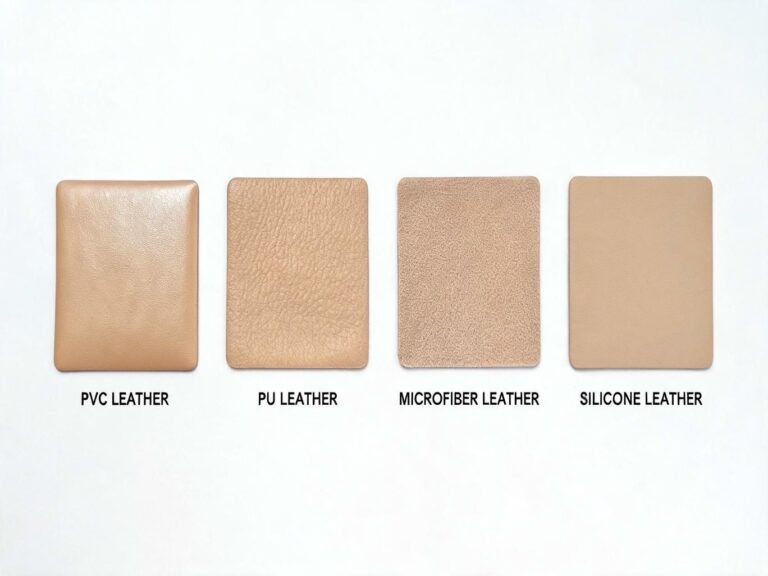
Natural warm tones achievable in bio-based and silicone leather materials
Durability Benchmarks: The Numbers Behind Marketing Claims
Performance data for mycelium leather material is improving rapidly, but it hasn’t closed the gap with mature synthetic alternatives. Let’s look at the verified numbers:
- Abrasion resistance — MycoWorks’ Reishi product claims up to 50,000 Martindale cycles. Industry minimums for commercial furniture start at 30,000. Silicone leather delivers 200,000+ cycles — four times the best mycelium benchmark.
- Tear strength — Mycelium leather achieves 3-30 N/mm depending on formulation and binder content. Silicone leather consistently exceeds 30 N/mm across all product lines.
- Hydrolysis resistance — Mycelium’s polymer binder (typically PU) remains susceptible to hydrolysis. Silicone is inherently hydrophobic with zero hydrolysis degradation.
- UV stability — Limited published data exists for mycelium leather UV performance. Silicone leather withstands 1,000+ hours with zero yellowing.
In our material comparison lab, we’ve tested bio-based materials alongside our eco-friendly silicone leather. The pattern is consistent: bio-based materials excel on carbon footprint but trail significantly on abrasion, chemical resistance, and long-term dimensional stability. For applications where the material must survive daily cleaning with disinfectants — medical, hospitality, public transit — that gap is decisive.

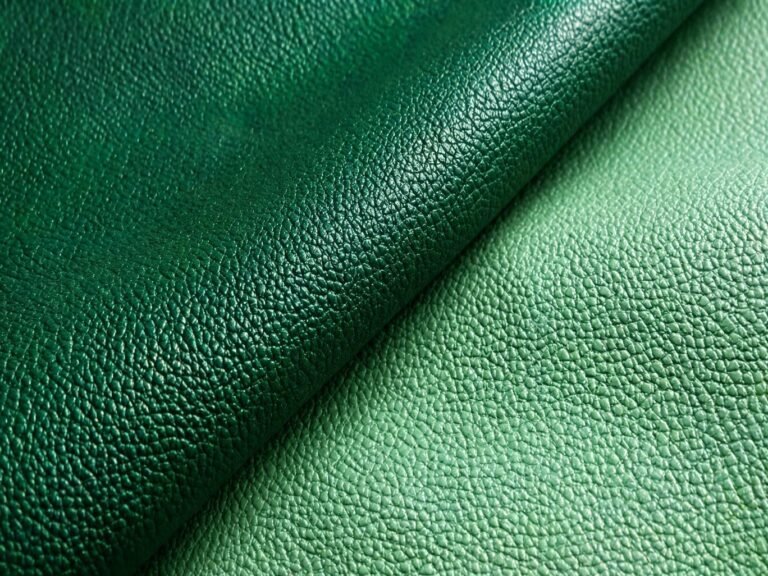
Tensile strength testing — where bio-based materials reveal their structural limits
Mycelium leather’s CO₂ advantage is real — 2.76 kg CO₂ eq/m² vs 45+ kg for cowhide. But B2B buyers must weigh carbon footprint against a 4× gap in abrasion performance and unverified long-term durability data.
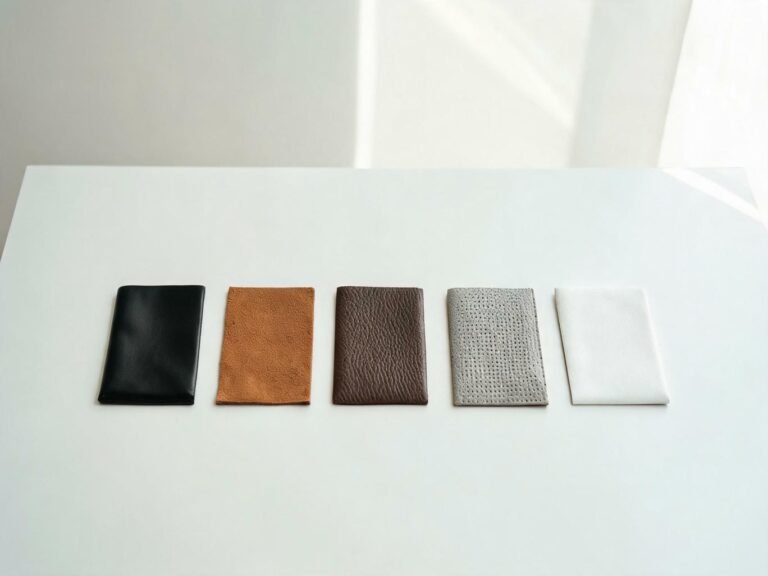
Material comparison overview — how silicone leather benchmarks against emerging bio-based alternatives
Cost and Supply Readiness for B2B Procurement
Current production costs for mycelium leather material range from USD 12-18 per square meter for raw material, compared to USD 8-14 for commodity bovine leather tanning. The gap is narrowing — mycelium sheet goods now sit at a 10-25% premium to PU/PVC, down from 20-40% in 2024. But raw material cost doesn’t capture the full B2B picture.
Supply chain maturity remains the bigger concern. Mycelium leather production is concentrated in a handful of facilities — MycoWorks announced a second EU plant for 2027, and Ecovative operates primarily from the US. For B2B buyers requiring 500,000m² monthly capacity, multi-year supply agreements, and consistent quality across batches, this concentration creates supply risk. One facility outage, one contamination event in fermentation, and your production line stops.
Silicone leather, by comparison, runs on established industrial coating lines with decades of process optimization. TOPSUN’s monthly capacity of 500,000m² across multiple production lines means supply continuity is engineered into the process, not dependent on biological fermentation cycles.

Plant-based leather in furniture applications — aesthetic appeal vs industrial durability
Mycelium Leather vs Silicone Leather: Head-to-Head
For procurement teams evaluating both materials for the same application, here’s how the verified data compares side by side:
| Property | Mycelium Leather | Silicone Leather | PU Leather |
|---|---|---|---|
| CO₂ footprint (kg/m²) | 2.76 | Low (solvent-free) | High (DMF solvents) |
| Martindale abrasion (cycles) | Up to 50,000 | 200,000+ | 10,000-30,000 |
| Temperature range | Limited data | -40°C to 250°C | Up to 80°C |
| Hydrolysis resistance | Depends on binder | Inherent, zero degradation | Poor (2-4 years) |
| Supply scale (m²/month) | Limited, concentrated | 500,000+ | Industrial scale |
| Biodegradable end-of-life | Yes (pure mycelium) | Recyclable, separable | No |
The comparison reveals a clear pattern: mycelium leather material leads on biodegradability and carbon footprint, while silicone vs PU leather comparison shows silicone dominates on durability, chemical resistance, and supply readiness. For most B2B applications, the durability gap is the deciding factor. You can also explore our detailed bio-based leather material analysis and leather vs silicone leather cost breakdown for deeper sourcing data.
Frequently Asked Questions
Is mycelium leather material fully biodegradable?
Pure mycelium sheets are biodegradable. However, over 80% of commercial mycelium leather products use hybrid formulations with 20-40% polymer binders (typically PU), which are not biodegradable. The EU Green Claims Directive now requires third-party verification for biodegradable and compostable claims, so buyers should request certification for the specific product formulation, not generic mycelium properties.
Can mycelium leather replace PU in automotive interiors?
Not yet at industrial scale. Mycelium leather’s abrasion resistance (up to 50,000 Martindale cycles) falls short of automotive interior requirements, which typically demand 100,000+ cycles for door panels and seating. Additionally, supply volume and batch consistency remain insufficient for Tier-1 automotive procurement. Silicone leather, with 200,000+ Martindale cycles and established industrial supply, is the proven alternative for automotive applications.
Bio-Based Potential vs Proven Performance
Mycelium leather material represents genuine innovation in sustainable material science. Its carbon footprint advantage is verified and significant. But for B2B procurement decisions in 2026, the material remains in an early commercialization phase — limited supply, hybrid formulations with polymer binders, and durability benchmarks that haven’t reached industrial thresholds. Silicone leather offers a different value proposition: proven 200,000+ Martindale cycles, 10+ year service life, zero-VOC manufacturing, and 500,000m² monthly capacity available today. For buyers who need both sustainability and industrial durability, silicone leather delivers both without compromise.
About TOPSUN
TOPSUN manufactures solvent-free silicone leather material for B2B buyers who need verified sustainability without sacrificing industrial durability. Our eco-friendly production process delivers zero-VOC, fully recyclable leather alternatives across automotive, furniture, medical, and consumer applications.
200,000+ Martindale cycles · Solvent-free dry coating · FDA & ISO 10993 certified · 100% recyclable · Trusted by 100+ global brands · 500,000m² monthly capacity