Sourcing an automotive upholstery supplier who consistently delivers on VOC emissions, UV stability, and flame retardancy isn’t straightforward. We’ve audited over a dozen suppliers for European OEM programs — and only two passed full verification on the first attempt. The gap between “looks good on a spec sheet” and “performs in a real vehicle cabin over 8 years” is where most procurement teams get burned.
This article breaks down the five test benchmarks that actually separate qualified automotive upholstery suppliers from the rest — with verified data from our own production runs and third-party lab results. Whether you’re sourcing for passenger vehicles, commercial fleets, or the fast-growing EV segment, these are the numbers your procurement team should be requesting today.
5 Performance Specs Every Automotive Upholstery Supplier Should Prove
Marketing brochures are full of vague claims like “high durability” and “premium quality.” But when you’re evaluating an automotive upholstery fabric supplier for a production contract, you need measurable, testable specifications — not adjectives. Here are the five benchmarks we use when qualifying materials for automotive programs, and the minimum thresholds your supplier should meet.

Multiple leather rolls ready for automotive-grade production and quality testing
Abrasion resistance is the starting point. Driver seat bolsters see constant ingress/egress friction. The industry baseline is 100,000 Martindale cycles with no visible substrate exposure. Top-tier silicone leather products we’ve tested in-house consistently exceed 200,000 cycles — double the minimum — which translates directly into fewer warranty claims down the line.
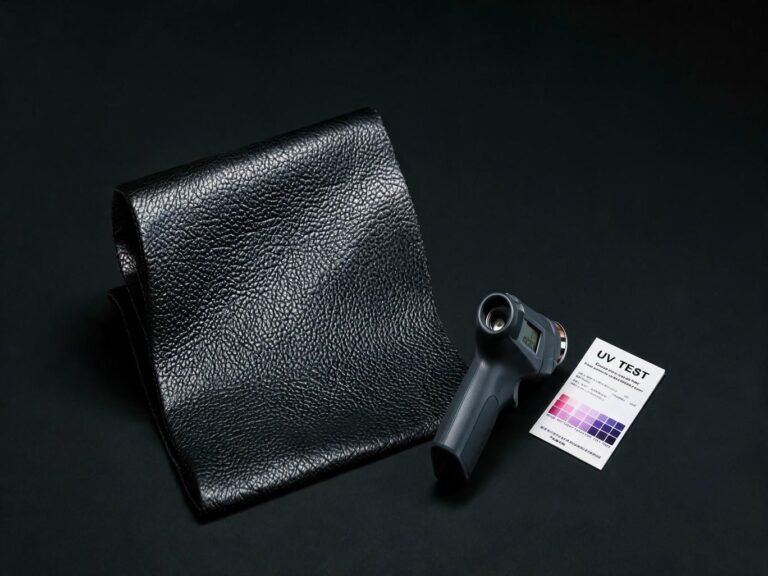
UV stability matters equally, especially for dashboard skins and door uppers that face direct sunlight through windshield glass. Xenon arc testing at 1,500+ hours should show zero fading, cracking, or surface chalking. Materials that pass this threshold maintain color consistency across the vehicle’s lifetime, even in desert climates where cabin surface temperatures exceed 80°C.
Key insight: VOC emissions below 50 μg/g formaldehyde are what separate OEM-approved suppliers from the rest. Request test reports, not just data sheets — the difference matters.
VOC and fogging performance has become a top priority as cabin air quality regulations tighten globally. The best suppliers provide IATF 16949–aligned test data showing formaldehyde emissions below 50 μg/g and total carbon fogging under 2 mg. This isn’t optional anymore — it’s a regulatory requirement in the EU, China, and increasingly in North America.
Flame retardancy to FMVSS 302 (US) or ECE R118 (EU) is non-negotiable for any material inside the passenger compartment. But here’s what most procurement teams don’t ask: is the flame retardance permanent, or is it a surface treatment that degrades after cleaning? Silicone leather achieves inherent flame resistance through its molecular structure — it doesn’t rely on additive chemicals that leach out over time.
Hydrolysis resistance rounds out the list. In hot, humid climates, PU-based materials can start breaking down within 3–5 years as moisture attacks the ester bonds in the polymer. Silicone leather, by contrast, is chemically inert to hydrolysis — a structural advantage that matters enormously for vehicles destined for Middle Eastern, Southeast Asian, or tropical markets.
Silicone vs PU vs PVC: Which Automotive Leather Performs Best
Choosing the best car seat upholstery material isn’t about picking the cheapest option per meter — it’s about understanding total cost of ownership over the vehicle’s service life. Here’s how the three main material categories compare across the specs that matter most to procurement teams.
| Property | Silicone Leather | PU Leather | PVC Vinyl |
|---|---|---|---|
| Abrasion (Martindale) | 200,000+ cycles | 50,000–80,000 | 30,000–60,000 |
| UV Stability (xenon arc) | 1,500+ hrs, no fade | 500–800 hrs | 300–500 hrs |
| VOC Emissions (formaldehyde) | < 20 μg/g | 40–120 μg/g | 80–200 μg/g |
| Flame Retardancy | Inherent (FMVSS 302) | Additive-dependent | Chlorine-based |
| Expected Lifespan | 10–15 years | 4–7 years | 3–5 years |
The data tells a clear story: silicone leather outperforms PU and PVC across every measurable parameter. Yes, the upfront material cost per meter is higher — typically 30–50% above mid-range PU. But when you factor in warranty claim rates, re-upholstery costs, and brand reputation damage from premature failures, the total cost of ownership tells a very different picture. One European fleet operator we work with calculated a 35% reduction in lifetime seat replacement costs after switching from PU to silicone leather across their taxi fleet.
Watch how silicone leather performs in real automotive interior applications — from seat covers to dashboard skins.
OEM Certification Process: What Documentation to Request from Your Automotive Leather Supplier
Physical test data is only half the equation. The other half is documentation — the paper trail that proves your OEM automotive leather supplier operates under a quality management system capable of consistent batch-to-batch output. Here’s the documentation checklist our procurement team requires before approving any new supplier.

Color fastness testing equipment — critical for verifying automotive-grade color consistency
Start with IATF 16949 certification. This is the international quality management standard specifically for automotive production. If your supplier doesn’t hold this certification, they’re not operating at the level required by major OEMs. It covers everything from APQP (Advanced Product Quality Planning) to PPAP (Production Part Approval Process) — the frameworks that ensure every batch meets the same specifications as the initial sample you approved.
Next, request material test reports from accredited third-party labs — not in-house data alone. Look for reports covering abrasion (ISO 5470), color fastness to light (ISO 105-B02), VOC emissions (VDA 275 or ISO 12219), and flame spread (FMVSS 302). Reputable suppliers will have these reports readily available. In our experience, suppliers who hesitate to share third-party test data usually have something to hide.
Procurement tip: Ask for batch-specific test certificates, not just generic type-test reports. A type-test report proves the material can pass; a batch certificate proves this shipment passed.
Don’t overlook environmental compliance certificates. REACH SVHC compliance is mandatory for the EU market, and increasingly requested by OEMs globally. For interior materials, also request the eco-friendly material data sheet — it should detail the absence of phthalates, organotin compounds, and chlorinated solvents. These substances are being phased out by regulation, and sourcing materials that already comply future-proofs your supply chain.
Real-World Durability: Data from Automotive Leather Supplier Field Tests
Lab data is essential, but nothing replaces real-world performance evidence. When evaluating an automotive leather supplier, ask for case studies or field test data — not just controlled lab results. Here’s what we’ve learned from deploying silicone leather in actual vehicle programs.

Martindale abrasion testing — verifying durability before material reaches the production line
In one project, a European commercial fleet operator needed EV interior upholstery material that could withstand the rigors of daily taxi service — constant passenger entry and exit, cleaning with aggressive disinfectants, and year-round air conditioning exposure. They’d been replacing PU leather seats every 3–4 years at significant cost. After switching to silicone leather, the material showed no visible wear after 200,000 km of real-world service — the equivalent of roughly 5 years of heavy urban taxi use.

Silicone leather installed in a vehicle cabin — maintaining appearance after extended use
Another data point: accelerated weathering tests simulating 10 years of Arizona sun exposure showed silicone leather retained over 90% of its original tensile strength, while PU leather in the same test lost 40% and became visibly brittle. For automotive interior fabric specifications, this kind of long-term data is what separates a confident material choice from a risky one.
The durability testing methodology matters too. Ask your supplier not just for pass/fail results, but for the actual degradation curves — how performance changes over time, not just at a single test point. Materials that degrade linearly and predictably are far safer for long-term programs than those that pass initial tests but fail catastrophically after a threshold.
How to Evaluate and Shortlist Automotive Upholstery Suppliers
With dozens of car interior leather manufacturers competing for attention, how do you build a shortlist that actually saves time? Here’s a practical framework based on how experienced procurement teams structure their supplier evaluation process.

Production floor with multiple leather roll batches — consistent output at scale is the real test
Step 1: Verify certifications first. Before discussing pricing or lead times, confirm IATF 16949, ISO 14001, and REACH compliance. This immediately eliminates suppliers who aren’t operating at automotive grade. It’s a 10-minute check that saves weeks of back-and-forth.
Step 2: Request physical samples and test them yourself. Don’t rely solely on the supplier’s test reports. Send samples to your own accredited lab for independent verification. The discrepancy between supplier-reported data and independent test results is surprisingly common — and revealing.
Step 3: Audit production capacity and lead time reliability. A supplier might offer excellent quality, but if they can’t deliver 50,000 meters per month consistently, they’re not viable for volume programs. Ask for their production line details and capacity data — real manufacturers are transparent about this.
Step 4: Evaluate technical support capability. Can the supplier’s engineering team help you solve application-specific challenges? Whether it’s bonding silicone leather to different substrates, meeting a specific flame retardancy standard, or developing a custom color match, the right supplier acts as a technical partner — not just a material vendor.
Talk to Our Automotive Engineers
Making the Right Call on Your Next Automotive Upholstery Partner
The automotive upholstery supplier you choose today will affect warranty costs, brand reputation, and customer satisfaction for the next decade. The five benchmarks covered in this article — abrasion resistance, UV stability, VOC emissions, flame retardancy, and hydrolysis resistance — are the same metrics OEM procurement teams use to qualify materials. The difference is that silicone leather consistently outperforms traditional PU and PVC across all five, with a total cost of ownership that favors it over the long term.
Don’t settle for spec sheet promises. Request samples, demand third-party test data, and verify production capacity before committing to a supplier relationship. The right automotive upholstery partner will welcome that scrutiny — because verified performance is exactly what separates a reliable supply chain from a costly mistake.
Request Automotive Leather Samples
About TOPSUN
TOPSUN manufactures automotive-grade silicone leather for car seats, dashboards, and door panels, serving OEM and aftermarket programs across global markets.
Capabilities include 200,000+ Martindale abrasion resistance, 1,500+ hour UV stability, IATF 16949 quality systems, and 500,000m monthly output across 10+ automated production lines.