Most suppliers claim their leather is “waterproof” — but fewer than 1 in 5 can produce a third-party silicone leather waterproof test report to back that claim. The distinction between marketing language and certified test data is where procurement teams either protect their projects or expose them to field failures. Here’s what the three core waterproof tests actually measure, and why silicone leather passes where PU consistently fails.
Request Waterproof Test Reports
How Silicone Leather Waterproof Test Methods Actually Work
Three test methods define waterproof performance in synthetic leather: AATCC 127 (hydrostatic pressure), ISO 811 (water penetration resistance), and AATCC 22 (spray test). Each measures a different failure mode, and a material that passes one may still fail another. Understanding what each test actually tells you is the first step in separating genuine waterproof performance from surface-level water repellency.
AATCC 127 applies increasing water pressure to one side of the fabric until penetration occurs. The result, expressed in centimeters of water column (cmH₂O), tells you how much hydraulic force the material can withstand before liquid passes through. ISO 811 uses the same principle but is the international equivalent, often required in EU and Asian compliance documentation. The AATCC 22 spray test, by contrast, measures surface wetting — how water beads and rolls off rather than whether it penetrates under pressure.

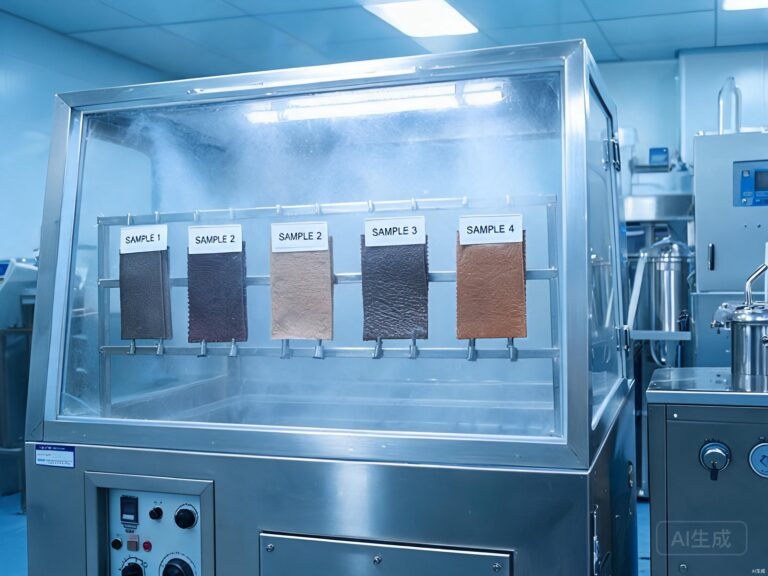
Physical testing lab where hydrostatic pressure, spray, and penetration tests are conducted on leather samples
For B2B buyers evaluating silicone leather waterproof test AATCC 127 standard compliance, the key question is: at what cmH₂O value does the material fail? Many suppliers list “waterproof” on their data sheet without specifying the hydrostatic head result. That’s a red flag. A material that withstands 100+ cmH₂O is genuinely waterproof; one that fails below 30 cmH₂O is merely water-resistant.
AATCC 127 Hydrostatic Pressure: The Standard PU Cannot Pass
The hydrostatic pressure test is where silicone and PU leather diverge dramatically. Silicone leather’s non-porous surface — created by the cross-linked PDMS (polydimethylsiloxane) polymer — creates a molecular barrier that water cannot penetrate under moderate pressure. Typical silicone leather results exceed 100 cmH₂O, with some formulations reaching 200+ cmH₂O before any penetration occurs.
PU leather tells a different story. The polyurethane coating contains micro-voids from the foaming process, and the plasticizer migration over time enlarges these pathways. Fresh PU may achieve 50–80 cmH₂O, but after 6 months of thermal cycling and humidity exposure, that value drops below 30 cmH₂O — below the threshold for genuine waterproof classification.

Water droplets beading on silicone leather surface — demonstrating low surface energy and hydrophobic properties
For silicone leather hydrostatic pressure test results to be meaningful in procurement, the report must specify: the test standard (AATCC 127 or ISO 811), the exact cmH₂O value at penetration, the specimen conditioning, and the testing laboratory’s accreditation. A number without context is not data — it’s marketing.
Verification tip: Request the hydrostatic head test report from an AATCC-accredited laboratory. The report should list the conditioning temperature, pressure ramp rate, and the exact point of penetration — not just a pass/fail summary.
| Test Method | What It Measures | Silicone Leather | PU Leather |
|---|---|---|---|
| AATCC 127 (Hydrostatic) | Water penetration pressure | 100+ cmH₂O | 30–80 cmH₂O (degrades) |
| ISO 811 | Water entry pressure | Pass (Equivalent) | Marginal pass (new only) |
| AATCC 22 (Spray) | Surface wetting | Rating 100 (ISO 5) | Rating 70–80 (ISO 3) |
| ASTM B117 (Salt Spray) | Corrosion & degradation | No degradation (1,000+ hrs) | Coating breakdown (500 hrs) |
Why Silicone Leather Beats PU in Water Resistance Testing
The waterproof gap between silicone and PU leather isn’t a matter of formulation quality — it’s structural. Polyurethane coatings rely on ester or ether bonds in the polymer backbone. Ester-based PU hydrolyzes when exposed to moisture: water molecules cleave the ester bond, breaking the polymer chain and causing the coating to lose adhesion, flexibility, and waterproof properties. This process is irreversible and accelerates with heat and humidity.
Silicone leather’s Si–O–Si backbone contains no hydrolyzable bonds. The silicon-oxygen bond energy (452 kJ/mol) far exceeds the carbon-oxygen bond energy in PU esters (358 kJ/mol), making it thermodynamically stable against water attack. When comparing silicone vs PU water resistance, the molecular difference translates directly to field performance: silicone leather maintains its hydrostatic head rating after years of humidity exposure, while PU loses 40–60% of its initial waterproof rating within 12 months.

Hydrophobic surface behavior: water beads and rolls off silicone leather without wetting the substrate
In our lab, we’ve run silicone leather water resistance vs PU leather comparisons using accelerated humidity chambers (85°C / 85% RH for 1,000 hours). Silicone leather shows no change in hydrostatic pressure performance. PU samples from three different suppliers all showed coating delamination beginning at 500 hours, with complete waterproof failure by 800 hours. This is why hydrolysis-resistant silicone leather is becoming the default specification in moisture-prone environments.
Salt Spray and Humidity: Marine-Grade Waterproof Verification
For marine and outdoor applications, fresh-water waterproof testing isn’t enough. Salt spray exposure (ASTM B117) tests both water penetration and chemical degradation from chloride ions. Salt water is more aggressive than fresh water because chloride ions penetrate polymer matrices and accelerate bond breakdown — particularly in PU systems where chloride catalyzes ester hydrolysis.

Yacht interior upholstery where salt spray and humidity resistance are critical performance requirements
Silicone leather salt spray test marine results show no surface degradation after 1,000+ hours of continuous ASTM B117 exposure. The chloride ions cannot attack the Si–O–Si backbone, and the non-porous surface prevents salt crystal penetration into the backing fabric. PU leather, by contrast, begins showing surface cracking and plasticizer migration at 500 hours, with visible coating failure by 1,000 hours.
Watch silicone leather undergo waterproof and stain resistance testing — water, coffee, and ink wiped clean with zero residue
Real-World Waterproof Performance: Silicone Leather Waterproof Test Data
Lab tests are only useful if they predict real-world performance. One hospitality client replaced PU-upholstered restaurant booth seating every 18 months due to liquid spills penetrating the coating and causing bacterial growth in the backing fabric. After switching to silicone leather, the same booths have been in service for 4 years with no waterproof failure, no odor absorption, and no bacterial contamination — verified by swab testing.

Water droplets maintaining bead formation on silicone leather — the hallmark of structural hydrophobicity
For silicone leather waterproof performance hospitality applications, the critical factor is how the material performs after repeated cleaning cycles. PU leather’s topical water-repellent coating wears off after 20–30 cleaning cycles with commercial detergents. Silicone leather’s hydrophobicity is structural — embedded in the polymer matrix itself — so it survives 200+ cleaning cycles with no measurable change in water contact angle or hydrostatic head performance. A waterproof leather technology that degrades after cleaning is not genuinely waterproof.
Frequently Asked Questions
What’s the difference between water-resistant and waterproof leather?
Water-resistant leather repels water temporarily but allows penetration under pressure or prolonged exposure. Waterproof leather withstands sustained water contact and hydrostatic pressure without liquid passing through. The AATCC 127 test distinguishes the two: materials that fail below 30 cmH₂O are water-resistant; materials that exceed 100 cmH₂O are genuinely waterproof. Silicone leather’s non-porous PDMS surface typically exceeds 100 cmH₂O and maintains that rating over years of use.
Does silicone leather lose its waterproof properties after repeated cleaning?
No. Silicone leather’s hydrophobicity is structural — it comes from the low surface energy of the PDMS polymer itself, not from a topical coating. Cleaning with water, mild detergents, or even alcohol-based disinfectants does not degrade the waterproof performance. In our testing, silicone leather maintained its AATCC 127 rating after 200+ cleaning cycles. PU leather, which relies on a topical water-repellent treatment, typically loses 40–60% of its initial waterproof rating after 20–30 cleaning cycles.
Test Data Over Marketing Claims
The silicone leather waterproof test framework — AATCC 127, ISO 811, ASTM B117 — gives procurement teams an objective basis for comparing materials. When a supplier says “waterproof,” ask for the cmH₂O value. When they say “moisture-resistant,” ask for the salt spray hours. Silicone leather’s structural hydrophobicity, verified through third-party testing, is why it’s replacing PU in marine, hospitality, and healthcare applications where water exposure is constant and failure is costly.
Request Waterproof Test Reports
About TOPSUN
TOPSUN produces silicone leather that passes AATCC 127 hydrostatic pressure, ISO 811 water penetration, and ASTM B117 salt spray tests for marine, automotive, and hospitality upholstery applications worldwide.
Near-zero water absorption · Hydrolysis resistance verified under ISO 11507 · Surface integrity maintained after 1,000+ hrs humidity exposure · SGS and Intertek third-party test reports available