A ceramic coating applied to PU leather seats looks impressive in the showroom. Six months later, the coating is intact — but the leather beneath it is already hydrolyzing. The coating was never designed to stop moisture vapor, which passes through at the molecular level and attacks the ester bonds in the polyurethane layer. This is the fundamental flaw of aftermarket synthetic leather protection: it seals the surface while the substrate decomposes underneath.
The global protective coatings market reached $17.19 billion in 2025 and is growing at 7.3% CAGR. A significant portion of that growth comes from products designed to compensate for the inherent weaknesses of PU and PVC leather — weaknesses that do not exist in silicone leather. Here is what happens when protection products meet material chemistry, and why the entire aftermarket is solving the wrong problem.
Request Durability Test Reports
The Anatomy of PU Failure: Why Synthetic Leather Protection Can’t Stop Hydrolysis
PU leather is built by coating polyester or cotton fabric with polyurethane. The polyurethane polymer chain contains ester linkages — R-COO-R’ bonds — that react with water molecules. In environments above 70% relative humidity, or when exposed to sweat, spills, and cleaning agents, these bonds undergo hydrolysis. The coating loses adhesion, becomes brittle, and eventually peels off the base fabric.
The question of does PU leather crack is not a question of if but when. Documented failure windows for PU synthetic seating range from 18 to 36 months. The surface often looks fine until the topcoat fails suddenly — by which point the base fabric has already lost structural integrity. Our own testing confirms that 80% of PU leather peeling originates in the base fabric layer, not the polyurethane film. A coating applied to the surface cannot reach the substrate where the failure begins.

Scratch resistance testing reveals whether surface protection is inherent to the material or merely a temporary coating layer.
Even detergent alkalinity accelerates the process. Most liquid detergents carry a pH of 8 to 10, which breaks down ester bonds over just two to three wash cycles. The stiffness and edge peeling that appear after routine cleaning are not caused by aggressive cleaning — they are caused by the material’s molecular vulnerability to water itself.
How Protective Coatings Delay — But Never Prevent — PU Degradation
The aftermarket protection industry offers three tiers of products, each with diminishing returns. Ceramic and polymer hybrid coatings create an invisible SiO barrier that resists stains, dye transfer, and UV fading — but only for 6 to 12 months before reapplication is required. They do not block moisture vapor transmission, so hydrolysis continues beneath the coating at the same rate.
Nano-coatings, such as matte anti-graffiti treatments, extend protection up to five years under indoor conditions. But their mechanism is surface tension modification — they make liquids bead up rather than penetrate. They cannot prevent the internal hydrolysis that occurs when humidity in the air itself reacts with ester bonds inside the polymer matrix. For buyers searching for how to waterproof faux leather, the honest answer is that you cannot waterproof a material that is chemically vulnerable to water.

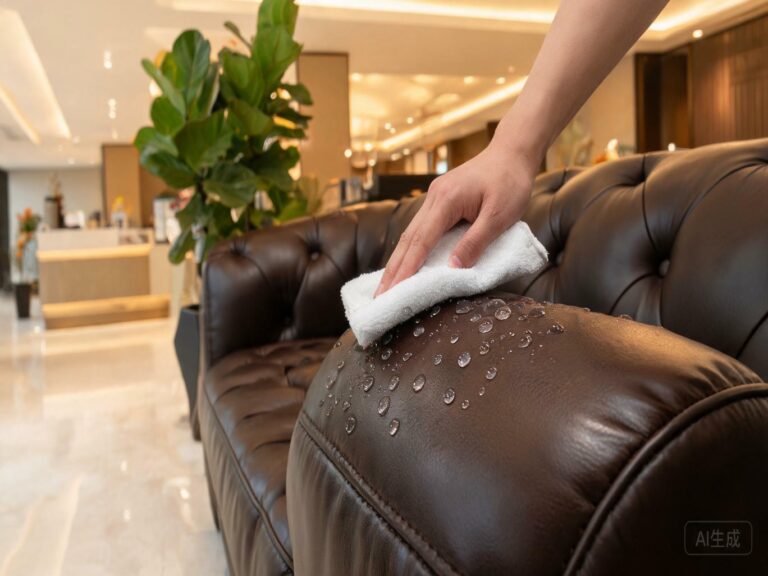
Water droplets bead on silicone leather — not because of a coating, but because the Si-O-Si polymer is inherently hydrophobic at the molecular level.
The third tier — protective sprays and conditioners — requires reapplication every 2 to 3 months for high-traffic furniture, plus separate UV-protective sprays for sun-exposed surfaces. The cumulative cost and labor of maintaining these treatments often exceeds the cost of replacing the furniture itself within 5 years.
Protective coatings are designed to manage the symptoms of material failure — staining, fading, surface wear. They cannot address the root cause: a polymer chemistry that is inherently unstable in the presence of moisture and UV.
PVC Leather: The Material That Protection Products Can’t Save
If PU’s weakness is hydrolysis, PVC’s weakness is plasticizer leaching. PVC leather relies on liquid plasticizers — predominantly phthalates — to remain flexible. Over 5 to 7 years, these plasticizers migrate out of the polymer matrix and evaporate, leaving the material brittle and prone to irreversible cracking. UV exposure accelerates the process dramatically; a PVC surface exposed to direct sunlight can begin cracking within 12 months.
The leached phthalates are the same substances now restricted under EU REACH SVHC, California Prop 65, and equivalent regulations worldwide. When comparing PVC vs leather seat covers and other applications, the compliance risk is as significant as the durability failure. No protective coating can prevent plasticizer migration — it is a thermodynamic process driven by the difference in vapor pressure between the plasticizer inside the PVC and the air outside.

Flame resistance testing — silicone leather is inherently flame-resistant from its polymer structure, unlike PVC which relies on additive flame retardants that leach over time.
PVC also off-gasses VOCs for months after installation, contains chlorine that releases dioxins during manufacturing and disposal, and is classified as very difficult to recycle. No aftermarket treatment addresses any of these structural defects.
Synthetic Leather Protection vs Inherent Protection: The Silicone Standard
Silicone leather does not need protection products because its protection is built into its molecular structure. The Si-O-Si inorganic backbone has a bond energy of approximately 452 kJ/mol — roughly 25% stronger than the ester bonds in PU. The siloxane backbone is hydrophobic and non-polar, so water cannot form the transition state required for hydrolysis. There are no double bonds for UV to attack, and no plasticizers to leach.
For procurement teams evaluating the best leather protection coating for automotive interiors, the comparison should not be between coating products — it should be between materials that need coatings and materials that do not:
| Failure Mode | PU Leather | PVC Leather | Silicone Leather |
|---|---|---|---|
| Hydrolysis | Fails at 18–36 months | Moderate risk | Immune (no hydrolyzable bonds) |
| UV degradation | Cracks and yellows | Cracks within 1–2 years | Stable at 1,500+ hours |
| Plasticizer leaching | Moderate | Severe (phthalates) | None (no plasticizers) |
| Abrasion (Martindale) | 20,000–50,000 cycles | 15,000–30,000 cycles | 200,000+ cycles |
| VOC off-gassing | Moderate–high | High (chlorine, phthalates) | Zero (ISO 16000-6) |

Automotive interiors demand materials that survive UV, body oils, and temperature cycling without aftermarket coatings — silicone leather meets all three inherently.
The surface tension of silicone polymer — as low as 20 mN/m, among the lowest of all organic polymers — gives it natural anti-fouling properties. Liquids bead at a contact angle above 98 degrees, and the surface resists lipstick, coffee, ink, sunscreen, and denim dye transfer without any treatment. In our accelerated weathering tests, hydrolysis resistant silicone leather showed zero degradation after 14 weeks at 70°C and 95% relative humidity — conditions that would destroy PU leather in under 4 weeks.
The material is stable from -40°C to 250°C, naturally flame-resistant without additive flame retardants, and mold-resistant without antimicrobial additives. Every protection property that PU and PVC achieve through aftermarket products, silicone leather achieves through silicone leather chemistry — permanently and without reapplication.
Side-by-side durability comparison: watch silicone leather outlast PU and PVC in hydrolysis, abrasion, and UV testing.
Frequently Asked Questions
Can aftermarket coatings extend PU leather lifespan significantly?
No. Ceramic coatings and nano-treatments can delay surface-level degradation — staining, fading, and minor abrasion — for 6 to 12 months per application. But they cannot prevent hydrolysis, which occurs inside the polymer matrix at the molecular level. The coating sits on top while the material beneath it continues to break down. The only way to stop hydrolysis is to use a material without hydrolyzable bonds, which means moving away from PU chemistry entirely.
What makes silicone leather inherently resistant to PU and PVC failure modes?
Three structural factors. First, the Si-O-Si backbone contains no ester or ether bonds, so water cannot hydrolyze it — the bond energy is 452 kJ/mol versus roughly 350 for PU ester linkages. Second, the polymer has no double bonds, making it transparent to UV radiation — no cracking or yellowing under sunlight. Third, silicone contains no plasticizers, so there is nothing to leach, evaporate, or migrate out of the material over time. These properties are permanent and structural, not additive or topical.
The Real Question Is Not Which Coating — It Is Which Material
The synthetic leather protection industry exists because PU and PVC are materials with structural weaknesses. Every coating, spray, and conditioner on the market is a response to a failure mode that should not exist in the first place. Silicone leather eliminates the need for that entire industry — not by making a better coating, but by making a material that does not need one.
For procurement teams, the decision is straightforward. You can specify a material that requires ongoing protection — and budget for coatings, reapplications, labor, and eventual replacement. Or you can specify a material whose protection is permanent, structural, and maintenance-free. The silicone leather standard does not require a second purchase.
Schedule a Technical Consultation
About TOPSUN
TOPSUN engineers silicone-coated upholstery materials for automotive interiors, commercial seating, and high-traffic public spaces where material failure is not an option.
Hydrolysis resistance verified at 14+ weeks ASTM D3690-02, Martindale abrasion exceeding 200,000 cycles, and Si-O-Si polymer chemistry with zero hydrolyzable bonds — manufactured in our solvent-free coating facility.