EU formaldehyde limits just tightened to 0.062 mg/m³, and if you are sourcing leather and textile materials for European markets, your current supplier list may not survive the next audit. The sustainable fabrics segment is growing at 14.7% CAGR — nearly triple the overall textile rate — yet most procurement teams still default to PU and PVC without questioning whether those materials will pass 2026 compliance checks. Here are five forces rewriting the rules, and why each one changes what you should specify on your next purchase order.
The EU Formaldehyde Rule Changes Leather and Textile Sourcing Overnight
Regulation (EU) 2023/1464, effective since December 2023, reclassifies formaldehyde as a Category 1B carcinogen under REACH Annex XVII. Furniture and indoor articles must now stay below 0.062 mg/m³ in emissions testing. For procurement teams specifying sustainable leather textile materials, this single rule shifts the entire supplier shortlist.
Here is what catches buyers off guard: PU and PVC coatings often rely on formaldehyde-based crosslinkers to bond the surface layer to the base fabric. When the new limit applies, these formulations fail — sometimes silently, sometimes catastrophically, depending on how your testing lab reports. Genuine leather tanned with certain aldehyde systems carries similar risk. In our own testing, TOPSUN’s silicone leather required zero reformulation to meet the 0.062 mg/m³ threshold, because the silicone polymer contains no formaldehyde releasers or crosslinkers at any stage of production. We have seen competitors scramble to reformulate PU coatings in response, with mixed success.

Physical testing lab where formaldehyde emission and VOC compliance are verified to EU 2023/1464 limits.
The European Commission tracks this shift under its TCLF ecosystem framework — Textiles, Leather and Fur industries — which integrates the new formaldehyde rule with broader chemical safety legislation. Buyers who ignore this framework risk importing non-compliant goods.
Genuine Leather vs Textile: What Procurement Teams Actually Need
The differences between leather and textile go well beyond aesthetics. For B2B sourcing, the real comparison rests on three axes: regulatory compliance, lifecycle cost, and supply chain resilience. The global leather market is projected to reach USD 311 billion by 2032 at 6.43% CAGR, while textiles trail closely at USD 2.41 trillion. But volume does not equal viability — not when compliance windows are narrowing.

Material specification sheets must now account for VOC emissions, recyclability, and certification status — not just texture and color.
A quick comparison of the four material families procurement teams evaluate most often:
| Material | VOC Emissions | Expected Lifespan | EU 2026 Compliant | Recyclable |
|---|---|---|---|---|
| Genuine Leather | Low–moderate | 5–10 years | Depends on tannage | Limited |
| PU Leather | Moderate–high | 2–5 years | Often fails | Difficult |
| PVC Leather | High | 3–5 years | Fails (phthalates) | Very difficult |
| Silicone Leather | Zero | 10–15+ years | Yes — no reformulation | Yes |
The pattern is clear: the materials buyers default to for cost reasons — PU and PVC — are the ones most likely to fail compliance checks. The material that passes every test, silicone leather, is the one most buyers have not yet evaluated.
Sustainable fabrics are growing at 14.7% CAGR — nearly 3x the overall textile rate. Procurement teams that wait to specify compliant materials will face shrinking supplier options and rising prices.
Why PU and PVC Quietly Fail Under 2026 Compliance Pressure
PU leather fails not from the surface down but from the bond up. The polyurethane coating contains ester linkages that react with moisture — a process called hydrolysis. In environments above 70% relative humidity, these bonds break down within 18 to 36 months. The surface looks fine until the topcoat separates from the backing, and by then the only fix is replacement. For a leather manufacturing B2B sourcing guide that actually protects the buyer, this failure mode should be the first spec on the checklist.

Solvent-free coating process flow — silicone leather production eliminates the chemical crosslinkers that cause PU and PVC compliance failures.
PVC has a different but equally terminal problem: plasticizer leaching. PVC relies on liquid plasticizers — many of them phthalates now restricted under REACH SVHC — to stay flexible. Over five to seven years, these plasticizers migrate out, leaving the material brittle, cracked, and non-compliant. UV exposure accelerates the process dramatically. A PVC chair left near a window can start cracking within 12 months.
Neither material is recyclable. Both generate VOC emissions during production and use. And both require aftermarket protective treatments that add cost without extending lifespan. When the silicone vs PU comparison is done honestly, the total cost of ownership gap is staggering — silicone leather costs $5–10/m²/year in maintenance versus $15–30 for genuine leather and even more for premature PU replacement cycles.
Silicone Leather Passes Every Leather and Textile Test Without Reformulation
The reason silicone leather passes where others fail comes down to chemistry. The Si–O–Si inorganic backbone contains no hydrolyzable bonds, no double bonds for UV to attack, and no plasticizers to leach. It is the same molecular family used in medical-grade seals and food-contact bakeware. For procurement teams evaluating leather fabric material for B2B buyers, this means the material’s compliance profile is structural, not additive.
The performance data backs this up:
- Martindale abrasion resistance: 200,000+ cycles (10x mid-grade genuine leather)
- Temperature tolerance: -40°C to 250°C with no cold-cracking or heat degradation
- VOC emissions: zero, verified by ISO 16000-6
- UV aging: 1,500+ hours xenon-arc with minimal color change (Grade 4+)
- Hydrolysis resistance: 14+ weeks at 70°C/95% RH, zero degradation
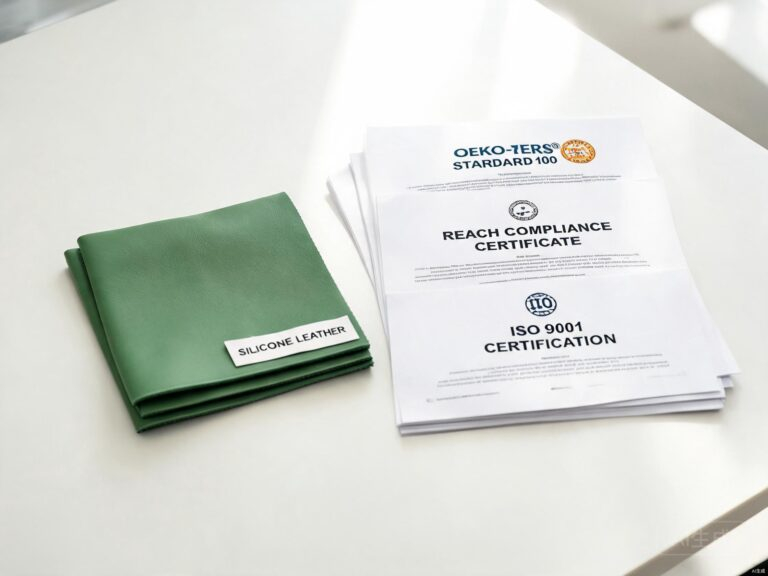
- Certifications: REACH, RoHS, FDA 21 CFR 177.2600, ISO 10993

Full color and texture range — silicone leather supports 100+ custom colors and textures without changing its compliance profile.
Watch how silicone leather outperforms PU and PVC in side-by-side material comparison testing.
For B2B buyers, this translates to a material that works across multiple application areas — automotive interiors, furniture upholstery, medical surfaces, children’s products — without re-specifying for each use case. One material, one compliance profile, one supplier relationship.

10-year total cost of ownership: silicone leather vs genuine leather vs PU leather.
Frequently Asked Questions
Is leather considered a textile material?
No. Leather is an animal-derived material composed of collagen fibers from treated hide, while textiles are woven or knitted from yarn or fiber. However, both fall under the TCLF (Textiles, Clothing, Leather, and Footwear) regulatory ecosystem, which is why EU compliance rules like the formaldehyde regulation apply to both categories simultaneously. For procurement purposes, treating them as a single compliance category is practical — and silicone leather, being a coated textile, bridges the gap between both worlds.
Can silicone leather replace both genuine leather and textile in upholstery?
In most commercial upholstery applications, yes. Silicone leather delivers the tactile quality and visual depth of genuine leather while using a textile substrate that provides dimensional stability. It meets or exceeds OEM abrasion, flammability, and VOC standards across automotive, furniture, and medical sectors. The main exception is applications requiring the specific breathability of woven textiles — in those cases, a silicone-coated breathable fabric may be specified instead.
The Leather and Textile Industry Is Splitting — Which Side Are You On?
The five forces — tightening formaldehyde rules, the 14.7% CAGR surge in sustainable fabrics, PU hydrolysis failures, PVC plasticizer leaching, and silicone leather’s structural compliance advantage — are not separate trends. They are the same shift viewed from different angles. The leather and textile supply chain is splitting into two camps: materials that need constant reformulation to chase moving regulatory targets, and materials that are compliant by design.
Procurement teams that specify silicone leather now are not just buying a material — they are buying regulatory peace of mind for the next decade. The question is whether your current supplier can say the same.
About TOPSUN
TOPSUN manufactures silicone-coated leather and textile materials for automotive interiors, furniture upholstery, and medical surfaces supplied to B2B clients across Europe and North America.
Zero-VOC formulation verified by ISO 16000-6, Martindale abrasion exceeding 200,000 cycles, and full REACH / RoHS / FDA compliance — with OEM/ODM customization spanning 100+ colors and textures from our in-house production line.