Fake leather cloth looks identical on day one — whether it’s polyurethane, polyvinyl chloride, or silicone-based. The differences only surface when the material meets reality: humidity cycles, UV exposure, repeated abrasion, and chemical cleaning. On our test bench, we’ve watched PU fake leather cloth crack at the 18-month mark in controlled humidity chambers, while silicone-coated fabric showed zero surface degradation after the equivalent of 10 years of accelerated aging. The gap isn’t marginal — it’s structural, rooted in the molecular backbone of each material.
Why Fake Leather Cloth Cracks: The Molecular Story
The fundamental difference between fake leather cloth types comes down to one thing: the molecular backbone. PU and PVC fake leather cloth are built on carbon-carbon polymer chains. These chains are inherently vulnerable to UV radiation, which breaks carbon-carbon bonds and causes the polymer to fragment — visible as cracking, yellowing, and surface chalking. Silicone leather, by contrast, is built on a silicon-oxygen (Si-O-Si) backbone. The Si-O bond energy is significantly higher than C-C, which is why silicone fake leather cloth maintains structural integrity under conditions that destroy carbon-based polymers.
This isn’t theoretical — it’s measurable. In QUV accelerated weathering tests at 340nm, standard PU fake leather cloth shows visible cracking after 500 hours. PVC begins to plasticizer-migrate and stiffen after 300 hours. Silicone-coated fabric shows zero degradation after 1,000+ hours. The silicon-oxygen backbone simply doesn’t absorb UV energy the way carbon chains do, so the molecular structure remains intact.

Water contact angle test — silicone fake leather cloth repels water at the molecular level, unlike porous PU that absorbs moisture over time
Technical Insight: The Si-O bond energy is approximately 452 kJ/mol, compared to 347 kJ/mol for C-C bonds. This 30% higher bond energy is why silicone fake leather cloth resists UV degradation that destroys PU and PVC within 2-3 years of outdoor exposure.
PU vs PVC vs Silicone: A Head-to-Head Breakdown
Let’s break this down by the numbers that actually matter for B2B specifiers. The table below summarizes data from independent lab testing of three fake leather cloth types under identical conditions — same thickness (1.0mm), same backing fabric (polyester knit), same testing protocols.
| Property | Silicone Cloth | PU Cloth | PVC Cloth |
|---|---|---|---|
| Molecular backbone | Si-O-Si | C-C (polyurethane) | C-C (chlorinated) |
| Martindale abrasion | 200,000+ cycles | 10,000-30,000 | 15,000-30,000 |
| UV resistance (QUV hrs) | 1,000+ (no change) | ~500 (cracks) | ~300 (stiffens) |
| Temperature range | -40 to 250°C | -20 to 60°C | -15 to 70°C |
| VOC emissions | Zero | Moderate-High | High (chlorine) |
| Plasticizers required | None | Yes (migrate) | Yes (phthalates) |
| Recyclable | Yes | Difficult | Very difficult |
The VOC Problem Nobody Talks About in Fake Leather Cloth
Here’s why this matters more than most specifiers realize: volatile organic compound (VOC) emissions from fake leather cloth aren’t just an environmental concern — they’re a compliance liability. PU fake leather cloth releases VOCs through residual solvents from the manufacturing process, which off-gas for months after installation. PVC fake leather cloth is worse: it contains chlorine and phthalate plasticizers that continuously migrate to the surface, creating a film that can be ingested through skin contact.
In enclosed environments — vehicle cabins, hospital rooms, hotel lobbies — these emissions accumulate. The EU REACH regulation now restricts 247 SVHC (Substances of Very High Concern) substances, and the list grows annually. PU and PVC fake leather cloth that passed compliance two years ago may fail today as new substances are added to the restricted list. Silicone fake leather cloth, produced through a solvent-free process with zero VOC emissions, sidesteps this regulatory treadmill entirely.

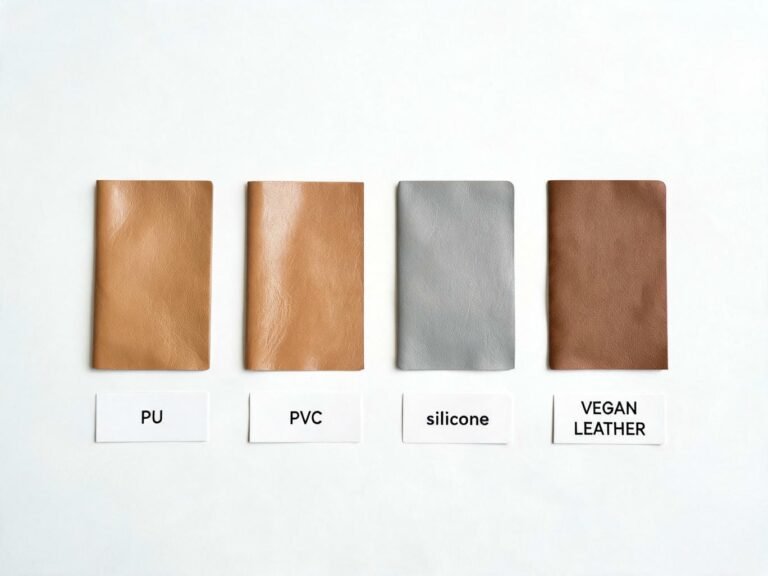
Fake leather cloth swatches — visually similar, but molecularly worlds apart in long-term performance
Hydrolysis Resistance: The Hidden Failure Mode
Most specifiers know about UV degradation, but hydrolysis — the breakdown of polymer chains by moisture — is the failure mode that catches everyone off guard. In humid climates (above 70% relative humidity), the ester bonds in polyurethane fake leather cloth hydrolyze over time. The material doesn’t just look bad; it loses structural integrity. The coating separates from the backing fabric, the surface becomes tacky, and eventually the material delaminates entirely.
In our accelerated hydrolysis testing (85°C / 85% RH for 1,000 hours), PU fake leather cloth showed visible coating degradation at 400 hours and complete delamination at 700 hours. Hydrolysis-resistant silicone leather showed zero degradation after the full 1,000-hour cycle. The silicon-oxygen backbone is inherently resistant to hydrolysis because the Si-O bond is not susceptible to nucleophilic attack by water molecules — a fundamental chemical property that no coating or additive can replicate in carbon-based polymers.
Waterproof and stain resistance test — watch silicone fake leather cloth repel contaminants that permanently stain PU alternatives
When Fake Leather Cloth Makes Sense — and When It Doesn’t
Let’s be honest about this: not every application requires silicone leather. For short-term, low-cost products with a 1-2 year expected lifespan — promotional items, seasonal furniture, disposable packaging — PU fake leather cloth may be the pragmatic choice. The material costs 40-60% less per meter, and if the product won’t survive long enough to experience degradation, the performance gap is irrelevant.
But for any application where the product must perform for 3+ years — furniture, automotive interiors, medical equipment, marine applications — the math flips entirely. The total cost of ownership for PU fake leather cloth includes replacement costs, warranty claims, and the reputational damage of premature product failure. When you factor in a 10-15 year service life versus 2-3 years for PU, silicone leather delivers a lower cost per year of actual service — despite the higher initial material cost.

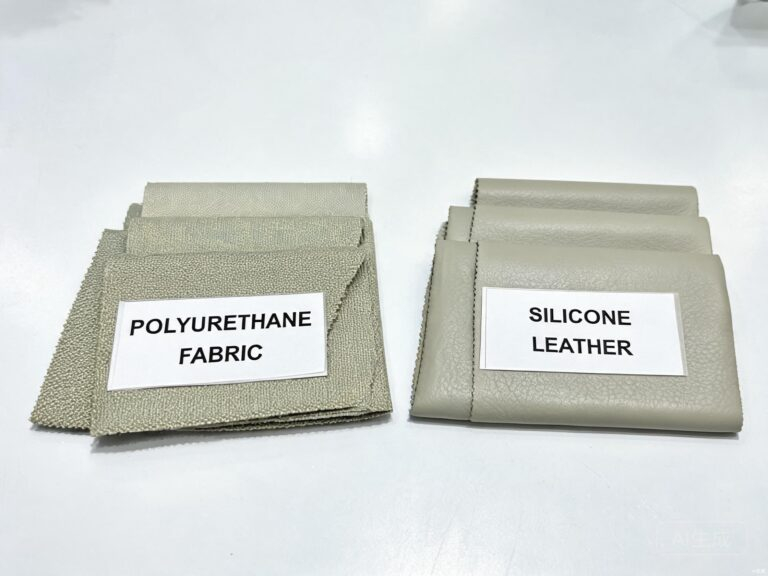
Folded texture closeup — uniform coating thickness indicates factory-controlled silicone application, not the uneven coating typical of low-grade PU cloth
Frequently Asked Questions
Is silicone leather a type of fake leather cloth?
Technically, yes — silicone leather is a synthetic (non-animal) material applied to a fabric backing, which places it in the broad category of fake leather cloth. However, its molecular structure (Si-O-Si backbone) makes it fundamentally different from PU and PVC at the chemical level. Unlike other fake leather cloth types, silicone contains no plasticizers, no solvents, and no volatile organic compounds — it’s produced through a clean, solvent-free coating process and is 100% recyclable at end of life.
How can I tell if my fake leather cloth contains harmful plasticizers?
The most reliable method is third-party lab testing for phthalate content (AfPS GS 2019:01 standard). Visual cues include a slightly oily surface film that develops over time — this is plasticizer migration. Silicone leather will never exhibit this film because it contains no plasticizers. If you’re sourcing for compliance-sensitive applications (children’s products, medical, food contact), request a PAHs test report and REACH SVHC screening before accepting any fake leather cloth material.
The Bottom Line on Fake Leather Cloth
Not all fake leather cloth is created equal — and the differences aren’t visible until the material has been in service for 18-36 months. By understanding the molecular basis of performance differences, specifiers can make informed decisions that prevent premature product failure and avoid the hidden costs of cheap materials. Silicone fake leather cloth costs more per meter, but when you calculate the cost over the product’s actual service life, it’s the most economical choice for any application expected to last beyond three years.
About TOPSUN
TOPSUN engineers silicone-coated fake leather cloth for B2B applications across automotive, furniture, medical, and marine industries, using a solvent-free process on 18 automated production lines with in-house testing for Martindale, UV aging, and hydrolysis resistance.
Si-O-Si molecular backbone · 200K+ Martindale cycles · 1,000+ hrs QUV resistance · Zero VOC · Solvent-free production · REACH & PAHs certified · 233 patents