Orange is the riskiest color in synthetic leather. That’s not an opinion — it’s pigment chemistry. Orange colorants, whether azo dyes or iron oxide pigments, absorb light in the blue-violet spectrum, which means they receive the highest energy photons and degrade fastest under UV exposure. We’ve seen orange faux leather chair cushions lose 30-40% of their color saturation within 18 months of placement near a sunlit window. For B2B buyers sourcing orange faux leather for furniture, hospitality, or retail fixtures, color fastness isn’t a secondary spec — it’s the primary procurement criterion.
This guide covers what buyers need to evaluate: UV color fastness testing standards, cost drivers for custom orange shades, commercial application fit, and how custom color silicone leather solves the fading problem that plagues conventional orange PU faux leather.
Request Orange Leather Sample Swatches
Why Orange Faux Leather Demands Special Attention
Most B2B buyers treat color selection as an aesthetic decision. For orange faux leather, it’s a engineering decision. The orange spectrum (Pantone 1505 through 165, RAL 2000 through 2013) spans warm tones that appeal to hospitality designers, retail brand managers, and furniture manufacturers targeting autumn collections. But the same molecular properties that produce vibrant orange also make it the most UV-vulnerable color in the synthetic leather palette.
The problem manifests differently depending on the base material. PU faux leather relies on surface-applied pigments in the polyurethane coating layer. When UV radiation breaks down the pigment molecules, the orange shifts toward a washed-out yellow-pink — a visual defect that cannot be reversed. PVC faux leather faces the same issue compounded by plasticizer migration, which distorts both color and surface texture. Silicone leather avoids this failure mode because the silicone polymer matrix is inherently UV-stable, protecting embedded pigments from photodegradation.

Orange leather swatch range — color fastness testing should be mandatory before approving any orange shade for commercial deployment
Color Fastness Testing for Orange Faux Leather
Before approving any orange faux leather for production, require the following test data from your supplier. These tests quantify the color stability that visual inspection alone cannot predict:
| Test | Standard | Pass Criteria | PU Faux Leather | Silicone Leather |
|---|---|---|---|---|
| Light Fastness | ISO 105-B02 | Grade 4 minimum | Grade 2-3 (fades) | Grade 4-5 (stable) |
| Xenon Arc UV | ISO 4892-2 | 1,000+ hours | 300-500 hrs (degrades) | 1,500+ hrs (stable) |
| Rubbing Fastness | ISO 105-X12 | Grade 4 minimum | Grade 3-4 (variable) | Grade 4-5 (stable) |
| Perspiration | ISO 105-E04 | Grade 4 minimum | Grade 3 (bleeds) | Grade 4-5 (stable) |
| Color Migration | ISO 105-X10 | Grade 4 minimum | Grade 3 (transfers) | Grade 4-5 (no transfer) |

Color matching process — orange shades require Pantone/RAL reference standards and spectrophotometer verification at Delta E ≤ 1.0
Orange Faux Leather Cost Factors
The cost of orange faux leather is driven by three factors that buyers should understand before negotiating price:
- Pigment cost: Orange pigments — particularly high-performance quinacridone oranges and DPP oranges — cost 2-4x more per kilogram than carbon black or titanium white. This pigment premium directly affects material cost per meter, especially for deeply saturated orange shades.
- Color matching labor: Custom orange shades require more formulation iterations than neutral colors because the human eye is highly sensitive to orange shifts. Expect 3-5 color lab rounds versus 1-2 for grays or blacks. Each round adds 2-3 days to the development timeline.
- Batch consistency difficulty: Orange is the color most prone to visible batch-to-batch variation because even small pigment concentration changes produce noticeable shifts. Suppliers must maintain tighter process control (±0.5% pigment loading) to achieve Delta E ≤ 1.0, which increases production cost.
- Minimum order quantity impact: Because orange is a non-stock color for most suppliers, custom runs typically require 500-1,000 meter minimums. This locks up working capital for buyers who only need 100-200 meters for a specific project.
- UV stabilizer addition: Premium orange faux leather formulations include UV stabilizers (HALS — hindered amine light stabilizers) to extend color life. These additives add 5-10% to material cost but are essential for any application with sun exposure.

Lychee texture orange leather — surface embossing can help mask minor color variation but does not prevent UV fading
Orange Faux Leather in Commercial Applications
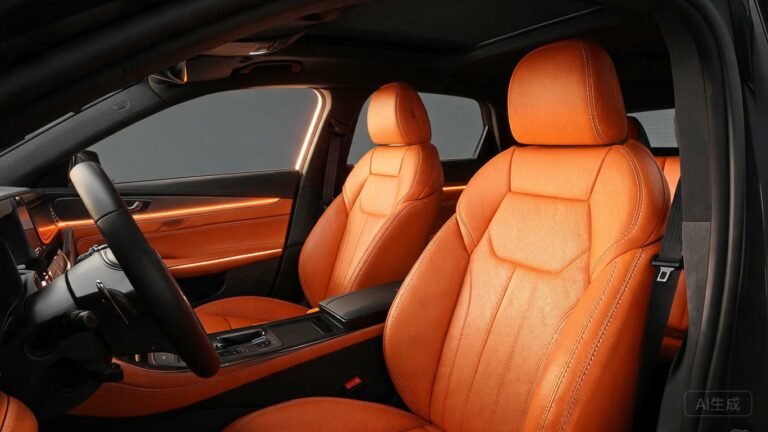
Orange faux leather finds its strongest commercial demand in hospitality interiors, retail environments, and event furniture — spaces where bold color statements drive brand identity. Hotel lobbies use orange accent chairs to create warmth and visual energy. Restaurant booths in orange tones stimulate appetite per color psychology research. Retail display furniture uses orange to draw attention to featured products. In all these scenarios, the color must remain vibrant for the duration of the furnishing contract — typically 5-7 years for hospitality and 3-5 years for retail.
The gap between expectation and reality is where orange faux leather fails. A hotel that specified vibrant orange PU faux leather for lobby seating discovers, 18 months later, that sun-exposed chairs have faded to a muted salmon while shaded chairs retain their original color. The resulting patchwork appearance undermines the design intent and triggers premature replacement. For furniture applications requiring color longevity, silicone leather’s inherent UV stability eliminates this failure mode entirely — the orange shade you approve at sampling remains the orange shade your client sees in year five.
Silicone Leather: Superior Orange Color Stability
The technical reason silicone leather outperforms PU in orange color stability comes down to polymer chemistry. Polyurethane’s urethane bonds are susceptible to UV-initiated photo-oxidation, which breaks down both the polymer matrix and embedded pigments. Silicone (PDMS — polydimethylsiloxane) contains Si-O bonds that are inherently UV-transparent and chemically inert, meaning the polymer doesn’t degrade under UV exposure and the pigments embedded within it remain protected.
For B2B buyers specifying orange faux leather, this translates to three procurement advantages: First, color fastness grade 4-5 is achievable without UV stabilizer additives, reducing material cost. Second, batch-to-batch consistency is higher because the silicone coating process operates at lower temperatures than PU curing, reducing pigment thermal degradation. Third, the 10-15 year lifespan of silicone leather means the orange shade maintains its original appearance for the full contract duration, eliminating the replacement cycles that make orange PU faux leather more expensive in total cost of ownership despite lower upfront pricing. For buyers exploring custom orange shades, our custom leather texture design capabilities and color manufacturing options provide additional specification guidance.

Full color swatch rack — orange shades should be tested alongside adjacent colors to verify no pigment migration occurs in multi-color assemblies
Does orange faux leather fade in sunlight?
Yes, orange faux leather — particularly PU-based formulations — is prone to UV fading. Orange pigments have lower light fastness than darker colors like black or navy, typically achieving grade 2-3 on the ISO 105-B02 scale. Silicone leather achieves grade 4-5 for orange shades due to the UV-stable silicone polymer matrix, maintaining color integrity after 1,500+ hours of xenon arc exposure. For any application with direct or indirect sun exposure, specify minimum light fastness grade 4 and request xenon arc test data from your supplier.
What is the minimum order quantity for custom orange faux leather?
For custom orange color matching (Pantone or RAL), typical minimum order quantities range from 500-1,000 meters depending on the supplier. Color sample development takes 5-7 working days, with mass production requiring 7-15 days. Suppliers with in-house color labs can often accommodate smaller sample runs of 50-100 meters for prototype development before committing to full production volumes. Always request a physical color swatch approval before mass production begins — digital color approvals are unreliable for orange shades due to monitor calibration variations.
Get Custom Orange Leather Quote
About TOPSUN
TOPSUN produces silicone leather with industry-leading color stability for orange and other high-risk pigment formulations. Our in-house color laboratory performs Pantone and RAL matching with Delta E ≤ 1.0 accuracy, supported by spectrophotometer verification on every production batch. Orange silicone leather from our facility achieves light fastness grade 4-5 (ISO 105-B02) and passes 1,500+ hours of xenon arc UV testing without detectable color shift. We maintain 90+ standard colors across basic, light, and dark series, with custom orange shade development available in 5-7 working days. Every shipment includes color fastness certificates, UV test data, and physical reference swatches for quality control at the buyer’s cutting table.
Related reading: Light leather color guide · Leather fabric buyer guide · Eco-friendly silicone leather