When Upholstery Fades, Balance Sheets Bleed
When a hotel chain replaces 500 sofa units after just 18 months because the upholstery faded from deep navy to washed-out grey, the procurement team learns a hard lesson: color fastness isn’t a line item on a spec sheet. It’s a measurable predictor of replacement cycles. In our testing lab, we’ve watched silicone leather color fastness test samples maintain Grade 4+ ratings after 2,000+ hours of xenon arc exposure, while conventional PU leather starts showing visible degradation at roughly 400 hours. The difference comes down to molecular structure — and it’s the reason procurement teams are rewriting their material specifications.
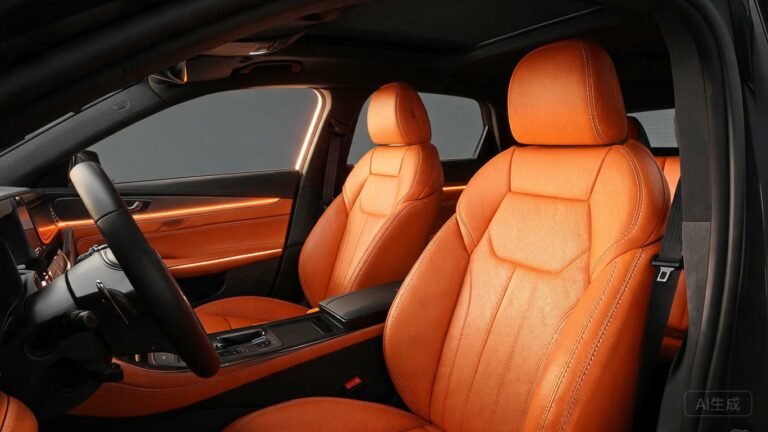
Color fastness determines whether a deep burgundy automotive interior still looks burgundy after five summers, or whether a marine cockpit cushion stays true to its original shade after seasons of salt spray and UV bombardment. For B2B buyers specifying materials for products with 5-10 year lifecycles, understanding the silicone leather color fastness test landscape isn’t optional. It’s due diligence.
What Is Color Fastness in Leather Materials?
Color fastness describes a material’s ability to retain its original color when exposed to environmental stressors — light, friction, moisture, perspiration, and chemical agents. The concept originated in textile testing but applies equally to synthetic leather, where pigments are embedded in or coated onto a polymer matrix. When that matrix degrades, pigments migrate, oxidize, or wash out, and the surface color shifts.
For synthetic leather specifically, four color fastness categories matter most in procurement specifications:
- Light fastness — resistance to fading under UV and visible light exposure (the dominant failure mode for automotive and outdoor applications)
- Crocking fastness — resistance to color transfer when rubbed against another surface (critical for furniture and apparel)
- Wash fastness — resistance to color loss during cleaning cycles (relevant for medical and hospitality environments)
- Perspiration fastness — resistance to color change from human sweat contact (important for seating, wearables, and athletic equipment)
Each category is independently tested and graded. A material can score Grade 5 in crocking but Grade 2 in light fastness — which is exactly what happens with budget PU leather that feels fine to the touch but fades within months of sun exposure. Color fastness standards for synthetic leather are not a single number; they’re a profile.

Color fastness testing equipment at TOPSUN’s factory laboratory — xenon arc and crocking test apparatus.
Key Color Fastness Test Standards: AATCC vs ISO
Two organizations dominate color fastness testing: the American Association of Textile Chemists and Colorists (AATCC) and the International Organization for Standardization (ISO). Their standards overlap in principle but differ in procedure and grading references. A silicone leather color fastness test report typically references both systems, depending on the target market.
AATCC TM16 covers colorfastness to light, with three sub-methods: 16.1 (outdoor sunlight exposure), 16.2 (carbon-arc lamp), and 16.3 (xenon-arc lamp, the most common for synthetic leather). The test exposes samples to controlled light irradiance alongside blue wool reference standards, then grades the result on a 1-5 scale where 5 means no change and 1 means severe fading.
ISO 105-B02 is the international equivalent, also using a xenon arc fading lamp but grading on a 1-8 scale using ISO blue wool references. AATCC and ISO blue wool standards are not directly interchangeable — an ISO Grade 4 does not equal an AATCC Grade 4. Buyers comparing suppliers across regions need to verify which standard was used.

Physical testing laboratory at TOPSUN — multi-station equipment for abrasion, flexing, and color fastness evaluation.
For crocking, AATCC Test Method 8 uses a crockmeter to rub a white cotton square against the leather surface under fixed pressure, then grades color transfer on a 1-5 grey scale. ISO 105-X16 covers the same principle for small-area specimens. AATCC 61 and ISO 105-C06 handle washing fastness through accelerated laundering cycles. The grey scale for color change and the grey scale for staining are the two visual reference tools used across all these tests.
How Silicone Leather Achieves Grade 4+ Color Fastness
The reason silicone leather consistently outperforms PU and PVC in color fastness tests isn’t a better surface coating or a UV-stabilizer additive. It’s the molecular backbone. Silicone polymers are built on Si-O-Si (silicon-oxygen) bonds, which carry significantly higher bond energy than the C-C (carbon-carbon) bonds in polyurethane. Higher bond energy means more energy is required to break the molecular chain — and UV radiation at typical earth-surface wavelengths simply doesn’t deliver enough energy to cleave Si-O bonds.
In our testing, TOPSUN’s High Performance Collection achieves UV resistance Grade 4+ after 1,000 hours of xenon arc exposure, and our Marine grade maintains Grade 4+ through 2,000+ hours. For context, Grade 4 means “slight change” — visible only under controlled comparison against an unexposed reference. Grade 5 means “no change.”
Beyond UV stability, the silicone matrix also resists thermal degradation across a -40°C to 250°C range, meaning pigments stay locked in the polymer network through temperature cycles that would accelerate migration and fading in conventional materials. Our custom color silicone leather achieves ≥4 levels for both washing fastness and light fastness, verified through independent third-party laboratory testing.

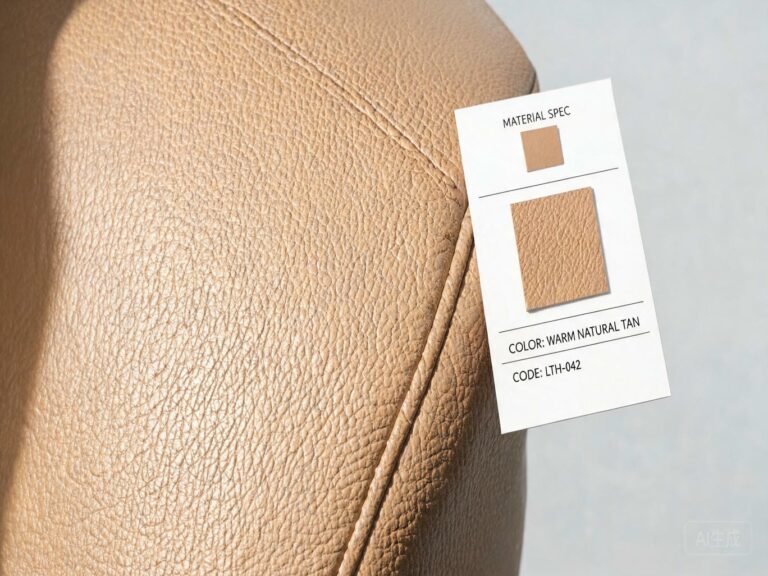
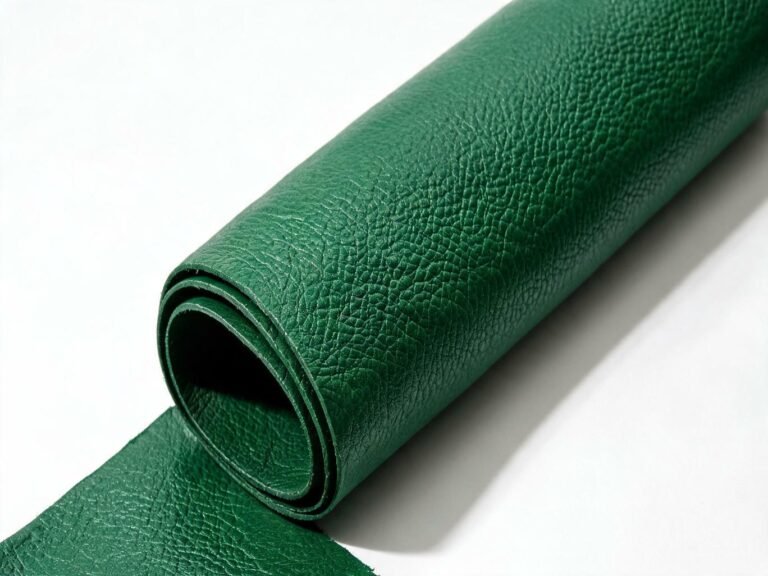
TOPSUN color swatch library — each color formulation is validated for Grade 4+ light and washing fastness before production approval.
Silicone Leather vs PU Leather: Color Fading Comparison
The most common question we hear from procurement teams: “How much better is silicone leather, really?” The answer depends on the test, but the gap is wider than most buyers expect. Here’s how the two materials compare under standardized testing conditions:
| Test Standard | What It Measures | Grading Scale | Silicone Leather | PU Leather (Typical) |
|---|---|---|---|---|
| AATCC 16.3 (Xenon Arc) | Light fastness | 1-5 (5=best) | Grade 4+ (2000h+) | Grade 3 (400h) |
| AATCC 8 (Crocking) | Color transfer (dry) | 1-5 (5=best) | Grade 4-5 | Grade 3-4 |
| AATCC 61 (Washing) | Wash fastness | 1-5 (5=best) | Grade 4+ | Grade 3 |
| ISO 105-B02 (Xenon) | Light fastness (ISO) | 1-8 (8=best) | Grade 6-7 | Grade 4 |
Table: Color fastness comparison based on TOPSUN internal test data and industry-typical PU leather values. Actual PU performance varies by formulation and quality grade.
The practical implication: in a tropical climate with high UV index, PU leather upholstery typically shows noticeable fading within 1-2 years. Silicone leather maintains color stability for 10+ years under the same conditions — confirmed through both accelerated xenon arc testing and real-world deployment in marine and outdoor applications.

Marine-grade leather undergoing combined UV and salt-spray testing — simulating years of outdoor exposure in weeks.
How to Read a Color Fastness Test Report
A supplier hands you a test report. It lists “AATCC 16.3: Grade 4.” What does that actually tell you? Here’s what to check:
- Which sub-method was used? 16.1 (outdoor) and 16.3 (xenon arc) produce different results. Xenon arc is the industry standard for synthetic leather — if the report says 16.1, ask why.
- What was the exposure duration? Grade 4 at 100 hours is not the same as Grade 4 at 2,000 hours. Always check the test duration, not just the grade. A material rated Grade 4 after 40 hours of exposure may drop to Grade 2 by 400 hours.
- Which blue wool references were used? AATCC uses L2-L9 references; ISO uses 1-8. If the report mixes systems, the grading may not be directly comparable across suppliers.
- Was the test third-party verified? In-house testing is a starting point, but independent laboratory verification (SGS, TUV, Intertek) carries more weight in procurement decisions.
- What color was tested? Dark colors (navy, black, deep red) typically show fading more visibly than light colors. A Grade 4 on a pastel sample doesn’t guarantee the same grade on a dark navy formulation.
In our experience working with automotive OEMs and hospitality groups, the single most valuable specification is “Grade 4+ at 1,000+ hours xenon arc, third-party verified, per AATCC 16.3.” That one line eliminates 80% of materials that will fail in real-world deployment. For more on how silicone leather compares to PU across all performance dimensions — not just color fastness — our technical comparison page provides the full parameter breakdown.

TOPSUN’s color swatch display wall — every color undergoes color fastness validation before entering the production catalog.
FAQ: Color Fastness Testing for Silicone Leather
What color fastness grade is acceptable for outdoor applications?
For outdoor and marine applications, specify Grade 4 or higher on the AATCC 1-5 scale (equivalent to ISO Grade 6+), verified at a minimum of 1,000 hours of xenon arc exposure. Grade 3 materials will show visible fading within 12-18 months of continuous outdoor use. Grade 5 is ideal but rare in pigmented synthetic materials — Grade 4+ is the practical industry target for premium outdoor specifications.
How long does silicone leather retain its color under direct sunlight?
Based on accelerated xenon arc testing (2,000+ hours at Grade 4+) and real-world deployments in tropical climates, TOPSUN silicone leather maintains color stability for 10+ years under direct sunlight exposure. The Si-O-Si molecular backbone resists UV-induced chain scission, which is the primary mechanism of pigment degradation in polymer-based materials. For applications in extreme UV environments, we recommend our Marine grade, which includes enhanced UV-stable pigment formulations.
About TOPSUN
TOPSUN manufactures silicone leather engineered for color stability across automotive, marine, furniture, and medical applications. Our testing capabilities include AATCC 16 light fastness, AATCC 8 crocking, and ISO 105-B02 xenon arc exposure, with Grade 4+ results across our High Performance and Marine collections. Every custom color formulation is validated for washing fastness and light fastness before entering production — and we provide third-party test reports with every batch shipment. Learn more about TOPSUN.
Stop Guessing. Start Specifying.
Color fastness is the difference between a 2-year replacement cycle and a 10-year investment. If you’re specifying materials for products that will see sunlight, friction, or repeated cleaning, don’t settle for a spec sheet that says “good UV resistance” without the test data to back it up. Request our color fastness test reports, compare the numbers, and specify with confidence.
Request Color Fastness Test Reports
Related reading: faux leather durability testing results and silicone leather cleaning and maintenance guide.