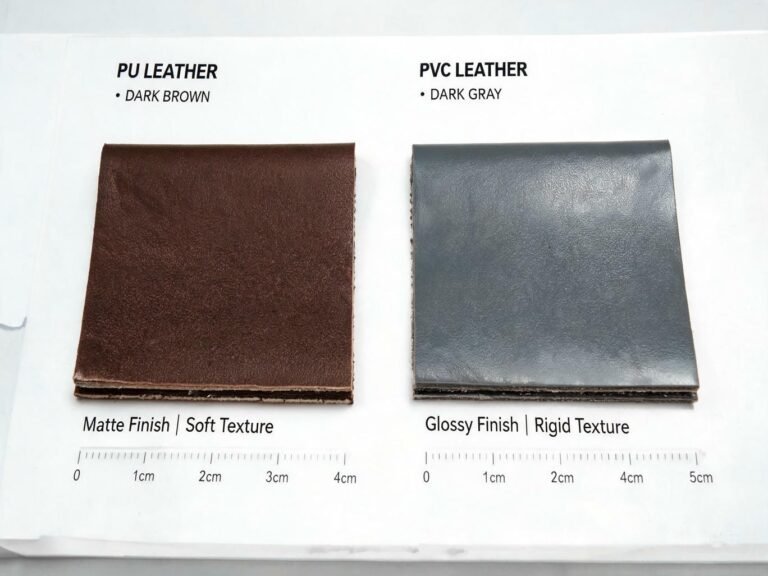
When a European electronics brand asked me to diagnose why their speaker grilles were delaminating after just eight months, I peeled back the surface layer and found the answer in the film itself — a PVC leather film that had embrittled under cyclic humidity. The same product, re-specified with a silicone leather film, is now entering its third production year with zero field returns. That contrast isn’t anecdotal; it’s a pattern I see across every B2B project where thin leather films are involved.
Leather Films: What Changes When You Switch from PVC to Silicone
The performance gap between traditional PVC or PU leather films and silicone-based alternatives is not marginal — it’s structural. PVC films rely on plasticizers to achieve flexibility, and those plasticizers migrate out over time, especially under heat and UV exposure. PU films improve on flexibility but remain vulnerable to hydrolysis in humid environments. Silicone leather films cross-link at the molecular level without plasticizers, delivering stable performance across temperature swings from -40°C to 200°C.
For procurement teams, this means the material you specify at the film level directly determines warranty exposure, replacement cycles, and downstream complaint rates. A side-by-side comparison makes the procurement impact unmistakable. For a deeper chemistry breakdown, see our silicone vs PU comparison guide.
| Property | PVC Film | PU Film | Silicone Film | Procurement Impact |
|---|---|---|---|---|
| Hydrolysis resistance | Poor (cracks in 6–12 months) | Moderate (2–3 years) | Excellent (10+ years) | Longer warranty cycles |
| UV color fastness | Grade 2–3 | Grade 3–4 | Grade 5 | Fewer replacement claims |
| Temperature range | -10°C to 80°C | -20°C to 120°C | -40°C to 200°C | Broader application scope |
| Thickness tolerance | ±0.15 mm | ±0.10 mm | ±0.05 mm | Lower die-cut reject rate |
| Plasticizer content | 20–40% | 0–5% | 0% | No surface tack migration |
| Peel strength (aged) | 1.5–2.0 N/cm | 2.5–3.0 N/cm | 3.5+ N/cm | Structural bond reliability |

Silicone leather lamination line — the bonding stage where film and substrate become a single engineered composite.
The data tells one story, but factory behavior tells another. I once oversaw a lamination trial where three PVC film samples from different suppliers showed thickness variances of ±0.15 mm across a single roll — enough to cause die-cutting rejects. The silicone film sample held ±0.05 mm, and our reject rate dropped from 6% to under 1% on the same tooling. That’s the kind of contrast that changes how you structure supplier qualification.
Thin-Gauge Tolerance and Lamination Bond Strength
Thin-gauge leather films — anything below 0.6 mm — are where most specification failures originate. The problem isn’t the film alone; it’s the interface between film and substrate. PVC films bonded with solvent-based adhesives can delaminate when the adhesive itself degrades. Silicone films, laminated with compatible silicone adhesives or heat-activated bonding, maintain peel strength above 3.5 N/cm even after 500 hours of accelerated aging per ASTM International test protocols.

Release film roller controlling surface texture during the leather film coating process.
In our lamination line, we control four variables that determine bond integrity: roller temperature (±2°C), line pressure (±0.5 bar), dwell time, and substrate tension. A deviation in any one shifts the peel strength curve. I’ve watched buyers specify a film grade without matching it to a lamination process, then blame the material when edges curl. The film and the bonding method must be engineered as a system, not sourced separately. Learn more about our factory production process.
Where Traditional Leather Films Fail Under Real-World Stress
Three failure modes account for the majority of field returns I investigate: hydrolytic cracking, UV-driven color shift, and plasticizer migration causing surface tack. PVC leather films hit all three. PU films address tack but still hydrolyze. Silicone leather films are inherently hydrolysis-resistant, UV-stable to Grade 5, and contain zero plasticizers — eliminating the root cause of tack entirely.
When I benchmark cost-per-year rather than cost-per-meter, the picture inverts. A PVC film at $4.50/m² that needs replacement every 18 months costs more over a five-year product life than a silicone film at $12.00/m² that lasts the full warranty period. Procurement teams that evaluate only unit price consistently underestimate total cost of ownership for thin-gauge leather films.

Material structure comparison — the internal architecture that explains why different leather films age differently.
A medical equipment manufacturer approached us after their PU film upholstery cracked within 14 months of autoclave cycling. We supplied a 0.7 mm silicone leather film with a polyester fabric backing. After 18 months and over 1,200 sterilization cycles, the surface showed no cracking, no discoloration, and no measurable peel-strength loss. The buyer has since converted three additional product lines to the same specification. For more test data, see our faux leather sheet performance analysis.
Side-by-side material comparison: silicone leather film vs traditional PVC and PU films under identical stress tests.
Specification Checklist for Custom Leather Film Production
When you issue an RFQ for leather films, these are the parameters I recommend locking down before any sample is cut. Vague specifications invite substitutions that look identical on a swatch but fail differently in service.
- Total thickness and tolerance band (e.g., 0.5 mm ±0.05 mm)
- Substrate type and weight (knit, woven, nonwoven; g/m²)
- Surface texture and release paper specification
- Peel strength minimum after accelerated aging
- Abrasion resistance threshold (Martindale cycles or Taber)
- Hydrolysis resistance test method and pass criterion
- Color fastness grade (light, rubbing, perspiration)
- Certifications required (REACH, RoHS, OEKO-TEX, FDA food contact)

Precision coating rollers applying the silicone film layer — gap tolerance directly determines thickness consistency.
Missing any of these creates ambiguity that suppliers will fill with their cheapest default. I’ve reviewed spec sheets where “thickness: 0.6 mm” appeared with no tolerance — and the delivered product ranged from 0.48 to 0.72 mm. Our die-cut leather tolerance guide covers this in detail. For coating ratio implications, the full vs semi-silicone guide is also essential reading.
About TOPSUN: Thin-Film Production Capabilities
TOPSUN operates a dedicated thin-film silicone leather production line engineered for B2B buyers who need precision-controlled leather films at scale. Our coating and lamination equipment maintains thickness tolerances of ±0.05 mm across roll widths up to 1,500 mm, with in-line metrology checking every 20 meters. We support custom substrate pairings — from lightweight knits for 3C electronics to heavy-duty nonwovens for transit seating — and offer full traceability from silicone compounding through final slitting. Quality benchmarks are verified against ISO standards at every production stage.
Whether you’re specifying a 0.4 mm overlay for consumer electronics or a 1.2 mm upholstery film for transit seating, the principle is the same: the material chemistry of your leather films will outlast every other variable in your product. Choose the chemistry that fails last — not the one that costs least on day one.