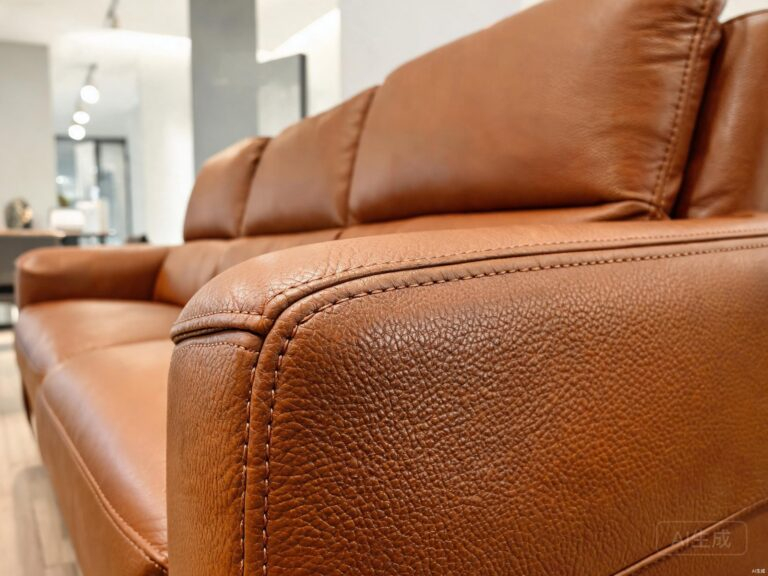
A facilities manager walks through a law firm’s conference room and notices the armrests on the eight-year-old leather chairs. The full-grain leather on the seat backs still looks rich. The top-grain panels on the armrests are cracking at the edges where elbows rest during every meeting. Same supplier, same purchase order, two different grades of real leather fabric for upholstery — and only one is aging well.
That gap between grade expectations and field performance is where most upholstery sourcing decisions go wrong. Buyers specify “genuine leather” and assume the phrase guarantees quality. It does not. This guide decodes the grade hierarchy that separates a 15-year surface from a 3-year surface, identifies the testing priorities that spec sheets routinely omit, and maps the maintenance reality that turns a premium material into a hidden cost center. For sourcing teams evaluating furniture sofa applications, these are the benchmarks that matter after the warranty expires.
Request Upholstery Material Samples
Real Leather Fabric for Upholstery: The Grade Hierarchy Decoded
The phrase “real leather” tells you the material came from an animal hide. It tells you nothing about which part of the hide, how it was tanned, or how long it will survive daily contact. The real leather fabric grades for upholstery follow a strict hierarchy based on which layer of the hide is used — and that layer determines everything from tear strength to aging behavior.
Here is what each grade actually means for upholstery performance:
- Full-grain leather — the outermost layer of the hide with the natural grain intact. No sanding, no correction. The densest fiber structure delivers the highest tear strength and develops a patina rather than wearing through. This is the grade that lasts 15+ years in commercial upholstery — and the grade the law firm’s seat backs were made from.
- Top-grain leather — the outer layer sanded or buffed to remove imperfections, then finished with a protective coating. Softer and more uniform in appearance than full-grain, but the sanding removes the densest fibers. The coating wears over time, exposing the less durable substrate underneath. This is the grade that cracked on the armrests.
- Split leather — the lower layers of the hide after the top grain is removed. Looser fiber structure, lower tear strength, typically given a heavy embossed finish to simulate grain. Used on hidden upholstery areas (sides, backs) where contact is minimal.
- Bonded leather — leather fibers bonded with polyurethane or latex binder. Contains 10–90% leather fiber but has none of the structural properties of a hide. Cracks, peels, and delaminates within 2–4 years. Some suppliers market it as “genuine leather” — technically true, functionally misleading.

Classic leather swatch rack — visual comparison of grades reveals texture and density differences invisible on a spec sheet
The price spread between these grades is dramatic — and it maps directly to lifespan. Understanding this hierarchy is the first quality benchmark. The second is knowing how to verify which grade a supplier actually delivered.
| Grade | Hide Source | Typical Thickness | Durability Rating | Price Range (USD/yd) |
|---|---|---|---|---|
| Full-grain | Outer hide, uncorrected | 1.2–2.0 mm | 15+ years | $25–55 |
| Top-grain | Outer hide, corrected | 1.0–1.5 mm | 5–8 years | $15–35 |
| Split | Lower hide layers | 0.8–1.2 mm | 3–5 years | $8–18 |
| Bonded | Fiber scraps + binder | 0.6–1.0 mm | 2–4 years | $3–8 |
Testing Priorities: What Lab Reports Miss About Daily Use
A leather upholstery spec sheet typically reports Martindale abrasion, tear strength, and colorfastness. These are valid metrics — for day one. What they do not capture is how the material behaves after 500 hours of UV exposure, 200 cleaning cycles, or three years of body heat and perspiration. For buyers who need to identify genuine leather upholstery quality beyond the certificate, the testing priorities should extend to long-term performance indicators.
The tests that actually predict field failure:
- Flex fatigue (Bally flexometer, ISO 5402) — simulates the repeated bending that occurs when someone sits and stands. Full-grain leather typically withstands 50,000+ flex cycles; top-grain begins showing surface cracks at 15,000–25,000 cycles. This test predicts armrest and seat-edge cracking — the failure mode the law firm experienced.
- Accelerated UV aging (ISO 105-B02) — measures color shift and surface embrittlement after simulated sunlight exposure. Real leather finishes fade at different rates depending on the dye type and topcoat chemistry. A material that passes Grade 4 colorfastness on day one may drop to Grade 2 after 200 hours of UV.
- Perspiration resistance (ISO 11641) — body contact degrades leather finishes through salt and acid exposure. This test predicts staining and coating breakdown on seating surfaces — the most common complaint in commercial upholstery.
- Coating adhesion (ASTM D751) — measures the force required to separate the finish from the leather substrate. Low adhesion values predict peeling, especially at stress points where the leather stretches during use.

Abrasion resistance tester — the standard Martindale test that every spec sheet reports, but only one piece of the performance puzzle

Tensile strength testing — measures the force required to rupture the leather, a key indicator of hide quality and grade integrity
The ASTM International standards provide the testing framework, but few suppliers volunteer long-term aging data. Buyers should request flex fatigue and UV aging results alongside the standard abrasion numbers — and walk away from suppliers who cannot produce them.
The Maintenance Reality Behind Real Leather Upholstery
Here is the cost that never appears on a purchase order: conditioning. Real leather is a natural material that loses moisture over time. Without periodic application of leather conditioner — typically every 6 to 12 months for commercial upholstery — the hide dries, loses flexibility, and begins to crack at stress points. The real leather upholstery maintenance cost compounds over the material’s lifespan and often exceeds the original material price.
In our experience working with furniture buyers who track lifecycle costs, the maintenance burden breaks down as follows:
- Conditioning products — $8–15 per bottle, applied 2x per year per seating unit. For a 200-chair conference center, that is $3,200–6,000 annually in conditioner alone.
- Labor for application — 15–20 minutes per unit, performed by facilities staff or contracted service. At $25/hour, that adds $1,500–3,000 per year for the same 200 units.
- Specialized cleaning — real leather requires pH-neutral cleaners. Standard commercial disinfectants and alcohol-based sanitizers strip the protective finish, accelerating coating failure.
- Repair and reupholstery — cracked or torn panels require professional leather repair ($75–150 per panel) or full reupholstery ($200–500 per unit). These costs typically appear in years 4–7 for top-grain, years 8–12 for full-grain.

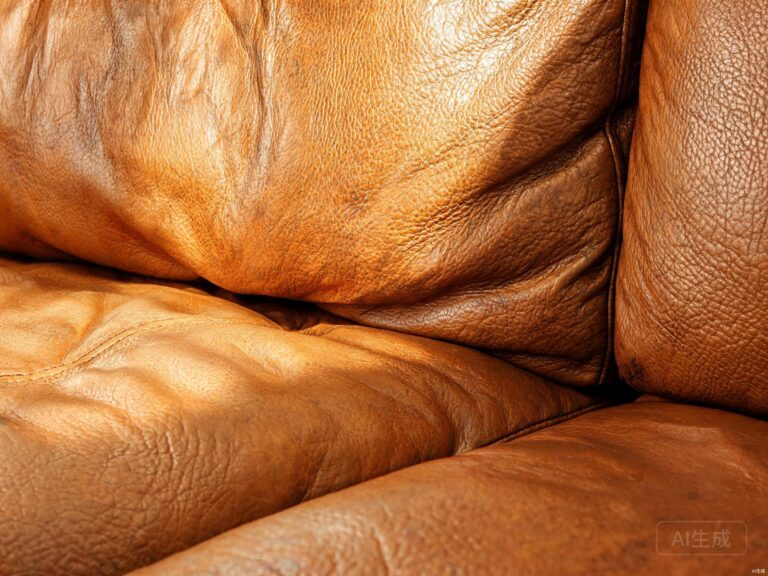
Genuine leather texture closeup — the natural grain that requires ongoing conditioning to prevent drying and cracking
Field observation: One of our clients — a corporate facilities team managing 1,200 leather conference chairs — tracked $14,000 in annual maintenance costs (conditioner, labor, and minor repairs) for top-grain upholstery. When they switched to silicone leather for a renovation pilot, those costs dropped to zero. The cleaning and maintenance guide for silicone leather requires only standard soap and water — no conditioners, no specialized cleaners, no annual treatment cycle.
Talk to Our Material Engineers
Sourcing Real Leather Fabric for Upholstery: Custom Production Paths
Custom real leather fabric for upholstery sourcing involves three specification layers that determine final quality — and most buyers only specify one. Getting all three right is the difference between a material that performs and a material that disappoints.
The three specification layers for custom real leather upholstery sourcing:
- Hide origin — cattle breed, climate, and diet affect hide density and fiber structure. European hides (German, French) generally offer tighter grain patterns; South American hides tend to be larger but with more variable density. Specify the origin, not just “cowhide.”
- Tanning method — chrome tanning produces soft, pliable leather suitable for upholstery but raises environmental concerns (hexavalent chromium). Vegetable tanning is environmentally cleaner but produces stiffer leather less suitable for seating. Semi-chrome tanning splits the difference. The Leather Working Group rates tanneries on environmental performance — look for gold or silver ratings.
- Finishing specification — pigment-coated finishes offer color consistency and UV resistance but sacrifice breathability and the natural patina. Aniline finishes preserve the natural surface but stain easily and fade faster. Semi-aniline strikes a balance. Specify the finish type explicitly, with reference samples.

Physical testing laboratory — where hide quality, tanning consistency, and finishing adhesion are verified before production approval
A critical sourcing risk is grade substitution — when a supplier delivers top-grain or split leather labeled as full-grain. This happens more often than the industry admits, especially in custom orders where the buyer cannot easily verify the grade without laboratory testing. Always request a cross-section micrograph (available from any materials testing lab for $50–100) that shows the fiber density pattern. Full-grain leather has a dense, interlocking fiber network at the surface that is visually distinct from the looser structure of split leather.
For more on the broader leather sourcing landscape, our faux vs real leather comparison covers the cost-performance tradeoffs across material types.
When Real Leather Meets Silicone: A Practical Comparison
The question is not whether real leather is superior to synthetic alternatives. It is whether the specific performance advantages of real leather justify the maintenance cost, supply variability, and ethical sourcing complexity that come with it. The real leather vs silicone leather upholstery comparison reveals where each material earns its place.
Real leather wins on three attributes that synthetics struggle to replicate:
- Breathability — the natural pore structure of animal hide allows moisture vapor transmission that no synthetic coating fully matches. This matters most in direct skin-contact applications.
- Patina development — full-grain leather ages beautifully, developing a character-rich surface that synthetic materials cannot replicate. For heritage and luxury applications, this is a genuine differentiator.
- Tactile uniqueness — no two hides are identical. For bespoke and artisanal products, this natural variation is a feature, not a defect.

Real vs synthetic leather comparison — the visual and tactile differences that drive material selection in upholstery applications
Silicone leather wins on five attributes where real leather creates operational friction:
- Zero maintenance — no conditioning, no specialized cleaners, no annual treatment cycle. Standard soap and water.
- Consistent supply — no hide-to-hide variation, no seasonal supply fluctuations, no grade substitution risk. Every roll meets the same specification.
- Chemical inertness — compatible with all commercial disinfectants, including alcohol-based sanitizers. No coating to strip, no finish to degrade.
- Faster custom color matching — silicone pigmentation delivers precise Pantone matching in weeks, versus months for leather dyeing with variable absorption.
- No ethical sourcing exposure — animal-free material eliminates traceability requirements, animal welfare audits, and brand reputation risks.
For buyers weighing the cost dimension, the leather vs silicone leather cost analysis provides a detailed TCO breakdown. The short version: real leather’s upfront cost is higher, but silicone leather’s lifecycle cost is lower once maintenance, repair, and replacement are factored in. Our silicone leather introduction covers the technical properties in detail.
Durability comparison video — see how silicone leather performs against real leather in abrasion, flex, and chemical resistance tests
Frequently Asked Questions
How can I tell if upholstery is full-grain or top-grain leather?
Full-grain leather retains natural surface imperfections — insect bites, scars, and grain variation. If the surface looks perfectly uniform with a repeating embossed pattern, it is likely top-grain or corrected grain. The definitive test is a cross-section micrograph: full-grain shows dense, interlocking fibers at the surface; top-grain shows a sanded surface with a coating layer on top. For field identification, press a fingernail lightly into an inconspicuous area — full-grain shows a temporary mark that fades as fibers recover; top-grain coating does not recover because the finish is rigid.
Does real leather fabric for upholstery require special fire-retardant treatment?
It depends on the application. Real leather has natural fire-resistant properties — it chars rather than melting — but does not inherently meet commercial fire codes. For hospitality, aviation, and mass transit applications, real leather upholstery must pass CAL 117, EN 1021, or FAR 25.853 depending on the jurisdiction. Topical fire-retardant treatments can be applied, but they may alter the leather’s hand-feel and reduce breathability. Silicone leather, by contrast, naturally achieves UL94 V-0 rating without additional treatment — a significant advantage for fire-regulated environments.
Choosing Real Leather Fabric for Upholstery With Open Eyes
Real leather remains the benchmark for tactile luxury in upholstery — but only when buyers specify the right grade, verify it with the right tests, and budget for the maintenance it demands. The law firm with cracking armrests did not buy bad leather. They bought the wrong grade for the wrong application and assumed “genuine leather” meant “durable leather.” For B2B sourcing teams, the four benchmarks — grade hierarchy, long-term testing, maintenance accounting, and custom specification depth — are the filters that separate a 15-year investment from a 3-year disappointment. And when the maintenance burden or supply inconsistency of real leather exceeds the project’s tolerance, real leather fabric for upholstery alternatives like silicone leather deliver the same tactile experience without the hidden costs. For a broader comparison, our synthetic vs genuine leather guide covers additional decision factors.
Request Real Leather vs Silicone Comparison Kit
About TOPSUN
TOPSUN produces silicone leather that replicates the hand-feel and visual depth of premium real leather for B2B buyers who need upholstery performance without the maintenance burden and supply variability of animal hides.
Our material matches full-grain leather’s tactile comfort while delivering 100,000+ Martindale cycles, zero conditioning requirements, and consistent batch-to-batch color across custom orders — backed by LWG-aligned environmental standards, REACH compliance, and UL94 V-0 fire safety certification.