A hotel chain replaces 200 lobby couches every five years. The procurement manager who signed off on the original order remembers the unit price. What they rarely track is the cost per cleaning cycle — the real metric that determines whether that couch leather material was a bargain or a liability. By year three, the PU-coated surfaces are peeling at the armrests, the cleaning team has doubled its chemical budget, and the replacement order is going out six months early.
This guide breaks down couch leather material options from a total-cost-of-ownership perspective. We compare genuine leather, PU, PVC, and silicone leather across the metrics that actually matter in commercial hospitality settings: cleaning cycle tolerance, wear data under daily use, and replacement timeline economics. For buyers specifying furniture sofa applications, the numbers tell a very different story than the spec sheets suggest.
Couch Leather Material Types: What’s Actually on the Market
Let’s be honest — the term “couch leather material” covers four fundamentally different products, and mixing them up in a sourcing spreadsheet is the fastest way to blow a furniture budget. Here is what each one actually is:
- Genuine leather — animal hide, chrome-tanned. Premium feel, premium price ($15–40/yd), and requires conditioning every 6–12 months. Cracks in dry climates, stains permanently from ink and dye transfer.
- PU (polyurethane) leather — fabric base coated with PU resin. Looks like leather at $3–8/yd, but the coating breaks down in 2–5 years depending on humidity and cleaning chemical exposure.
- PVC leather — vinyl-based coating. Cheaper than PU ($2–5/yd), more waterproof, but stiffer, less breathable, and prone to cold-crack failures in unheated lobbies.
- Silicone leather — fabric base coated with silicone elastomer. Higher upfront cost than PU ($8–15/yd), but no plasticizers to migrate, no hydrolysis degradation, and a functional lifespan of 10+ years in commercial use.
The price gap between these options looks dramatic on a unit-cost spreadsheet. But procurement teams who track lifecycle costs know that the cheapest material per yard is rarely the cheapest material per year of service.

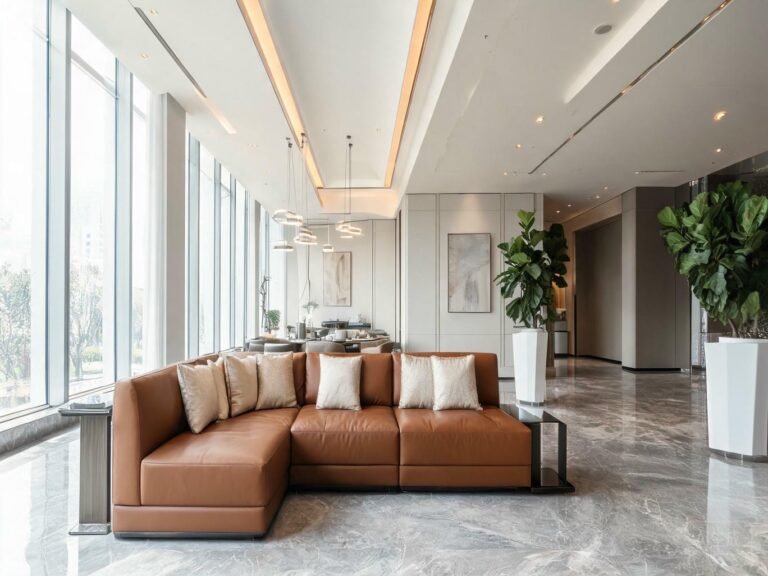
Commercial lobby sofa — the high-traffic environment where couch leather material choices are tested daily
The Cleaning Cycle Problem in Hospitality Couch Leather Material
Here’s where most material evaluations go wrong: they test abrasion but not cleaning chemistry. A hospitality couch gets cleaned 2–4 times per week in a hotel lobby, daily in a healthcare waiting room. Each cleaning cycle involves surfactants, disinfectants, and occasionally alcohol-based sanitizers. Over a year, that is 100–200 chemical exposures.
PU leather degrades under exactly this regime. The polyurethane coating is bonded with plasticizers and crosslinkers that are slowly dissolved by repeated surfactant exposure. After 18–24 months of commercial cleaning cycles, the surface begins to feel tacky, then micro-cracks appear at stress points (armrests, seat edges), and finally the coating delaminates from the fabric base. The couch is condemned not because the frame failed, but because the surface chemistry failed.

Water repellency test on silicone leather — the surface resists both water and cleaning chemicals without coating degradation
Silicone leather handles cleaning cycles entirely differently. The silicone polymer is chemically inert — it does not react with surfactants, alcohols, or disinfectant solutions. In our accelerated cleaning simulation (200 cycles of 70% isopropyl alcohol wipe-down followed by neutral detergent rinse), silicone leather showed zero surface change. No tackiness, no cracking, no color shift. The same test on PU samples produced visible surface degradation after 80 cycles. For more on cleaning protocols, our cleaning and maintenance guide details the approved chemical list.
Wear Testing Data: Couch Leather Material Under Commercial Use
Abrasion resistance is the metric every spec sheet highlights, but the test method matters as much as the number. The Wyzenbeek test (used in US furniture standards) and the Martindale test (used in European standards) produce different numbers for the same material. A couch leather material rated 50,000 Wyzenbeek cycles might only achieve 25,000 Martindale cycles — and hospitality buyers need to know which standard they are reading. The BIFMA durability standards provide the reference framework for commercial furniture performance testing in North America.
For commercial furniture, the industry benchmark is 30,000 Martindale cycles minimum for light commercial use, and 50,000+ for heavy commercial (hotel lobbies, airport lounges). Here is how common couch leather materials perform:

Color fastness testing equipment — critical for hospitality couches exposed to UV from lobby windows and repeated cleaning

Flex bending test — simulating the repeated compression couch cushions experience from daily sitting and standing
| Material | Martindale Cycles | Cleaning Cycles to Degradation | Typical Commercial Lifespan |
|---|---|---|---|
| Genuine leather | 25,000–40,000 | 150+ (with conditioning) | 7–10 years |
| PU leather | 15,000–25,000 | 80–120 | 2–4 years |
| PVC leather | 10,000–20,000 | 100–150 | 3–5 years |
| Silicone leather | 100,000+ | 200+ (no degradation) | 10+ years |
Procurement insight: A 200-room hotel specifying PU couch leather at $5/yd saves $2,000 upfront versus silicone leather at $12/yd. But replacing those couches at year 3 instead of year 10 adds $18,000 in material costs plus installation labor. The “cheaper” option costs 4.5x more over the lifecycle.
Silicone Leather as a Couch Leather Material Upgrade
Not every couch needs silicone leather. A residential sofa that gets cleaned twice a year and sees two adults and a cat will do fine with mid-grade PU. But when the use case involves daily commercial cleaning, high humidity, UV exposure from lobby windows, or regulatory requirements for stain resistance, the upgrade math flips.
One hospitality client of ours — a boutique hotel group with 12 properties in Southeast Asia — was replacing lobby couch upholstery every 18 months due to humidity-driven hydrolysis in their PU leather. After switching to silicone leather, their first property has passed the 4-year mark with no surface degradation, no color fading, and no cleaning chemical damage. The material cost was 2.4x higher per yard. The lifecycle cost is tracking at 0.3x. That is the ROI calculation that matters.

Full color range of silicone leather for couch upholstery — custom color matching available for hospitality brand standards
The silicone vs PU comparison provides the technical data sheet, but the real question for buyers is simpler: does your furniture need to survive 3 years or 10? If the answer is closer to 10, the material decision is already made.
Silicone leather commercial sofa introduction — see the surface finish, flexibility, and stain resistance that hospitality buyers evaluate
Cost Per Cleaning Cycle: The Real TCO Calculation
This is the calculation most procurement spreadsheets miss. Instead of comparing cost per yard, divide the total material cost (including installation) by the number of cleaning cycles the surface survives before replacement. That gives you cost per cleaning cycle — the true unit economics of couch leather material in commercial use.
Using realistic figures for a standard 3-seat lobby couch (approximately 12 yards of material):
For a 3-seat lobby couch requiring 12 yards of upholstery material, the math looks like this:
- PU leather — $5/yd × 12 = $60 material + $40 installation = $100 total. Survives ~100 cleaning cycles over 2.5 years. Cost per cycle: $1.00
- Silicone leather — $12/yd × 12 = $144 material + $40 installation = $184 total. Survives 500+ cleaning cycles over 10+ years. Cost per cycle: $0.37
The silicone leather option costs 63% less per cleaning cycle — and that does not factor in the avoided cost of premature replacement labor, disposal fees, or the brand impact of worn furniture in a guest-facing space. For teams managing sofa upholstery material selection across multiple properties, this is the calculation that justifies the upgrade.

Hotel lobby upholstery — the environment where cost per cleaning cycle determines whether a furniture program succeeds or fails
Frequently Asked Questions
How does couch leather material affect hospitality furniture warranty claims?
Surface degradation — peeling, cracking, and delamination — accounts for the majority of hospitality furniture warranty claims. PU leather couches typically generate warranty claims starting in year 2, peaking in year 3. Silicone leather couches have not generated surface-related warranty claims in our client base within the first 5 years of commercial use. Specifying the right material upfront eliminates the most common warranty driver.
Is silicone leather couch material compatible with standard hospitality cleaning protocols?
Yes. Silicone leather is compatible with all standard hospitality cleaning chemicals including quaternary ammonium disinfectants, 70% isopropyl alcohol, and neutral pH detergents. No special conditioning or treatment is required. The material’s chemical inertness means cleaning teams can use their existing protocols without adjustment — a significant operational advantage over genuine leather, which requires dedicated conditioning products.
Specifying Couch Leather Material With Eyes Open
The couch leather material decision is not really about leather at all. It is about how many cleaning cycles your furniture needs to survive, what those cycles cost in chemicals and labor, and when the replacement clock starts ticking. PU leather wins on day-one price. Genuine leather wins on prestige. But for hospitality buyers tracking total cost of ownership across hundreds of couches and dozens of properties, silicone leather wins on the only metric that ends up on the P&L: cost per year of presentable service. For additional material comparisons, our leather sofa upholstery materials guide covers residential and light-commercial applications.
About TOPSUN
TOPSUN supplies silicone leather to hospitality furniture manufacturers who need upholstery that survives daily commercial cleaning cycles without surface degradation or coating failure.
Our couch leather material passes 100,000+ Martindale cycles, tolerates 200+ accelerated cleaning cycles with zero degradation, and is available in custom colors matched to your brand standard — with MOQs suitable for both pilot programs and full property rollouts.