Every procurement manager has faced the same question: what is the best leather for this project? The honest answer is that “best” depends entirely on your application, budget, regulatory environment, and expected service life. A material that performs beautifully in a climate-controlled showroom may crack within months in a humid commercial lobby. This guide cuts through the marketing noise to give you a grade-by-grade, spec-by-spec framework for making that call with confidence.
Request Free Leather Grade Samples
What Does “Best Leather” Actually Mean in B2B Procurement?
In consumer markets, “best leather” usually means the most expensive or most prestigious. In B2B procurement, the definition shifts entirely. The best leather for your project is the one that meets your performance specifications, passes your quality audit, fits your budget per linear meter, and holds up across the warranty period without triggering replacement claims.
That sounds obvious, but we regularly see sourcing teams default to full-grain animal leather because it carries prestige — then discover that leather’s moisture sensitivity, batch variation, and ethical sourcing complexity create more problems than they solve. Before specifying any material, define what “best” means for your specific application category: Is it abrasion resistance? Cleanability? UV stability? Certification compliance? Each of these answers points to a different material.

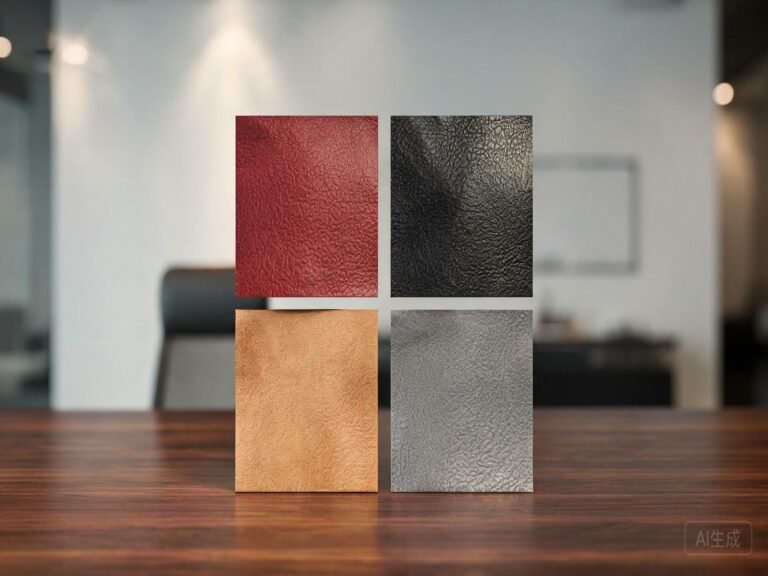
Leather swatch display — color and texture options available across genuine and synthetic grades
Leather Grades Explained: Full-Grain to Bonded
Animal leather comes in five recognized grades, and knowing the difference is the foundation of any sourcing decision. The Leather Working Group, an international multi-stakeholder group founded in 2005, provides environmental certification for tanneries — and their audit standards are a useful proxy for overall quality management.
- Full-grain leather — The highest grade, retaining the complete natural grain surface. Extremely durable, develops a patina over time. Price tier: premium. Best for high-end furniture and luxury automotive.
- Top-grain leather — Sanded and refinished to remove imperfections. More uniform than full-grain but slightly less durable. Price tier: high. Common in mid-range automotive and commercial furniture.
- Genuine leather — The layer below top-grain, often split and coated. Despite the name, this is a lower grade. Price tier: mid. Used in budget furniture and accessories.
- Bonded leather — Shredded leather scraps bonded with polyurethane binder. Contains only 10–17% actual leather fiber. Price tier: low. Short lifespan, prone to peeling.
- Synthetic leather — Includes PU, PVC, microfiber, and silicone-coated options. No animal content. Quality varies dramatically by formulation and coating technology.
For a more detailed breakdown of synthetic categories, our types of leather guide walks through each material type with application-specific recommendations.

Genuine leather texture — natural grain variation is both its aesthetic appeal and its quality control challenge
Performance Metrics for Evaluating Leather Quality in Bulk Orders
When you are ordering 10,000 meters of leather for a production run, subjective assessments are not enough. The ASTM testing standards provide the objective framework you need. Here are the five metrics we require on every supplier datasheet before approving a material for production:
| Leather Grade | Cost Tier | Service Life | Best Application |
|---|---|---|---|
| Full-grain | $$$ Premium | 15–20+ years | Luxury furniture, high-end auto |
| Top-grain | $$ High | 8–12 years | Commercial furniture, mid-range auto |
| Genuine | $ Mid | 3–6 years | Budget furniture, accessories |
| Bonded | Low | 1–3 years | Decorative, low-traffic only |
| Silicone leather | $$ High | 8–10+ years | Medical, marine, auto, furniture |

Tensile strength testing — every batch must meet ASTM D5034 break load specifications before release
One of our automotive clients switched from genuine leather to silicone-coated material for door panel trim and cut warranty claims by 35% in 18 months — the material passed 100,000 Martindale cycles with zero visible wear.
Genuine vs Synthetic: Which Is the Best Leather for Your Application?
The genuine-vs-synthetic debate is not about which material is inherently better. It is about which trade-offs your application can absorb. Genuine full-grain leather offers unmatched breathability and a unique patina that synthetics cannot replicate. But it also comes with batch-to-batch color variation, moisture sensitivity, and ethical sourcing documentation requirements that add weeks to your procurement cycle.
Synthetic options have closed the gap significantly. The top-grain leather guide on our blog covers the genuine side in detail. On the synthetic side, silicone-coated leather now matches genuine leather in tactile feel and exceeds it in hydrolysis resistance, UV stability, and cleanability. For a detailed silicone vs PU comparison, the data shows silicone outperforming PU across every metric except raw material cost.
Explore the full range of available leather textures — from natural grain patterns to custom embossing options
If your project involves healthcare, children’s products, or food-contact applications, the regulatory environment often makes the decision for you. Silicone leather is inherently non-toxic, free of plasticizers, and can achieve LWG environmental certification in tannery-audited supply chains. Understanding the difference between full and semi-silicone leather is also essential — the coating ratio directly affects both performance and price.
Supplier Evaluation Checklist for Bulk Leather Procurement
Whether you choose genuine leather or a synthetic alternative, the supplier you select will determine whether your material performs as specified. Here is the checklist our procurement team uses before placing any bulk order:
- Batch consistency — Request three production batches and measure color difference (Delta E should be ≤ 2.0 for furniture, ≤ 1.5 for automotive).
- Test certificates — Require Martindale abrasion, UV stability (QUV-B), and tensile strength data for every batch, not just the initial sample.
- MOQ and lead time — Confirm minimum order quantities align with your production schedule. Genuine leather MOQs are often higher due to hide availability.
- Certification documentation — For genuine leather: LWG rating, REACH compliance, chromium VI test results. For silicone: ISO 10993 biocompatibility, FDA food-contact, zero-VOC verification.
- Warranty terms — The best leather suppliers stand behind their material with written warranty terms covering hydrolysis, delamination, and color fastness.

Scratch resistance testing — a critical quality gate for any leather grade entering commercial production

Complete swatch rack — evaluating color, texture, and finish options across multiple leather grades
Frequently Asked Questions
How do I verify leather quality claims from a new supplier?
Request third-party test reports from accredited labs (SGS, Intertek, or TÜV) covering Martindale abrasion, tear strength, color fastness, and — for genuine leather — chromium VI content. Then order a trial batch of 50–100 meters and run your own incoming quality inspection. Compare the results against the supplier’s datasheet. If the gap exceeds 10% on any metric, escalate immediately.
Is genuine leather always better than high-quality synthetic alternatives?
No. Genuine leather excels in breathability and patina development, but it underperforms in moisture resistance, cleanability, and batch consistency. For applications requiring strict hygiene (medical, food), UV exposure (marine, outdoor), or regulatory compliance (VOC limits in automotive cabins), synthetic alternatives — particularly silicone-coated leather — often deliver better lifecycle value despite a similar or slightly higher upfront cost.
Making the Right Call
The best leather is not a single material — it is the material that meets your performance specs, budget constraints, and regulatory requirements while delivering acceptable lifecycle cost. Full-grain leather remains the gold standard for prestige applications where patina and breathability matter. But for an growing share of commercial, automotive, and healthcare applications, silicone-coated leather is proving to be the better engineering choice: same tactile quality, none of the hydrolysis or VOC headaches.
Our recommendation: before your next bulk order, request comparison swatches from at least two material categories. Touch them, test them, and let the data — not the marketing — tell you which is the best leather for your project.
Get a Custom Leather Comparison Quote
About TOPSUN
TOPSUN manufactures silicone-coated leather that matches or exceeds the performance characteristics buyers expect from the best leather, specifically for applications where animal leather faces ethical sourcing constraints, regulatory VOC limits, or hydrolysis failure risks.
Core capabilities include OEM-grade custom embossing with 200+ pattern options, REACH and ISO 10993 compliant formulations, color matching within Delta E ≤ 1.5, and 50,000+ linear meters monthly production capacity with full batch traceability.