When an OEM audits a potential automotive leather manufacturer, the first document they request isn’t a price list — it’s a PPAP package. A supplier without VDA 6.3 process audit results, VDA 277 VOC test data, and a documented IMDS submission history will be eliminated before the commercial discussion begins, regardless of how competitive their pricing is. The gap between a manufacturer who can make a good sample and one who can sustain OEM-grade production at volume is measured in compliance documentation, not swatches.
This guide maps the five evaluation pillars that procurement teams should apply when selecting an automotive leather supplier: certification readiness, lead time transparency, quality gate architecture, material chemistry for EV applications, and contractual risk protections for bulk orders.
Explore Automotive Interior Solutions
What an Automotive Leather Manufacturer Must Prove Before You Sign

The automotive leather manufacturer OEM partnership requirements checklist starts with three non-negotiable documentation sets. First, VDA 6.3 process audit results — this audit evaluates 59 questions across the entire production chain from incoming goods to customer delivery, and a score below Class B generally disqualifies a supplier from European OEM programs. Second, material-level VOC test data per VDA 277 (total VOC via gas chromatography) and VDA 278 (thermal desorption for VOC and fogging), which directly impact cabin air quality compliance under GB/T 27630 and equivalent regional standards. Third, an IMDS (International Material Data System) submission showing full material composition disclosure, including all substances of concern below the reporting threshold.
Beyond documentation, the manufacturer must demonstrate flame retardancy compliance. FMVSS 302 — the US Federal Motor Vehicle Safety Standard for interior material flammability — requires that horizontal burn rate does not exceed 102 mm/min. For European markets, the equivalent is ECE R118 or country-specific derivations. A supplier who cannot produce a current (within 12 months) third-party test report for the exact material formulation being quoted should not advance to the sampling stage.
One of our automotive clients learned this the hard way: they shortlisted a supplier based on attractive pricing and visual sample quality, only to discover during the PPAP submission that the supplier had never conducted VDA 277 testing. The resulting 14-week delay to commission and pass the tests pushed their SOP (Start of Production) milestone beyond the OEM’s locked-in launch window.
Lead Time Control: Why 12-Week Promises Become 20-Week Realities

Automotive leather manufacturer lead time bulk orders commitments are among the most frequently broken promises in the supply chain. A manufacturer may quote 12 weeks from PO to shipment, but that figure often assumes ideal conditions: no custom color development, no base fabric supply constraints, no curing oven scheduling conflicts, and no quality re-work cycles. The real-world lead time for a custom-color automotive leather order typically runs 16–22 weeks when all variables are accounted for.
The root causes of lead time inflation fall into three categories:
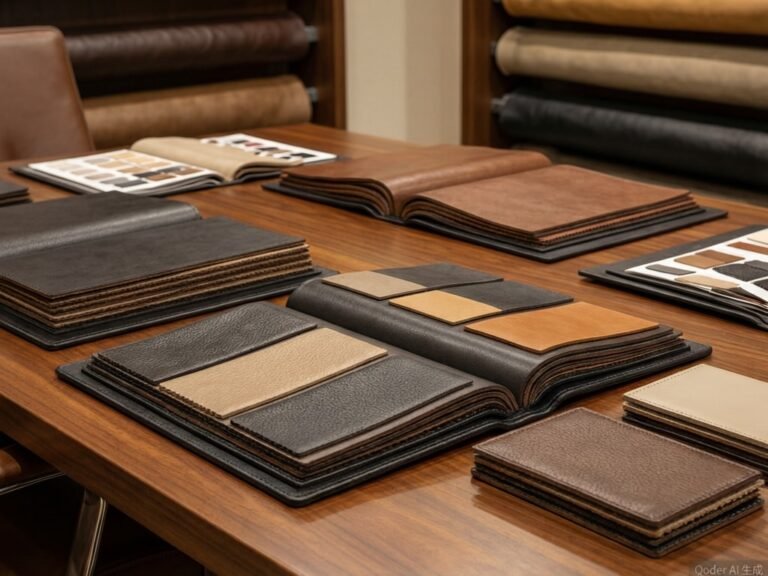
- Color development cycles: Custom automotive colors require 3–5 rounds of Delta E matching against the OEM master standard. Each round takes 7–10 days. A supplier without an in-house color lab adds 2–3 weeks of external lab turnaround per round.
- Base fabric availability: Automotive-grade base fabrics (typically 200–300 g/m² polyester or nylon) are not stock items. If the manufacturer doesn’t maintain a rolling inventory of base fabrics in the required weight and construction, expect 4–6 weeks for base fabric procurement before coating can begin.
- Quality hold cycles: First-batch production for a new formulation frequently fails one or more QC tests (abrasion, flame, VOC). Each hold cycle adds 7–14 days for root-cause analysis and re-production.
To control lead time risk, procurement teams should require a manufacturing capacity verification before PO: request the supplier’s production schedule for the next 12 weeks, confirm base fabric inventory levels, and ask for the historical on-time delivery rate for orders of similar volume. A manufacturer with a documented 92%+ on-time delivery rate and transparent capacity planning is worth a 5–8% price premium over a cheaper but opaque alternative.
Automotive Leather Manufacturer Quality Gates: From Sample to SOP
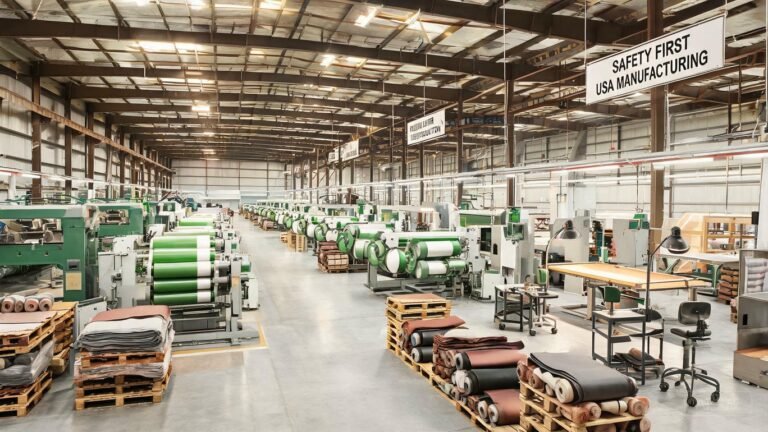
An automotive leather manufacturer quality control process worthy of OEM partnership doesn’t rely on final inspection — it deploys quality gates at every stage of production. The gate system below represents the minimum framework that procurement teams should verify during supplier audits:

- Gate 1 — Incoming base fabric inspection: Weight (g/m²), tensile strength, and visual defect scan against AQL 2.5 sampling plan. Rejects don’t enter coating.
- Gate 2 — Coating formulation verification: Viscosity, solids content, and color match check before the first meter is coated. A formulation drift of 3% in solids content can shift the final material’s abrasion performance by 15%.
- Gate 3 — In-line coating weight monitoring: Continuous beta-gauge or infrared measurement of coating thickness. Tolerance band: ±5% of target. Out-of-spec material is flagged and segregated in real time.
- Gate 4 — Post-curing physical testing: Martindale abrasion, tear strength, flex resistance (Bally flexometer, 100,000 cycles), and flame retardancy (FMVSS 302 or equivalent) on samples pulled from the production lot.
- Gate 5 — VOC and fogging test on retained samples: VDA 277 and VDA 270 (odor) on every production lot destined for OEM interior applications. Test reports archived for minimum 5 years per IATF 16949 retention requirements.
In our facility, Gate 3 catches approximately 4% of production length as out-of-spec before it reaches the finished goods warehouse. Without this in-line monitoring, that 4% would have been discovered at Gate 4 — by which point the material has already been laminated, embossed, and rolled, making rework impossible and forcing scrap. The cost of in-line monitoring equipment is recovered within 14 months on scrap reduction alone.
Learn About Our Silicone Leather Technology
Silicone vs PU for EV Interiors: Material Selection for OEMs

Selecting the best automotive leather manufacturer for EV interiors increasingly means selecting the right material chemistry. Electric vehicle programs impose requirements that traditional PU leather struggles to meet: ultra-low VOC emissions (to avoid chemical interactions with battery thermal management systems in sealed cabins), thermal stability at elevated temperatures (EV cabins can reach 70°C during fast-charging cycles with preconditioning), and weight reduction targets that favor thinner but stronger materials.
| OEM Requirement | PU Leather | PVC Leather | Silicone Leather | Why It Matters |
|---|---|---|---|---|
| VOC (VDA 277, µg C/g) | 40–80 | 60–120 | <5 | EV cabin air quality standards tightening annually |
| Cold crack (°C) | -15 | -20 | -40 | Arctic-region delivery and cold-soak testing |
| Martindale (cycles) | 25,000–40,000 | 30,000–50,000 | 50,000+ | Warranty cycle: 5yr / 100,000 km |
| FMVSS 302 burn rate | Pass (with additives) | Pass (inherently) | Pass (inherently) | Mandatory for all passenger vehicles |
| Recyclability | Limited | Poor (chlorinated) | High (silicone recyclable) | EU ELV Directive and CSR targets |
The data explains why hydrolysis-resistant silicone leather is gaining traction in EV programs from European and Chinese OEMs. While the per-meter cost runs 2–3× higher than PU, the total lifecycle calculation — factoring in warranty claim reduction, cabin air quality compliance margin, and end-of-life recyclability under the EU End-of-Life Vehicles Directive — consistently favors silicone for premium and mid-tier EV platforms. For a deeper technical comparison, see our analysis of automotive silicone leather and VDA 277 compliance.
Reducing Bulk Order Risk: Contract Clauses That Actually Work
Knowing how to choose an automotive leather manufacturer is only half the battle — the other half is structuring the contract so that the manufacturer’s incentives align with your quality and delivery requirements. Standard purchase orders leave critical gaps. The following clauses, drawn from our experience on both sides of the OEM-supplier relationship, have proven to prevent the most costly bulk order failures:
- Specification lock-in clause: The contract must reference a frozen technical data sheet (TDS) with revision number and date. Any change to the TDS — including raw material substitution by the manufacturer — requires written approval and a new PPAP submission. Without this clause, a supplier can legally change the coating formulation mid-production to reduce costs.
- Batch-level traceability requirement: Every roll must carry a barcode linking to production date, line number, base fabric lot, coating formulation batch, and QC test results. This enables targeted recalls instead of full-lot quarantine when a defect is discovered post-delivery.
- Lead time penalty ladder: Rather than a flat penalty for late delivery, structure a graduated penalty: 1% of order value per week for weeks 1–2 of delay, 2% per week for weeks 3–4, and the right to cancel without penalty after week 4. This incentivizes early communication of delays rather than silence followed by a missed deadline.
- First-article inspection (FAI) gate: The first 50 meters of every production lot must be shipped to the buyer’s QC team for inspection before the balance is produced. This prevents the scenario where a 10,000-meter order is completed before a systematic defect is discovered.
- Inventory buffer agreement: Require the manufacturer to hold 10% of the order volume as finished-goods buffer for 90 days post-delivery, available for expedited shipment if field defects require replacement material. The carrying cost is negotiated into the unit price.
For additional context on material selection for automotive applications, our vegan automotive leather guide covers the regulatory and branding drivers behind the shift away from animal leather in OEM programs.
Conclusion
Selecting an automotive leather manufacturer for OEM partnership is a structured risk-reduction exercise, not a sourcing transaction. VDA compliance and PPAP readiness are entry tickets, not differentiators. Lead time promises must be stress-tested against base fabric availability and color development cycles. Quality gates must exist at every production stage, not just at final inspection. Material chemistry must match the application — EV interiors demand lower VOC and higher thermal stability than traditional PU can deliver. And contractual protections must anticipate the specific failure modes that automotive leather production is prone to: formulation drift, batch-to-batch inconsistency, and silent lead time extension. Procurement teams that evaluate manufacturers against these five pillars will spend less time fighting fires after SOP and more time building durable supply relationships.
Schedule an Automotive Leather PPAP Consultation
Frequently Asked Questions
What certifications should an automotive leather manufacturer have?
At minimum, an automotive leather manufacturer should hold IATF 16949 (quality management for automotive), VDA 6.3 process audit compliance (Class A or B), and ISO 14001 (environmental management). Material-level certifications include VDA 277/278 VOC test reports, FMVSS 302 or ECE R118 flame retardancy reports, and IMDS submissions. For OEM programs targeting European markets, REACH compliance and RoHS declarations are also mandatory. Always request test reports no older than 12 months from an ISO 17025-accredited laboratory.
How long does the PPAP approval process take for automotive leather?
PPAP Level 3 — the most common level for automotive interior materials — typically takes 8–16 weeks from initial sample submission to full approval. The timeline includes: 2–3 weeks for initial sample production and internal QC, 3–5 weeks for third-party testing (VOC, flame, abrasion, fogging), 1–2 weeks for IMDS compilation and submission, and 2–4 weeks for OEM engineering review and sign-off. Suppliers who maintain pre-tested material formulations and have current VDA test data on file can compress this to 6–8 weeks. Suppliers starting from scratch on a new formulation should budget 16–20 weeks minimum.
About TOPSUN
TOPSUN supplies silicone-based automotive leather to OEM and Tier-1 interior manufacturers across passenger vehicle, commercial vehicle, and EV platforms. Our manufacturing facility maintains VDA 6.3 process audit compliance, provides VDA 277 and VDA 278 VOC test data on every material formulation, and supports PPAP Level 3 submissions with full IMDS documentation. Production capabilities include custom color development with Delta E ≤ 1.5 matching, Martindale ratings exceeding 50,000 cycles, FMVSS 302 flame retardancy compliance, and cold-crack resistance to -40°C — all backed by five-stage quality gates from incoming base fabric inspection through post-curing VOC verification.