Grape leather fabric sounds like a sustainability dream — winemaking waste transformed into a vegan, plant-based material for fashion and interiors. Italian innovator Vegea has pioneered this space, turning grape marc (skins, stems, and seeds) into a bio-based composite that has caught the attention of luxury brands like Stella McCartney. But if you are a B2B buyer evaluating materials for commercial production, the story behind the headline matters more than the headline itself.
As a materials specifier who has compared dozens of next-generation leather alternatives, I see grape leather fabric as a genuinely exciting development — with real limitations that procurement teams need to understand before committing. Scalability, durability data, certification coverage, and cost structure all paint a more complex picture than the marketing suggests. Here is what you need to evaluate before adding grape leather fabric to your sourcing shortlist.
What Is Grape Leather Fabric and How Is It Made?
Grape leather fabric is a bio-based composite material created from the byproducts of winemaking — specifically grape skins, stems, and seeds collectively known as grape marc or pomace. Companies like Vegea process this agricultural waste by combining it with vegetal oils, natural fibers, and bio-based polymers to form a sheet material that mimics the look and feel of traditional leather. The result is a partially plant-based alternative that reduces dependence on petroleum-derived inputs and animal hides.
The production process typically involves drying and milling the grape marc, blending it with a bio-polymer matrix, and then calendering or coating it onto a fabric backing. The exact formulation varies by manufacturer, and this is where B2B buyers need to pay close attention. Some versions use a significant percentage of petrochemical binders to achieve adequate strength and flexibility, which means the final material may be only partially bio-based despite the “grape leather” label.
This matters because the bio-based content percentage directly affects your sustainability claims, your carbon footprint calculations, and your compliance with emerging regulations like the EU Green Deal’s digital product passport requirements. Always request third-party verification of bio-based content — not just the marketing claim.

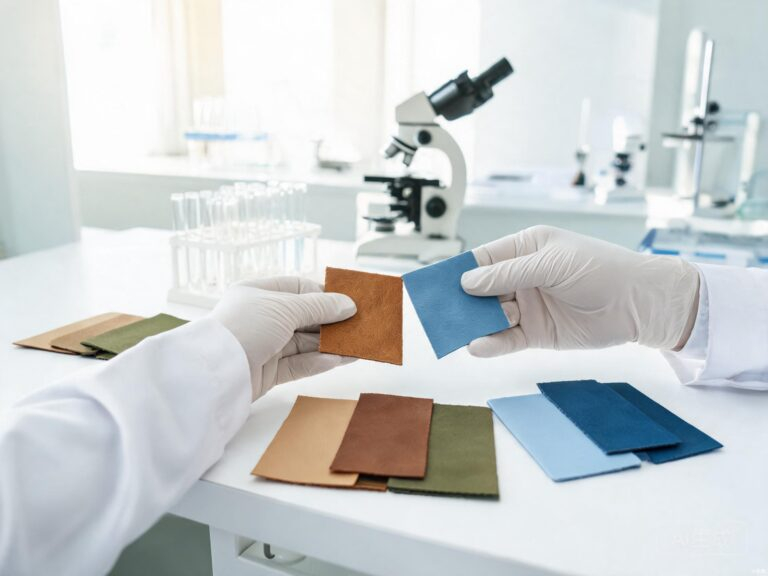
Material comparison: evaluating swatch quality across different leather alternatives
Where Grape Leather Fabric Shines in Design Applications
From a design perspective, grape leather fabric offers several genuine advantages that explain why luxury fashion houses have embraced it. The material has a distinctive organic texture that differentiates it from conventional synthetics — a subtle, natural variation in surface character that reads as premium rather than mass-produced. Color absorption tends to produce rich, earthy tones, particularly in burgundy, ochre, and deep brown palettes that align with current consumer preferences for natural aesthetics.
For fashion applications — handbags, footwear, small leather goods, and apparel accents — grape leather fabric performs well enough to justify its niche positioning. Vegea has demonstrated commercial viability through partnerships with brands like Stella McCartney and Moleskine, proving that the material can meet the aesthetic and quality bar for premium consumer products. The sustainability narrative is compelling: each square meter diverts winemaking waste from landfill or incineration, giving the material a strong circular economy story.
However, the design freedom that grape leather offers in fashion does not automatically translate to heavier-duty applications. Furniture upholstery, automotive interiors, and contract furniture demand performance characteristics that fashion accessories do not. This is where the evaluation gets more nuanced, and where many buyers discover the gap between a compelling prototype and a production-ready specification.

Plant-based leather alternatives in fashion applications
The Durability Question: Can Grape Leather Handle Commercial Use?
Durability is the single biggest question mark for B2B buyers evaluating grape leather fabric. Most bio-based leathers derived from agricultural waste face the same fundamental challenge: natural plant fibers are inherently less abrasion-resistant than synthetic polymers like polyurethane or silicone. While manufacturers continue to improve formulations, publicly available Martindale abrasion test data for grape leather remains limited compared to the extensive testing documentation available for established materials.
In our experience evaluating alternative leathers, materials with high bio-based content typically achieve Martindale ratings between 15,000 and 25,000 cycles before visible wear — adequate for fashion accessories but below the 50,000+ cycles expected for contract furniture and automotive seating. Water resistance is another concern: plant-based composites tend to absorb moisture more readily than fully synthetic alternatives, which can lead to dimensional instability, microbial growth, and accelerated degradation in humid environments.
For B2B buyers specifying materials for high-traffic commercial environments, these limitations are not deal-breakers on their own — but they require honest expectation-setting. If your product will see daily wear in automotive interiors, hospitality furniture, or healthcare settings, you need verified test data, not sustainability storytelling. Request Martindale abrasion results, UV stability testing, and accelerated aging data before approving any specification.

Physical testing equipment for evaluating leather durability and wear resistance
Grape Leather Fabric vs Silicone Leather for B2B Production
When B2B buyers compare grape leather fabric to silicone leather, the comparison reveals a fundamental trade-off between bio-based novelty and industrial reliability. Both materials position themselves as sustainable alternatives to conventional PU and PVC leather, but they solve different problems and serve different market segments. Understanding this distinction helps procurement teams make informed decisions based on their specific application requirements.
The table below summarizes the key differences across dimensions that matter most for commercial production decisions:
| Property | Grape Leather Fabric | Silicone Leather |
|---|---|---|
| Primary raw material | Grape marc (winemaking waste) + bio-polymer | Silicone elastomer + fabric substrate |
| Martindale abrasion | ~15,000–25,000 cycles (estimated) | 50,000+ cycles (verified) |
| Production scalability | Limited; tied to winery waste supply | Industrial-scale; raw material widely available |
| VOC emissions | Varies by formulation; data limited | Zero VOC (solvent-free process) |
| Certification coverage | Emerging; limited third-party data | REACH, Oeko-Tex 100, ISO 10993 |
The comparison is not about declaring a winner — it is about matching the material to the application. Grape leather fabric excels in fashion and lifestyle products where storytelling and novelty drive consumer willingness to pay a premium. Silicone leather, by contrast, is engineered for the demands of automotive interiors, contract furniture, and medical applications where durability, cleanability, and regulatory compliance are non-negotiable. Many B2B buyers we work with ultimately use both materials strategically — grape leather for limited-edition or marketing-driven product lines, and silicone leather for volume production where consistency matters.
Sourcing Checklist: Evaluating Grape Leather Fabric Suppliers
If you decide to explore grape leather fabric for your product line, a structured supplier evaluation process is essential. The category is still emerging, which means supplier capabilities vary widely and transparency is not guaranteed. Use this checklist to guide your conversations with potential suppliers:
- Bio-based content verification: Request ISO 16620 or ASTM D6866 test reports confirming the actual percentage of bio-based carbon. Do not accept unsupported marketing claims of “100% plant-based.”
- Durability test data: Ask for Martindale abrasion (ISO 5470), tear strength (ISO 3377), and flexing endurance (ISO 7854) results. If the supplier cannot provide these, treat it as a red flag for commercial production.
- Supply chain transparency: Understand where the grape marc comes from, how it is processed, and whether the supply is seasonal. Winemaking waste availability fluctuates with harvest cycles, which can affect production continuity.
- Minimum order quantities and lead times: Emerging materials often carry higher MOQs and longer lead times than established alternatives. Factor this into your production planning.
- End-of-life pathway: Ask whether the material is biodegradable, recyclable, or neither. A “bio-based” material that ends up in landfill is not automatically a sustainability win.
For buyers who need a material with proven industrial track records, silicone leather offers a complementary solution — one that delivers verified sustainability credentials alongside the durability and certification depth that volume production demands. Reading our analysis of carbon neutral leather claims and solvent-free synthetic leather can provide additional context for your evaluation.
Is grape leather fabric biodegradable?
It depends entirely on the formulation. The grape marc component is biodegradable, but the bio-polymer binders and any petrochemical additives may not be. Some manufacturers claim compostability under industrial conditions, but independent verification is scarce. If biodegradability is a requirement for your product, request certified compostability testing (EN 13432 or ASTM D6400) — not just a material composition claim. Without certification, the material may persist in landfill just as long as conventional synthetic leather.
Can grape leather fabric be used for automotive interiors?
Vegea has listed automotive as a target application, and some concept-stage demonstrations exist. However, automotive interior materials must pass stringent OEM specifications including UV stability (SAE J2412), abrasion resistance, fogging (ISO 6451), and flammability (FMVSS 302). Publicly available test data for grape leather fabric meeting these standards is limited. B2B buyers in the automotive sector should treat current grape leather offerings as experimental rather than production-ready, and request full OEM-grade testing before considering specification.
Grape leather fabric represents a meaningful step forward in bio-based material innovation — but it is not yet a drop-in replacement for established synthetic leathers across all applications. For fashion and lifestyle products where novelty and storytelling command a premium, it deserves serious consideration. For automotive, furniture, medical, and contract applications where durability and regulatory compliance drive purchasing decisions, the evidence base is still maturing. The smartest procurement strategy may be to pilot grape leather in limited product lines while relying on proven materials like silicone leather for your core production needs.
About TOPSUN
TOPSUN manufactures solvent-free silicone leather through an addition-cure coating process that requires no DMF, no plasticizers, and no animal-derived inputs, serving automotive OEMs, contract furniture brands, and healthcare device manufacturers who need verified sustainability without compromising on durability.
Zero-VOC production · REACH SVHC-free · Oeko-Tex Standard 100 · ISO 10993 biocompatible · Martindale 50,000+ cycles