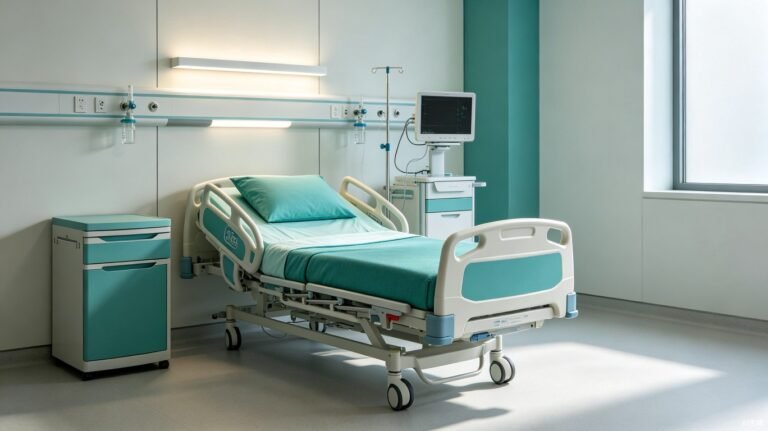
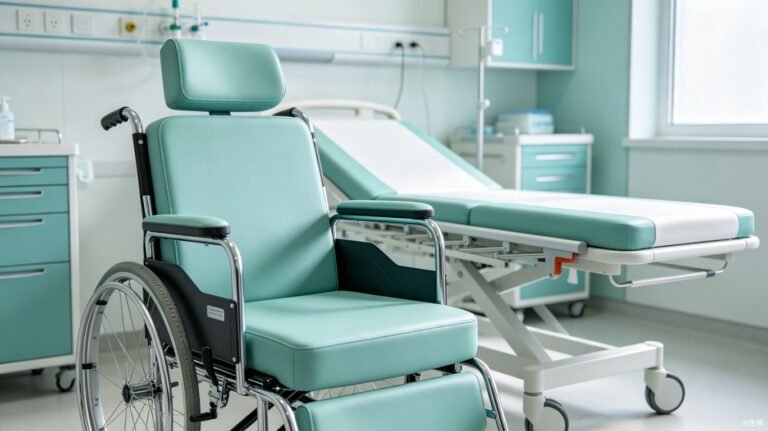
Every patient who sits on an examination table contacts a surface that may harbor pathogens. The hospital examination table material you specify directly affects infection rates, cleaning turnaround, and lifecycle cost. In U.S. hospitals, healthcare-associated infections (HAIs) affect roughly one in 31 patients on any given day. Selecting upholstery that resists disinfectants, blocks fluid penetration, and survives thousands of cleaning cycles is no longer optional — it is a patient-safety mandate. This guide breaks down what procurement teams must verify before approving any exam surface for clinical use.
Why Hospital Examination Table Material Is an Infection-Control Issue
Exam table upholstery serves as the primary contact surface between patients and clinical furniture. Pathogens such as MRSA, VRE, and C. difficile can survive on vinyl and fabric for days or even weeks. When upholstery develops micro-cracks, bodily fluids seep into the foam core, creating microbial reservoirs that surface wiping cannot reach.
The CDC’s Guidelines for Environmental Infection Control in Health-Care Facilities emphasize that nonporous, easily cleanable surfaces are essential in patient-care areas. In our testing with clinical disinfectants, traditional PU leather began to craze and delaminate after just 200 wipes with 70% isopropyl alcohol. Silicone leather showed no surface degradation after 5,000 cycles under identical conditions.

Off-white silicone leather under hydrostatic waterproof testing — a baseline requirement for any clinical exam surface.
Key data: A single cracked seam on a vinyl exam table can expose patients to microbial loads far higher than a sealed silicone surface after standard disinfection.
Key Material Requirements for Clinic Exam Table Pads
When evaluating a clinic exam table pad, procurement teams should verify six properties that determine long-term infection-control performance:
- Impermeability — Must block fluid penetration to the foam core. Look for hydrostatic head ratings above 10,000 mm.
- Chemical resistance — Must withstand bleach (1:10 dilution), 70% alcohol, quaternary ammonium, and hydrogen peroxide without cracking or discoloration.
- Cleanability — Should release bioburden in a single wipe pass, without abrasive scrubbing that damages the surface over time.
- Biocompatibility — Direct-contact materials must pass ISO 10993 cytotoxicity, sensitization, and irritation testing.
- Antibacterial efficacy — Verified per JIS Z 2801 against S. aureus and E. coli with ≥99% reduction.
- Durability — Flex cracking, Martindale abrasion, and seam strength must meet clinical furniture duty cycles.
Chemical resistance deserves particular attention, because disinfectant protocols vary by facility and region. Watch the short demo below to see how silicone leather holds up under direct alcohol exposure — a test where vinyl and PU typically fail within minutes.
Silicone leather alcohol-resistance demo — the surface stays intact where vinyl and PU craze and delaminate.
TOPSUN’s medical-grade silicone leather for healthcare applications is engineered to meet all six requirements, making it suitable for high-traffic outpatient and inpatient settings alike. Specifying material that fails even one of these criteria puts both patients and clinical staff at preventable risk.
Silicone Leather vs Traditional Vinyl and PU Treatment Table Materials
Most treatment table material in clinical use falls into three categories: PVC (vinyl), polyurethane (PU), and silicone leather. The comparison below summarizes how each performs under hospital disinfection protocols.

TOPSUN silicone leather swatches — color options for matching clinical interiors without compromising performance.
| Property | PVC (Vinyl) | PU Leather | Silicone Leather |
|---|---|---|---|
| Disinfectant resistance | Poor — cracks under alcohol/bleach | Fair — degrades after ~500 cycles | Excellent — 5,000+ cycles, no change |
| Waterproof barrier | Moderate, fails at seams | Poor after surface wear | Excellent, integral to material |
| Antibacterial action | Surface coating, wears off | Surface coating, wears off | Integral, permanent |
| Lifespan (clinical use) | 2–3 years | 3–4 years | 7+ years |
| Maintenance frequency | High (weekly spot repair) | Medium | Low (wipe-clean only) |
| Lifecycle cost | High (frequent replacement) | Medium | Lowest |
For facilities upgrading from legacy hospital bed upholstery material, the lifecycle math favors silicone despite the higher upfront cost. Over a five-year horizon, silicone leather can cut total upholstery expenditure by 50% or more through reduced replacement frequency.
Testing Standards Every Hospital Examination Table Material Must Pass
Request documented test reports before approving any medical examination table cover for clinical use. The following standards form the minimum verification baseline that procurement teams should require:
- ISO 10993-5 and -10 — Cytotoxicity, sensitization, and irritation testing for medical-device-adjacent materials.
- JIS Z 2801 / ISO 22196 — Antibacterial activity, measuring log reduction against specified organisms.
- AATCC 127 — Hydrostatic pressure test confirming the surface blocks fluid penetration.
- Martindale abrasion (ISO 5470) — Wear resistance, ≥50,000 cycles for clinical furniture grade.
- ISO 2812 — Chemical resistance after repeated disinfectant exposure.

TOPSUN’s in-house laboratory performs abrasion, hydrostatic, and chemical-resistance testing on every production batch.
The EPA maintains a List N of disinfectants effective against emerging pathogens. Cross-reference your upholstery material against the active ingredients in your facility’s approved products. For deeper technical data, see our medical-grade silicone leather specifications. Never accept marketing claims without batch-level test documentation from an accredited lab.
Real-World Performance: Doctor Exam Table Fabric in Hospital Settings
A 240-bed regional hospital replaced 60 vinyl-covered examination tables with silicone leather doctor exam table fabric over a phased 12-month rollout. After 18 months of daily use, environmental services reported a 40% reduction in cleaning time per room — silicone surfaces required fewer wipe passes and no spot repairs. Zero upholstery failures were recorded, compared with 12 vinyl replacements in the prior year.
We’ve seen hospitals extend upholstery life from 3 years (vinyl) to 7+ years (silicone) under identical daily usage patterns. The antibacterial silicone leather technology behind these results combines an integral antimicrobial additive with a non-porous surface that denies pathogens a colonization substrate.

Antibacterial silicone leather applied to clinical seating — the same material works across exam tables, chairs, and treatment surfaces.
Field result: Facilities switching to silicone leather report 50–60% lower upholstery replacement costs within five years, with no compromise on infection-control compliance.
Frequently Asked Questions
Can silicone leather withstand hospital-grade disinfectants like bleach and alcohol?
Yes. Silicone leather resists 70% isopropyl alcohol, sodium hypochlorite (bleach at 1:10), quaternary ammonium, and hydrogen peroxide without discoloration, cracking, or loss of surface integrity. In our lab, samples survived 5,000+ disinfection cycles with no visible change. For deeper chemical-resistance data, see our medical silicone resource.
How often should examination table upholstery be replaced?
Vinyl and PU typically need replacement every 2–4 years due to cracking, staining, or seam failure. Silicone leather routinely lasts 7+ years under daily clinical use. Replace immediately if any surface crack, puncture, or fluid penetration is observed, regardless of material type or age.
Is silicone leather certified for medical use?
Quality silicone leather is tested to ISO 10993 (biocompatibility) and JIS Z 2801 (antibacterial), and carries FDA, REACH, and RoHS compliance. Always request full batch-level test reports from the manufacturer rather than relying on marketing brochures. TOPSUN provides complete documentation for every production run.
How does silicone leather compare to antimicrobial vinyl?
Antimicrobial vinyl relies on a surface coating that wears off over time, while silicone’s antimicrobial properties are integral to the material itself. Vinyl also degrades faster under alcohol and bleach exposure. Silicone costs more upfront but delivers a lower lifecycle cost through reduced replacement and maintenance frequency.
Conclusion
The right hospital examination table material protects patients, reduces environmental services workload, and lowers total cost of ownership. By specifying silicone leather that meets ISO 10993, JIS Z 2801, and chemical-resistance standards, procurement teams can stop treating upholstery as a consumable and start treating it as a durable clinical asset that performs for years, not months.
About TOPSUN
TOPSUN manufactures medical-grade silicone leather engineered for healthcare environments, supplying hospitals and clinics across Europe and the Americas with upholstery that passes biocompatibility, antibacterial, and chemical-resistance testing on every production batch.
Certifications: ISO 10993, FDA, REACH, RoHS, antibacterial tested per JIS Z 2801