For decades, PVC leather was the default answer to a simple question: “How do we get the look of leather without the cost?” It was cheap, it was everywhere, and it worked — sort of. But the winds have shifted dramatically. The November 2024 EU REACH amendment banning lead in PVC articles sent a shockwave through the synthetic leather supply chain. Combined with tightening phthalate restrictions and growing OEM demand for sustainable materials, PVC leather is facing what industry analysts are calling a “managed decline.” Here’s what procurement teams need to understand about PVC leather — and what comes next.
Explore PVC-Free Leather Alternatives
What Is PVC Leather, and How Is It Made?
PVC leather — also called vinyl leather, PVC leatherette, or PVC imitation leather — is produced by coating a fabric backing (typically polyester or cotton) with a paste made from polyvinyl chloride resin, plasticizers, stabilizers, and pigments. The plasticizers — usually phthalates like DEHP or DINP — are what give PVC its flexibility. Without them, PVC is rigid and brittle. With them, it can mimic leather’s suppleness, at least initially.
Here’s the problem that defines PVC leather’s entire lifecycle: those plasticizers don’t stay put. They migrate out of the material over time — a process called plasticizer leaching. The result is a material that starts flexible and leather-like but gradually becomes brittle, cracks, and peels, typically within 3-5 years. The plasticizers that leach out? They’re the same phthalates now restricted under EU REACH, California Prop 65, and a growing number of international regulations.

The Regulatory Avalanche: Why PVC Leather Is Under Siege
If there’s one phrase that summarizes PVC leather’s regulatory situation in 2026, it’s “death by a thousand cuts.” The restrictions are coming from multiple directions simultaneously:
EU REACH Annex XVII Entry 63 (November 2024). This is the big one. The amendment banned lead content above 0.1% in PVC articles, effective immediately for new production. Recycled soft PVC got a transition period until May 2025; recycled rigid PVC gets until May 2033 for specific categories. Imported PVC products must now include independent third-party certificates of traceability and recycled content. For PVC leather manufacturers who relied on lead-based heat stabilizers, this was an existential blow. ECHA continues to expand its substance restriction list, with more phthalate and heavy metal restrictions expected in 2026-2027.
Phthalate Restrictions. DEHP, DBP, BBP, and DIBP — the four most common phthalate plasticizers — are already restricted to 0.1% concentration under REACH Annex XVII Entry 51. DINP and DIDP, the “replacement” plasticizers, face growing scrutiny. The European Chemicals Agency added DINP to the Substances of Very High Concern (SVHC) candidate list in 2024, a precursor to formal restriction.
California Prop 65. Requires warning labels on products containing chemicals known to cause cancer or reproductive harm. Phthalates, lead, and cadmium — all common in PVC formulations — are on the Prop 65 list. For B2B buyers selling into the US market, Prop 65 compliance is a practical necessity, not a theoretical concern.
The bottom line: PVC leather compliance is becoming more expensive and more complex every year. At some point — and for many buyers, that point is now — the compliance cost exceeds the material’s price advantage.
Performance Problems: Why PVC Leather Falls Short
Even setting aside the regulatory issues, PVC leather has inherent performance limitations that make it unsuitable for premium and demanding applications:
| Performance Issue | PVC Leather | PU Leather | Silicone Leather |
|---|---|---|---|
| Plasticizer Migration | Significant; becomes brittle | Minimal | None; no plasticizers used |
| Cold Resistance | Stiffens below 5°C, cracks at -10°C | Flexible to -20°C | Flexible to -50°C |
| Heat Resistance | Deforms above 70°C | Stable to 80°C | Stable to 250°C |
| Odor | Strong chemical smell, off-gassing | Mild odor, fades | Odorless |
| VOC Emissions | High; plasticizer evaporation | Moderate | Near-zero |
| Typical Service Life | 3-5 years in normal use | 5-7 years | 10+ years |
The cold resistance issue is particularly problematic for automotive applications. PVC leather stiffens at low temperatures, which means door panels and seats can crack in cold climates — a warranty disaster for OEMs. The odor issue is equally problematic for enclosed spaces like car cabins and indoor furniture, where customers expect a neutral, clean environment.
Where PVC Leather Still Hangs On (For Now)
Let’s be fair: PVC leather isn’t disappearing overnight. It still accounts for roughly 94.8% of the automotive PVC+PU leather market by volume, and it dominates ultra-low-cost applications where material price is the only consideration. You’ll still find PVC leather in:
Budget furniture and upholstery. Entry-level sofas, office chairs, and restaurant seating where price sensitivity trumps all other considerations. The 3-5 year replacement cycle is priced into the business model.
Low-cost automotive interiors. Economy vehicle segments in markets with less stringent VOC regulations. Even here, the trend is toward PU — the automotive PVC+PU leather market is growing at just 2.3% CAGR, reflecting the shift away from PVC.
Disposable and short-lifecycle products. Promotional items, temporary installations, and products where longevity isn’t expected.
But here’s the thing: even in these holdout segments, the math is changing. When a $2/meter PVC leather saves $3,000 on a 10,000-meter order but triggers $15,000 in compliance testing, documentation, and liability risk, the “cheap” option stops looking cheap. Procurement teams are running the numbers and reaching the same conclusion: PVC-free faux leather is the future.
The Migration Path: What’s Replacing PVC Leather?
The industry isn’t waiting for PVC leather to be fully banned — it’s already moving. The replacement landscape breaks down into three tiers:
Tier 1: PU Leather (Immediate Replacement). For applications currently using PVC leather, PU is the path of least resistance. It’s more expensive than PVC (typically 1.5-2x) but offers better hand feel, lower odor, and no phthalate concerns. Water-based PU variants address the solvent issue. The PU vs PVC leather comparison increasingly favors PU on both performance and compliance grounds.
Tier 2: Silicone Leather (Premium Upgrade). For applications where performance matters — automotive, healthcare, marine, premium furniture — silicone leather is the ultimate destination. The silicone vs PU comparison shows silicone winning on every performance metric. The higher upfront cost is offset by 3x longer lifespan and near-zero compliance burden.
Tier 3: Bio-Based Leather (Future Option). Plant-based materials (cactus, mushroom, apple, pineapple leather) are generating excitement in fashion and accessories. For industrial B2B applications, they’re not yet competitive on durability or cost, but the 17% CAGR suggests rapid improvement. Watch this space, but don’t bet your production line on it yet.
Frequently Asked Questions
Is PVC leather dangerous to use in furniture?
The primary concern with PVC leather is phthalate plasticizer migration and VOC off-gassing, particularly in enclosed spaces. While most regulatory bodies consider PVC leather safe for consumer use when properly formulated, the tightening restrictions on phthalates and lead indicate growing concern about long-term exposure. For B2B buyers, the practical risk is compliance liability — a product that passes today’s regulations may fail tomorrow’s.
How can I tell if a material is PVC leather or PU leather?
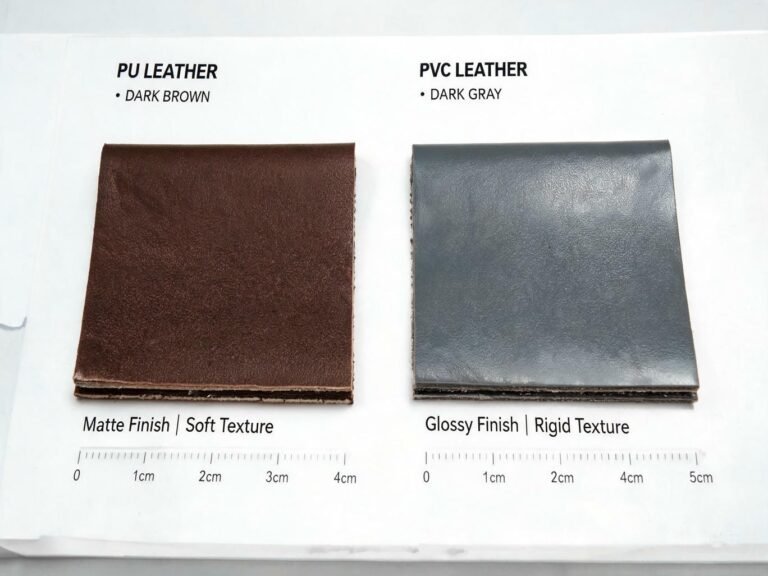
The simplest test is the burn test: PVC leather burns with a green-tipped flame and produces acrid, chlorine-smelling smoke. PU leather burns more like plastic with a yellow flame and less pungent odor. A less destructive method: PVC leather typically feels colder and more plasticky to the touch, while PU leather has a warmer, more fabric-like hand feel. When in doubt, request a material composition certificate from your supplier.
Will PVC leather be completely banned?
An outright ban on PVC as a material is unlikely in the near term. What’s happening is a gradual restriction of the additives that make PVC leather functional — lead stabilizers, phthalate plasticizers, and other substances of concern. As each additive gets restricted, reformulating PVC leather becomes more expensive. At some point, the cost of compliant PVC leather exceeds the cost of switching to PU or silicone. The market is already moving in that direction, regardless of whether a formal ban materializes.
Time to Plan Your Exit Strategy
PVC leather isn’t going to vanish from the supply chain tomorrow. But the direction of travel is unmistakable: rising compliance costs, tightening regulations, and growing OEM demand for sustainable alternatives are pushing PVC leather toward obsolescence in premium and mid-range applications. The automotive PVC+PU leather market’s sluggish 2.3% growth rate — compared to silicone leather’s 14% — tells the story in numbers.
For procurement teams, the smart move is to start migrating now, not when regulations force your hand. Qualify PU or silicone leather alternatives for your key product lines. Build the compliance documentation. Train your supply chain. The companies that make the transition early will have a competitive advantage — not just on compliance, but on the performance and sustainability metrics that increasingly drive B2B purchasing decisions.
Request PVC-Free Leather Samples
About TOPSUN
TOPSUN manufactures premium silicone synthetic leather — a PVC-free, phthalate-free, solvent-free alternative that outperforms traditional PVC leather on every metric. With 233 patents, 3 production bases, and 6 million meters of annual capacity, we help B2B buyers transition from PVC to sustainable, high-performance materials.
Certifications: ISO 10993-5 | REACH (247+7 SVHC) | FDA 21 CFR 175.300 | PAHs | EN 13773 Class 4 | FAR 25.853