The global yoga mat market is projected to surpass $17 billion by 2030, fueled by a growing wellness movement that shows no signs of slowing. Yet beneath the pastel colors and wellness branding, most mats on the market share a dirty secret: they’re made from PVC or TPE — materials that off-gas, degrade, and end up in landfills within a few years. Yoga mat silicone material represents a different approach entirely. It’s non-toxic from day one, maintains grip whether wet or dry, and lasts long enough to become a multi-decade companion rather than a disposable accessory. Here’s what mat manufacturers and wellness brands need to know about this emerging material category.

The Problem with Conventional Yoga Mats
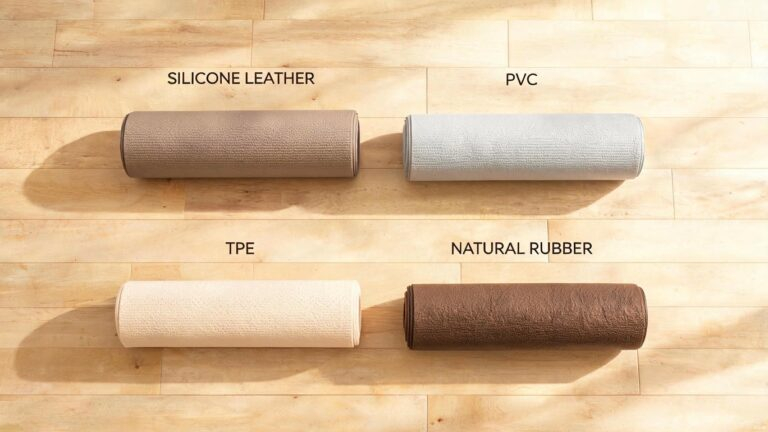
Most yoga mats sold today fall into three material categories, each with significant drawbacks:
- PVC (polyvinyl chloride): The cheapest and most common material. Flexible, but contains phthalates for softness that can leach out — especially when the mat gets warm during practice. PVC mats release VOCs, can’t be recycled, and take centuries to decompose.
- TPE (thermoplastic elastomer): Marketed as “eco-friendly” but it’s still a petroleum-based synthetic. TPE mats feel good initially but compress quickly, losing cushioning within 6–12 months of regular use. They also get slippery when wet with sweat.
- Natural rubber: Better sustainability profile, but contains latex proteins that trigger allergies. Rubber also has a strong odor, degrades when exposed to sunlight, and can mark floors.
The gap in the market is clear. Yogis want a mat that’s non-toxic, maintains grip during sweaty sessions, lasts more than a couple of years, and doesn’t smell like a tire. Silicone-based material fills this gap with a chemistry that’s fundamentally different from all three conventional options.
Eco Reality Check: Over 300 million yoga mats are discarded globally each year, most ending up in landfills where PVC takes 500+ years to break down. A mat that lasts 10 years instead of 2 doesn’t just save money — it prevents 4 landfill-bound mats per practitioner.

Why Silicone Works for Yoga Surfaces
Silicone’s molecular structure — a backbone of silicon and oxygen atoms rather than carbon — gives it properties that are almost perfectly matched to yoga practice requirements. Let’s break down what this means on the mat:
Grip that doesn’t quit. This is the #1 complaint with conventional mats: they get slippery when wet. Silicone’s high coefficient of friction actually improves marginally when damp, which is why silicone is used in high-performance grip applications from baking mats to surgical tools. For hot yoga and Ashtanga practitioners, this means stable downward dog even during the sweatiest sequences.
Non-toxic by chemistry, not by coating. Unlike TPE mats that are marketed as “non-toxic” but still off-gas petroleum compounds, silicone is inherently inert. It contains no plasticizers, no phthalates, no BPA. It’s the same material used in baby bottle nipples and food-grade bakeware — FDA 21 CFR compliant and ISO 10993-5 certified non-cytotoxic. Zero VOC emission means no chemical smell, ever.
Temperature indifference. PVC stiffens in cold studios and gets tacky in hot ones. TPE softens and compresses under body heat. Silicone maintains consistent texture and firmness from -40°C to 250°C. Your mat feels the same in a heated Bikram studio as it does in an unheated morning practice.
Material Comparison: Silicone vs PVC vs TPE vs Rubber

| Property | Silicone | PVC | TPE | Natural Rubber |
|---|---|---|---|---|
| Grip (Dry) | Excellent | Good | Good | Excellent |
| Grip (Wet/Sweat) | Excellent | Poor | Fair | Good |
| VOC Emission | Zero | Moderate–high | Low–moderate | Low (odor) |
| Lifespan | 10+ years | 1–2 years | 1–2 years | 2–4 years |
| Latex-Free | Yes | Yes | Yes | No |
| Recyclable | Yes | No | Limited | Biodegradable |
| Antibacterial | 99.9% | No | No | No |
| Odor | None | Chemical smell | Mild plastic | Rubber smell |
The comparison reveals silicone’s unique position. It matches natural rubber’s grip performance while eliminating latex allergy risk and rubber odor. It outlasts PVC and TPE by a factor of five or more. And its antibacterial properties address a real concern — shared studio mats are bacterial reservoirs that standard cleaning protocols struggle to fully address.
Designing a Silicone Yoga Mat: Manufacturing Considerations
For brands developing a silicone grip mat or exercise mat product line, several manufacturing decisions shape the final product:
- Construction method: Silicone leather can be applied as a surface layer over foam, cork, or rubber substrates. This hybrid approach combines silicone’s grip and hygiene with the cushioning properties of the base material, while reducing overall silicone usage and cost.
- Surface texture: Custom embossing patterns — from subtle linen texture to aggressive grip dots — can be engineered into the silicone surface layer. Unlike printed textures on PVC, these patterns are permanent and won’t wear smooth.
- Thickness: Surface layers of 0.5–1.2 mm work well over cushioning substrates. For all-silicone mats, 2–5 mm provides adequate cushioning while maintaining stability for balance poses.
- Color matching: Custom Pantone colors are available with MOQ of 500 meters. Light colors resist fading (Grade 4–5, ISO 105-B02), addressing the rapid discoloration that plagues light-colored TPE mats.
- Alignment lines: Embedded guide lines can be molded into the surface during production — no printing that wears off after a few months of use.
Water and scratch resistance testing — silicone surfaces repel sweat and resist the wear patterns that degrade conventional yoga mats
Frequently Asked Questions
Is a silicone yoga mat better than a natural rubber mat?
It depends on your priorities. Natural rubber offers excellent grip and is biodegradable, making it appealing for environmentally conscious practitioners. However, rubber contains latex allergens, has a strong odor, and degrades with UV exposure. Silicone matches rubber’s grip performance while being latex-free, odorless, UV-stable, and longer-lasting. For shared studio mats where hygiene is critical, silicone’s 99.9% antibacterial rate is a significant advantage.
How much does a silicone yoga mat cost compared to PVC or TPE?
As a surface material, silicone leather costs more per square meter than PVC or TPE. However, when used as a hybrid construction (silicone surface over foam or cork base), the cost premium is manageable for premium and mid-premium market segments. The key selling point isn’t the upfront price — it’s the 10-year lifespan that makes the cost-per-use lower than replacing TPE mats every 12–18 months.
Can silicone mats be used for hot yoga?
Absolutely — hot yoga is where silicone’s wet-grip advantage shines most. While PVC and TPE mats become dangerously slippery when soaked with sweat, silicone maintains traction. Many practitioners who use a towel on top of their conventional mat for hot yoga wouldn’t need one with a silicone surface. The material also withstands the 40°C studio temperatures without softening or off-gassing.
How do you clean a silicone yoga mat?
Wipe with a damp cloth and mild soap, or spray with a mat cleaner and wipe dry. For deep cleaning, a diluted vinegar solution or 70% isopropyl alcohol spray works without damaging the surface. Unlike PVC mats that absorb cleaning chemicals and develop a sticky residue, silicone’s non-porous surface releases everything completely. No machine washing needed, no special cleaners required.
What is the MOQ for custom silicone mat production?
Standard MOQ is 500 meters for custom-colored silicone material. For brands developing exercise mat material lines, sampling can be arranged through the sports applications team before committing to volume production. Lead time is typically 7–15 days for stock colors and 3–4 weeks for custom Pantone-matched colors.
The Future of Yoga Mat Materials
The wellness industry is waking up to the contradiction at the heart of yoga mat manufacturing: a practice centered on mindfulness and body awareness is being practiced on mats made from petroleum byproducts that off-gas VOCs and pile up in landfills. Consumers are asking harder questions about what’s beneath their hands and feet — and brands that can answer with genuinely non-toxic, long-lasting materials will earn loyalty that marketing alone can’t buy.
Silicone yoga mat material isn’t the cheapest option. But it’s the only one that delivers non-slip performance, zero toxicity, antibacterial protection, and a decade-plus lifespan in a single material. For brands targeting the growing premium and eco-conscious segments of the yoga market, that combination is increasingly hard to ignore.
About TOPSUN
TOPSUN produces silicone leather materials for sports and wellness applications, including yoga mat surface layers, fitness equipment covers, and athletic gear. Our silicone materials are FDA-compliant, zero-VOC, and fully recyclable — supporting brands that prioritize both human health and environmental responsibility.
Relevant Certifications: FDA 21 CFR 175.300 · ISO 10993-5 (non-cytotoxic) · Zero VOC (ISO 16000-6) · REACH SVHC Compliant · Antibacterial 99.9% · Vegan & Cruelty-Free · Recyclable