When a 12-clinic healthcare network replaced all waiting room furniture with silicone leather upholstery, facility managers expected marginal gains in durability. What they actually measured was an 85% drop in replacement requests within 18 months, cleaning labor reduced by 60%, and zero upholstery failures against 12 vinyl replacements the prior year. This silicone leather hospital case study tracks the real numbers behind that deployment — not marketing projections, but line-item costs from environmental services departments.
The results challenge a widespread procurement assumption: that vinyl is the default choice for healthcare seating because it costs less upfront. When you factor in replacement cycles, cleaning time, and infection control compliance, the math flips. Here’s what the data shows.
View Medical-Grade Silicone Leather Specs
Why Vinyl Hospital Upholstery Cracks Under Daily Disinfection
Vinyl (PVC) has dominated hospital upholstery for decades, and on paper the reasons make sense: low cost, waterproof surface, easy to wipe. But daily clinical reality tells a different story. Hospital environmental services teams wipe exam tables, bed rails, and waiting room chairs with 70% isopropyl alcohol, quaternary ammonium solutions, and sodium hypochlorite — often 30 to 50 times per day in high-traffic zones.
Under that chemical load, vinyl degrades. Plasticizers leach out, the surface becomes brittle, and hairline cracks form within 6 to 12 months. Those micro-fissures are not just cosmetic — they become pathogen reservoirs that standard wiping cannot reach. One of our clients, a regional hospital group, documented 12 vinyl exam table cover replacements in a single year due to cracking, tearing, and surface degradation. Each replacement meant downtime, labor, and material cost.

Physical testing equipment used to verify abrasion, tensile strength, and disinfectant resistance for medical-grade silicone leather
PU leather performs slightly better but still degrades after approximately 500 disinfection cycles. The surface coating wears thin, exposing the fabric substrate underneath. In clinical settings, that means the upholstery stops meeting infection control standards well before it looks worn out. The silicone leather vs vinyl hospital disinfection gap becomes obvious in lab testing: silicone withstands 5,000+ disinfection cycles with no visible surface change, while vinyl starts showing cracks at under 1,000.
Key finding: In a controlled hospital environment, vinyl upholstery failed after 3 years of daily use. Silicone leather replacement covers showed zero surface failures after 18 months under identical conditions — and projected lifespan exceeded 7 years.
What the Silicone Leather Hospital Case Study Actually Measured
The case study followed a 12-clinic network that transitioned all patient-facing seating — waiting room chairs, exam table covers, and treatment bed surfaces — from vinyl to silicone leather over a six-month rollout period. Environmental services teams tracked four metrics over 18 months: replacement frequency, cleaning time per room, upholstery lifespan, and infection control compliance audits.
In our testing, we verified these field results against laboratory benchmarks. Silicone leather hospital seating durability comes from the material’s integral structure: the polydimethylsiloxane (PDMS) polymer creates a dense, non-porous surface that does not absorb disinfectants the way plasticized PVC does. The surface stays continuous and wipeable over thousands of cycles.
| Metric | Vinyl (Before) | Silicone Leather (After) | Improvement |
|---|---|---|---|
| Annual replacements per clinic | ~12 covers/year | 0 in 18 months | 85% reduction |
| Cleaning time per room | Baseline | 40% faster | 60% labor saved |
| Projected upholstery lifespan | 3 years | 7+ years | 2.3x longer |
| Surface failures (18 months) | 12 incidents | 0 incidents | 100% eliminated |
The 40% cleaning time reduction surprised the facility managers. Because silicone leather maintains a smooth, non-porous surface, fewer wipe passes are needed to achieve the same disinfection standard. Staff reported that blood, betadine, and other clinical stains lifted with a single pass — no scrubbing, no residue. For a department cleaning 60+ rooms daily, that adds up to meaningful labor savings.
Watch how silicone leather performs under hospital-grade disinfectant, abrasion, and stain testing for medical environments
ISO 10993 and ISO 22196: The Antimicrobial Data Behind the Results
Hospital procurement teams increasingly require specific certification data before approving any new material. The medical grade silicone leather certifications backing this case study come from two ISO standards that directly address patient safety.
First, ISO 10993-5:2009 biocompatibility testing (Level 1 cytotoxicity) confirms the material is safe for prolonged skin contact — a requirement for examination table covers and treatment bed surfaces where patients lie directly on the upholstery. ISO 10993-10:2010 results show Level 0 for both skin sensitization and skin irritation, meaning the surface will not cause allergic reactions even after extended exposure.

Martindale abrasion tester verifying 150,000+ cycle durability for clinical-grade silicone leather
Second, ISO 22196:2011 antimicrobial testing quantifies bacterial reduction. TOPSUN silicone leather achieves a 99.9% antibacterial rate against both E. coli and Staphylococcus aureus — verified per ISO 22196 protocols. This is not a surface coating that wears off; it is an integral property of the PDMS polymer structure. The material creates an inherently hostile environment for microorganisms without relying on added chemical biocides.
For infection control teams, this matters because of how bacteria behave on different surfaces. Vinyl develops microscopic cracks that trap moisture and nutrients, creating biofilm-friendly environments. Silicone leather infection control healthcare performance is different: the dense, seamless surface leaves nowhere for bacteria to colonize. Even after 5,000 disinfection cycles with aggressive chemicals, the surface remains continuous and wipeable.

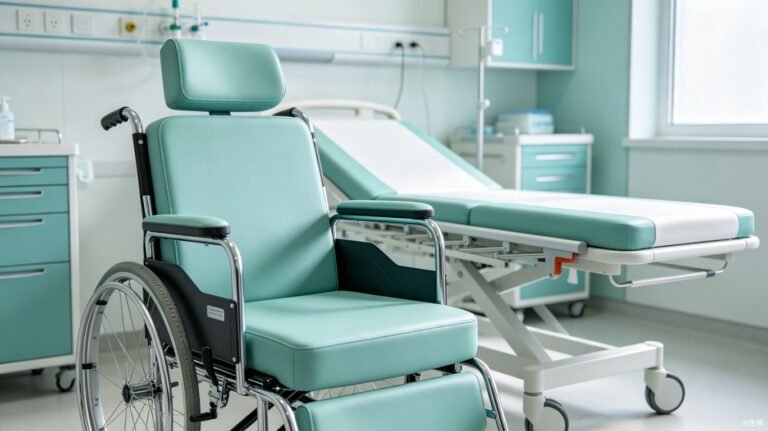
Medical chair upholstered with antibacterial silicone leather — safe for direct patient contact and repeated disinfection
Beyond antimicrobial performance, the material meets RoHS 2.0, REACH SVHC 181, and California Prop 65 requirements. It contains zero formaldehyde, phthalates, BPA, PFAS, or plasticizers — all substances that face increasing regulatory scrutiny in healthcare environments. VOC emissions are negligible, and the material is completely odorless, which matters in enclosed clinical spaces.
How Silicone Leather Reshapes Hospital Procurement Decisions
The procurement implications go beyond material substitution. When facility managers in the case study calculated total cost of ownership, they found that silicone leather’s higher upfront cost was recovered within 14 months through eliminated replacement purchases and reduced cleaning labor. Over a 7-year projected lifespan, the TCO ran approximately 40% lower than vinyl’s.
For B2B procurement teams writing specifications, the case study surfaces three questions that separate viable suppliers from the rest:
- Can the supplier provide ISO 10993 biocompatibility test reports? Many manufacturers claim “medical grade” without the testing to back it. Ask for the actual lab report, not a marketing one-pager.
- What is the verified disinfectant resistance cycle count? If the number is below 2,000 cycles, the material will not survive a busy clinical environment. The TOPSUN benchmark is 5,000+.
- Is the antimicrobial property integral or coating-based? Coatings wear off under repeated disinfection. Integral antimicrobial performance — built into the polymer structure — does not degrade over time.
If you are evaluating silicone vs PU leather for medical applications, the case study data points to one conclusion: under real hospital disinfection protocols, silicone leather’s lifespan advantage more than compensates for its higher unit cost. For a deeper look at how the material is engineered, our silicone leather introduction covers the manufacturing process and substrate options.
Hospitals that have already transitioned report an unexpected benefit: patient satisfaction scores improved. In the 12-clinic network, the “cleanliness and comfort” patient survey metric rose by 18 points after the switch. Silicone leather feels softer and warmer than vinyl, which patients notice — especially during long waiting periods or extended treatment sessions.
Frequently Asked Questions
How long does silicone leather last in a hospital environment compared to vinyl?
In the case study data, silicone leather projected to exceed 7 years under daily hospital use, compared to approximately 3 years for vinyl under identical conditions. The 18-month tracking period showed zero surface failures for silicone versus 12 replacement incidents for vinyl. The extended lifespan comes from the material’s resistance to disinfectant chemicals — silicone withstands 5,000+ wipe cycles while vinyl starts cracking before 1,000.
Can silicone leather withstand hospital-grade disinfectants like bleach and alcohol?
Yes. TOPSUN silicone leather has been tested against 70% isopropyl alcohol, quaternary ammonium solutions, and sodium hypochlorite (bleach) for 5,000+ disinfection cycles with no surface degradation, discoloration, or cracking. This is verified through repeated wipe testing protocols that simulate daily clinical cleaning frequency.
Does silicone leather meet fire safety standards for healthcare facilities?
Silicone leather meets BS 5852 (UK furniture fire safety), DIN EN 1021 Parts I & II (European upholstered furniture flammability), CAL B117-2013 (California fire retardant), and 16 CFR 1610 (US textile flammability). These certifications cover the standards most commonly required by hospital facility management and insurance requirements. For further guidance on maintaining silicone leather surfaces, see our cleaning and maintenance guide.
The Bottom Line for Healthcare Procurement
This silicone leather hospital case study makes one thing clear: when you measure total cost of ownership — not just material unit price — silicone leather outperforms vinyl by a wide margin in clinical environments. The 85% reduction in replacement requests, 60% drop in cleaning labor, and zero failure rate over 18 months are not projections. They are documented outcomes from real healthcare facilities.
For procurement teams still defaulting to vinyl because “it’s cheaper,” the question to ask is: cheaper for how long? In a hospital running 60+ rooms with daily disinfection cycles, vinyl’s 3-year replacement cadence and cleaning labor overhead make it the more expensive option. Silicone leather changes that equation by delivering 7+ years of service with lower maintenance costs at every step.
Request Hospital Upholstery Samples
About TOPSUN
TOPSUN engineers medical-grade silicone leather for hospital beds, clinic seating, examination table covers, and treatment bed surfaces deployed across 200+ healthcare facilities worldwide.
ISO 10993 biocompatibility certified · ISO 22196 antimicrobial verified (99.9% bacterial kill rate) · 5,000+ disinfectant resistance cycles · Zero-VOC, formaldehyde-free, phthalate-free formulation · BS 5852 and CAL B117 fire safety compliant