The toe crease is where PU material shoes tell the truth. In any wear trial, that narrow fold across the forefoot bends tens of thousands of times before a single review goes online. Last spring, a European casual footwear brand sent us samples from a three-month trial. The uppers looked flawless on the display shelf. Across every toe crease, however, a fine white powder had started to lift, the first visible stage of coating delamination.
That brand had chosen its upper on price per square foot alone. The samples taught a harder lesson: the material decision had to be judged by how it fails, not how it looks on day one. This article walks through what PU actually is, where it fails first, and the five checks we run before any shoe program commits to it.
| Upper Material | Typical Retail Role | Service Life | First Failure Mode |
|---|---|---|---|
| PVC synthetic | Budget casual | 1-2 years | Stiffness cracks at flex points |
| Standard PU | $20-50 mid-market | 18-30 months in humid climates | Flex delamination, then hydrolysis |
| Hydrolysis-resistant PU | Humid-climate programs | 4-6 years | Surface wear at 30-50% cost premium |
| Microfiber synthetic | Premium synthetic | Longest synthetic service life | Edge wear at seams |
| Silicone-coated | Long-wear and contract | 10-15 years | None observed in 14-week hydrolysis testing |
What PU Material in Shoes Actually Is
PU stands for polyurethane: a resin layer coated onto a fabric base, usually polyester or a non-woven sheet, then embossed with a grain pattern at 150-180°C. The finished sheet runs 0.5-1.2mm thick. Two production routes dominate. Dry process coats PU resin onto release paper and laminates it to the substrate, which yields a denser, more durable surface. Wet process coagulates resin in a water bath, which gives a softer hand-feel at a lower price.

Coating line at work: the resin layer’s thickness and cure quality decide most upper failures before the sheet ever reaches the cutting table.
In 2026, PU holds an 8-12% share of mid-market footwear uppers and dominates the $20-50 retail category, according to footwear sourcing data from ChinaShoe. It is the volume material for school shoes, basic dress shoes, and cost-optimized casual lines. FOB pricing sits at $1-3 per square foot, which is 60-75% below top-grain leather.
The trade-off is built into the chemistry. PU is water-resistant, easy to clean, and visually uniform from panel to panel. It does not breathe, and its polymer chains slowly break down in the presence of heat and moisture. That second weakness is the one that turns into warranty claims.
Where PU Material Shoes Fail First: Flex and Hydrolysis
Two failure modes account for most PU upper returns. The first is mechanical. Every step bends the coating against its fabric backing, and the two layers do not stretch at the same rate. Over time the coating separates from the backing, which the trade calls delamination. You see it as flaking across the toe crease. A quality inspector can reproduce it in the lab with a flexing tester long before consumers ever notice.
Flex testing in our lab: samples survive tens of thousands of bends before we approve a material for a footwear program.
The second failure mode is chemical. Hydrolysis breaks PU polymer chains in humid heat, turning the surface sticky, then cracked, then structurally weak. Sourcing data puts standard PU service life at 18-30 months in tropical climates and 5-10 years in dry ones. The industry’s fix is hydrolysis-resistant PU, sometimes marketed as bio-PU, which extends tropical life to 4-6 years at a 30-50% cost premium.
In our own climate chamber, at 85°C and 85% relative humidity over 14 weeks, silicone-coated samples show no delamination, no strength loss, and no surface degradation. PU controls in the same chamber typically fail within the test window. That gap is why material choice matters more in humid markets than any other single specification.
The 2026 Supply Shift: Water-Based PU and Stricter Rules
Supply is concentrating at the same time demand grows. China produces roughly 70% of the world’s PU synthetic leather, led by clusters in Wenzhou and Guangdong, while Taiwan holds about 15% of premium output and South Korea around 8%. Concentration cuts both ways for buyers. Quotes stay competitive because capacity is deep. But one regional disruption can stall a whole season’s upper supply across dozens of brands at once.
Regulation is also reshaping formulations. The wet process has traditionally relied on DMF solvent, and REACH pressure from the EU is driving a visible 2026 shift toward water-based PU that removes it. The change is real progress, yet it adds a documentation step: buyers should now ask which process a supplier runs and request the solvent declaration alongside the price. A quote that looks cheap on paper can carry audit costs later.
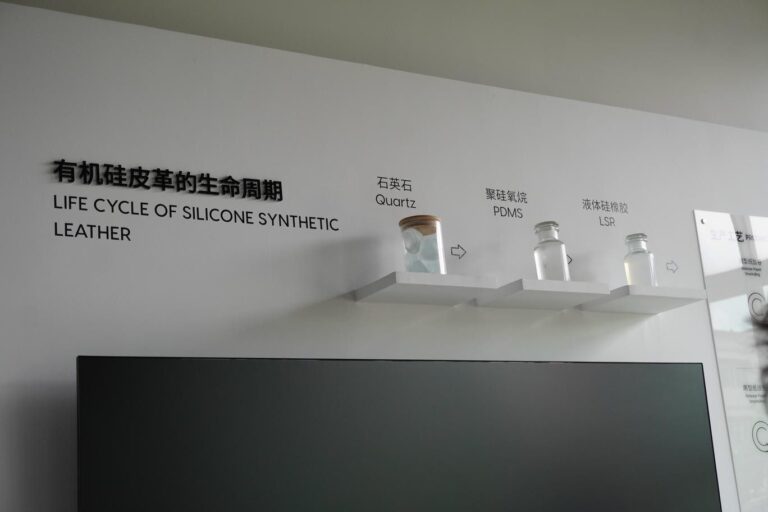
Our own production line sidestepped the solvent question entirely. The silicone system is solvent-free from the first coating pass, with VOC results at non-detect levels under ISO 16000-6, so the REACH conversation starts from a clean position. That difference matters most for programs selling into Europe, where retail customers increasingly request the paperwork before the price sheet.
The Five Checks Before You Commit a Shoe Program
Our QC team runs the same sequence on every upper material before it enters production. Buyers can ask any supplier for the same five data points:
1. Flex endurance. Ask how many Bally flex cycles the material survives before surface cracking. Fewer than 30,000 cycles signals trouble for daily-wear shoes.
2. Hydrolysis data. Request climate-chamber results, not marketing labels. A real test report lists temperature, humidity, and duration.
3. Abrasion loss. A Taber test target under 50mg loss per 1,000 cycles is the sourcing benchmark for durable uppers.
4. Chemical documentation. REACH and PAHs compliance matters for EU entry. Solvent-free production with non-detect VOC per ISO 16000-6 removes a whole class of audit risk.
5. Color fastness. Grade 4-5 on the standard scale keeps the upper matching across production batches and after cleaning.

Performance documentation separates materials that pass a wear trial from materials that pass a price comparison.
Cost Per Season: The Real Math on PU Material Shoes
The savings look large at the invoice level. Switching a 1.2-square-foot upper from top-grain leather to PU saves roughly $2.50-5.40 per pair, since PU adds only $1.20-3.60 in material cost against $4-9 for leather. For a $30 shoe, that difference can decide whether the program survives buying-season pricing.
The honest math divides cost by service life instead. A $2 upper that lasts two seasons costs more per season than a $6 upper that lasts ten. Hydrolysis-resistant grades narrow the gap, and silicone-coated materials close it entirely in long-wear programs.
The market context supports the investment. Women’s footwear alone is projected to grow from $216.9 billion in 2026 to $381.2 billion by 2036, per Future Market Insights. Synthetic materials already carry 45% of that demand. Volume is not the constraint. Return rates decide whether a program earns its shelf space. Buyers who plan for return rates instead of sticker prices are the ones still holding shelf space in season three.
When to Spec Silicone or Microfiber Instead
Silicone-coated uppers make sense when the shoe’s job punishes PU’s weaknesses. Kids’ shoes that live in rain and mud, work footwear rated for years of service, and sports applications with daily flexing all favor a chemistry that cannot hydrolyze. Silicone polymer chains resist water by nature, hold flexibility from -40°C up to 200°C, and pass abrasion requirements that most PU formulations cannot reach. A direct chemistry comparison is in our silicone vs PU analysis.

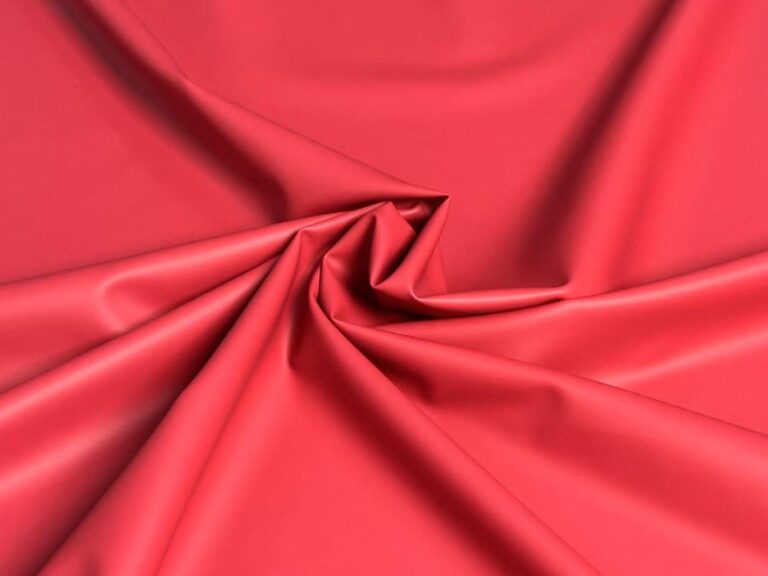
Lychee-texture sheets in program colors: alternative chemistries now match the look of PU without its service-life ceiling.
Microfiber earns its place in premium synthetic lines, where hand-feel and seam strength justify its higher cost. For buyers weighing the two, our hydrolysis-resistant silicone leather page documents the test data behind the 10-15 year service estimate. Sports and lifestyle programs can also review fit-for-purpose options on our fashion and sports applications page.
TOPSUN produces silicone-coated leather for footwear and accessory programs that outlast standard PU, with Martindale results above 200,000 cycles and SGS reports shipped with every order. Our 500,000-meter monthly capacity keeps mid-market programs supplied on 7-15 day lead times, and Pantone or RAL color matching runs on the same line.
Match the Material to the Shoe’s Job
PU material shoes are not a mistake. They are a specific tool with a specific lifespan, and the failure comes from mismatching the tool to the job. Before your next upper order, put four actions on the list:
1. Define the shoe’s real service life, then pick the chemistry that survives it, not the one that quotes lowest.
2. Match climate to grade: standard PU for dry markets, hydrolysis-resistant or silicone for humid ones.
3. Demand the five test reports as a condition of sampling, not after approval.
4. Run a 90-day wear trial on the toe crease before committing volume.
References
- ChinaShoe, “Polyurethane (PU) Synthetic Leather”: PU share of mid-market uppers, FOB pricing, hydrolysis timelines, and cost-per-pair comparisons. https://www.chinashoe.cc/knowledge/materials/po…
- Future Market Insights, “Women’s Footwear Market”: market size 2026-2036 and synthetic share of material demand. https://www.futuremarketinsights.com/reports/wo…