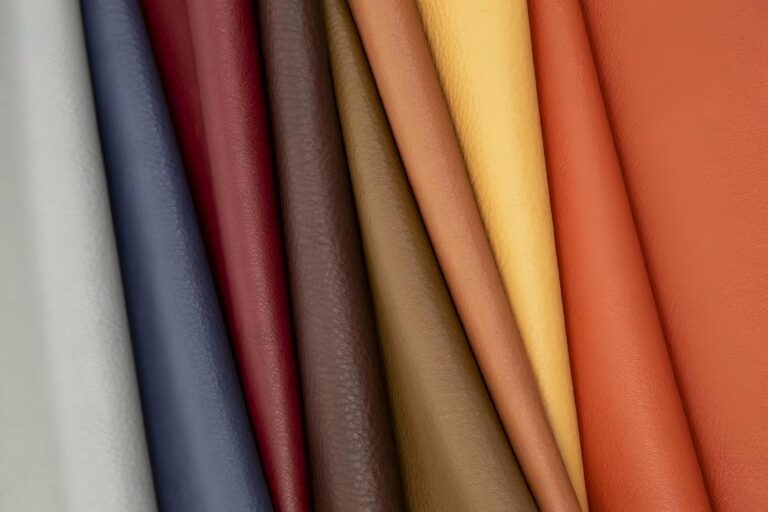
Here is the problem with premium synthetic leather. No ISO standard, no ASTM method, and no trade regulation defines the word. A supplier can print it on a quotation for a $0.88-per-meter roll or a $12-per-bag microfiber build. Both quotes are equally legal.
The conclusion of this article is short. Premium is a claim, and a claim only counts when a document carries it. What follows is the five-proof framework we use to substantiate the word. It covers test data, certification scope, process records, warranty terms, and third-party verification.

Proof one starts here: a named test, on a named machine, with a report number attached.
The Premium Price Ladder, and Where the Word Loses Meaning
The market prices premium roughly three tiers deep, and the gaps are real money. Standard PU for bags runs an estimated $1.5 to $4 per bag at the material line. Water-based PU adds an eco premium at $2.5 to $5. Microfiber PU, the tier most listings mean by premium, runs $5 to $12 per bag. Below all of it, commodity synthetic leather trades at $0.88 to $2.5 per meter.
The drivers behind the ladder are physical: coating thickness, substrate type, and surface system. Coating alone moves price from $2.50 to $8.00 per square meter. That spread maps thickness climbing from 0.5-0.8 mm toward 1.0-1.5 mm. So when a quote says premium without numbers, the honest translation is: pay first, discover the tier at the dock.
| Tier | Cost band | What premium must add | Document that proves it |
|---|---|---|---|
| Standard PU | $1.5–4 per bag (est.) | Baseline wear performance | Martindale report, baseline grade |
| Water-based PU | $2.5–5 per bag (est.) | Solvent-free process | VOC test report, process declaration |
| Microfiber PU | $5–12 per bag (est.) | Fiber structure, hand feel, durability | Construction spec, Martindale 100K+ |
| Silicone-coated | Contract-grade segment | Hydrolysis life, disinfection tolerance | Hydrolysis hours, cert scope, SGS report |
The Five Proofs, Document by Document
Proof one is test data with named standards. A defensible premium quote cites Martindale cycles under ISO 12947. It also names hydrolysis hours under 85°C and 85 percent humidity, and lightfastness hours under ISO 105-B02. The numbers must come from a lab report with a date and a batch, not from a brochure. Generic “high abrasion resistance” language is not proof. It is decoration.
Proof two is certification scope, not logos. A certificate image proves nothing until it carries scope, issuer, certificate number, and validity window. The premium segment should show REACH and PAHs compliance, plus ISO 10993 biocompatibility where skin contact applies. It should also carry FDA 21 CFR status for food-adjacent uses, RoHS, and California Prop 65 clearance. Ask for the scope PDF and check that the product family you are buying appears on it. Logos are marketing; scope pages are evidence.
Proof three is process control. Premium consistency is a production discipline, and it leaves records. Our own line runs multi-stage checks from raw material viscosity to final roll inspection. The stages cover in-line coating thickness, curing temperature, and spectrophotometer Delta E color control. Buyers are welcome to audit those nodes; the factory production notes describe each stage. If a supplier cannot name a single control point in their process, their premium is a label.

The physical lab: where proofs one through three either exist as reports or do not.
Proof four is warranty in writing. The premium tier should carry warranty terms that name years and coverage. A warranty is the supplier pricing their own risk. Vague promises about “long service life” transfer all risk to the buyer. Our contract-grade warranty approach is mapped in the notes on synthetic leather service life. The same pages cover the test hours behind it.
Proof five is third-party verification on the order itself. Premium claims survive contact with a customs lab and a client QA team. An SGS test report should ship with every order. Third-party inspection by SGS, BV, or TÜV should be welcome, not resisted. A supplier who blocks inspection is answering the premium question before you ask it.
Where the Word Fails the Audit
Four red flags end most premium audits early. First, certificate logos without scope pages. Second, premium pricing attached to a quote with no test numbers at all. Third, “OEM quality” as the only quality language in the thread; OEM describes the business model, not the roll. Fourth, a warranty that covers shipping damage but not material performance. Any one of these means the premium you are paying for exists only in the subject line of an email.

Where documented premium ends up: automotive interiors, contract seating, and brands that can afford a failed claim.
The Paper Trail We Publish
We manufacture silicone-coated synthetic leather, and we apply the five-proof standard to our own quotation. Every order ships with an SGS test report. Certification files cover REACH and PAHs, ISO 10993, FDA 21 CFR food-contact status, RoHS, and Prop 65. Buyers receive the scope documents, not just the marks.
Test data for the premium lines includes Martindale sampling per ISO 12947. Hydrolysis resistance is verified under 85°C and 85 percent humidity conditions. Production runs 500,000 square meters per month with a 500-meter minimum order. The company has eight-plus years of coating experience and clients in more than 30 countries. For constructions that pair the premium proof set with a microfiber build, the silicone microfiber line lists the full specification.
One line closes the audit: premium synthetic leather is the five documents, or it is a surcharge.
FAQ
Is premium synthetic leather worth the price gap?
Only when the gap lives in documents. A 2 to 4 times price difference is justified when all five proofs move up a tier with it. Test data, certification scope, process records, warranty terms, and third-party reports should each rise. If only the price moves, the gap is margin.
What documents belong in a premium quote?
Five, at minimum. A lab test report with named standards, certification scope pages, and a process control summary. Then written warranty terms and a third-party inspection arrangement. A quote missing any one of the five is describing standard material in premium language.
Request Five-Proof Sample Packs
References
1. https://www.lilalilabags.com/pu-leather-for-bag… — PU grade cost ladder: standard $1.5–4 per bag, water-based $2.5–5, microfiber $5–12 (estimated planning ranges)
2. https://fjyudeng.com/purchase-pu-leather-how-to… — Coating thickness as price driver: $2.50–8.00 per sqm across 0.5–0.8 mm to 1.0–1.5 mm builds