If you’re designing or manufacturing baby play mats, you already know that play mat leather material selection is the most important decision you’ll make. The surface material isn’t just what the baby touches — it’s what they put in their mouth, what they crawl on for hours, and what gets covered in snacks, juice, and who knows what else. Parents are paying more attention than ever to what’s in their baby’s products, and the wrong material choice can sink a product faster than any design flaw.
In this product design guide, we’ll walk through the key material requirements for baby play mats, compare the main material options on the market, and explain why silicone leather is becoming the premium choice for brands that want to stand out on safety, quality, and design.
Explore Baby & Kids Material Solutions
What Makes a Good Play Mat Surface Material?
Before we compare materials, let’s establish what we’re looking for. A play mat surface material needs to satisfy a surprisingly long list of requirements — and if any of them fails, the whole product suffers.
Safety Above All Else
This is non-negotiable. Babies put everything in their mouths — the mat, their hands after touching the mat, toys that have been on the mat. The surface material must be non-toxic, free of harmful chemicals like phthalates, BPA, lead, and formaldehyde. Ideally, it should meet food-contact safety standards, because if a baby can reach it, it’s going in their mouth. The material should also be hypoallergenic — no fragrances, no chemical residues, no potential irritants that could cause skin reactions or respiratory issues.
Easy to Clean — Really Easy
Play mats get dirty. There’s food, formula, juice, pureed vegetables, and — let’s be honest — the occasional diaper leak. A good play mat material should be wipeable with minimal effort. If parents need special cleaners, multiple steps, or have to worry about stains setting in, they’re going to be frustrated. Bonus points if it can be disinfected without damaging the surface, because when baby gets sick, you want to be able to actually clean the mat, not just wipe it with a damp cloth and hope for the best.
Soft and Cushioned but Firm Enough
The surface material works together with the foam core to create a safe, comfortable play surface. The outer material should be soft to the touch — pleasant for baby’s hands, knees, and cheeks — but not so soft that it’s hard to crawl on. It should provide a little give for tumbles, but still be firm enough that babies learning to crawl and walk get good traction. The texture matters too: too slippery and baby slides around; too rough and it irritates sensitive skin.
Durable Enough to Last
A play mat that tears or peels after a few months of use isn’t just a bad product — it’s a safety hazard, because peeling material can become a choking risk. The surface material needs to stand up to daily use: crawling, rolling, being pulled on, having toys dropped on it, and being cleaned constantly. It should also maintain its appearance — parents don’t want a play mat that looks beat up after three months, even if it’s still technically functional.
Looks Good in the Home
Let’s be real: the play mat is probably going to live in the living room. Parents want baby products that don’t make their house look like a daycare center. A play mat with a premium, attractive surface material — something that looks like a nice rug or a designer home accessory — will command a higher price point and get better reviews than one covered in cartoon characters and bright primary colors. The “instagrammable” factor matters more than you might think.

Safety testing in our quality lab — baby and kids products require the highest standards of material purity and non-toxic certification.
Designer tip: When parents research play mats, they don’t just look at the price and the pictures. They read the Q&A section, they search for “is this non-toxic,” they look for certifications like OEKO-TEX, FDA food-contact, and REACH compliance. If your product page doesn’t clearly state what certifications the material has, parents will assume the worst — and buy from a brand that does provide that information. Be specific, be transparent, and back it up with actual test results.
Comparing Play Mat Surface Materials
Now let’s compare the four most common play mat surface materials and how they stack up against the requirements we just discussed.
| Material | Safety / Non-Toxic | Cleanability | Softness | Premium Look |
|---|---|---|---|---|
| EVA foam (exposed) | Low (formamide concerns) | Poor (porous, stains) | Medium | Low |
| PU leather coating | Medium (additives, VOCs) | Good (wipes clean) | Medium | Medium-High |
| Fabric / microfiber | Medium-High | Very poor (absorbs) | High | High |
| Silicone leather | Highest (food-safe, inert) | Excellent (wipes instantly) | High (warm, soft) | Very high |
EVA Foam: Budget Option with Safety Questions
Exposed EVA foam is the cheapest option, which is why it’s so common in discount play mats. But it has significant drawbacks: it’s porous, so spills soak in and stains are permanent. More importantly, EVA foam has been linked to formamide emissions — a chemical that’s been restricted in children’s products in the EU and several US states. Even “non-toxic” EVA can have trace amounts, and the off-gassing is strongest when the mat is new. For budget products it’s still common, but for premium brands, EVA is increasingly seen as a liability rather than a feature.
PU Leather: The Mid-Range Workhorse
PU-coated play mats are a big step up from EVA. The PU surface is smooth, wipeable, and gives the mat a more premium appearance. But PU has its issues: it contains plasticizers and other chemical additives that some parents are wary of. It can also peel or crack over time, especially if it’s cleaned with disinfectants that break down the PU coating. For mid-range products, PU is a solid choice — but for brands positioning themselves as “premium” or “non-toxic,” PU is increasingly being replaced by silicone.
Fabric: Comfortable but Impractical
Fabric-covered play mats are the most comfortable and can look like nice area rugs. But they have a fatal flaw: they absorb everything. Spills soak in, stains set, and over time they can develop odors from trapped food and moisture. Some are machine washable, but washing a full-size play mat is a huge hassle — most home washing machines can’t handle them. Fabric is a great choice for nursery rugs that don’t get food on them, but for an actual play mat where babies eat, it’s a poor match.
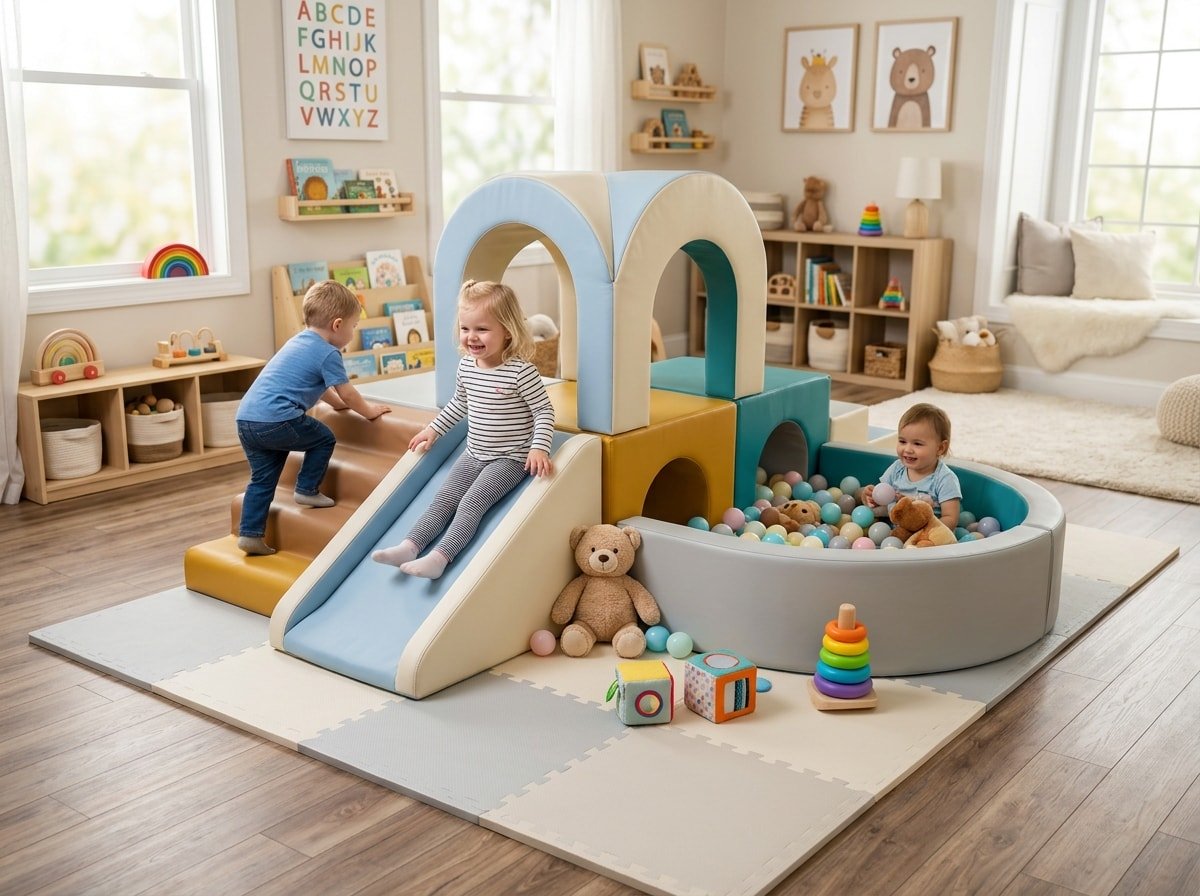
Premium play mats in modern nurseries — the right surface material keeps babies safe while complementing home decor.
Baby play mat material demonstration — see how silicone leather handles common baby messes compared to PU and EVA foam.
Why Silicone Leather Is the Premium Choice
Silicone leather checks every box for a premium play mat surface material — and in some categories, it exceeds what parents even knew they wanted. Let’s walk through the specific advantages.
Food-Safe Level of Purity
Silicone is widely used in baby products — bottle nipples, teething toys, baking mats, food storage containers — because it’s one of the safest materials available. It’s chemically inert, which means it doesn’t leach chemicals, doesn’t off-gas, and doesn’t react with food or skin. For a play mat surface, this is a game-changer. Parents don’t have to worry about what’s in the material, because the same material is used in products that babies actually put directly in their mouths. Silicone leather can be formulated to meet FDA and LFGB food-contact standards, which is the highest bar you can set for a baby product.
Effortless Cleaning That Actually Works
Because silicone has low surface energy, liquids bead up on it instead of soaking in. Spilled juice? Wipe with a damp cloth — gone. Spaghetti sauce? Wipe with a little soap — gone. Diaper cream? Wipe with a disinfectant wipe — gone. No scrubbing, no waiting, no stains. This is the single biggest day-to-day benefit for parents, and it’s the reason silicone play mats get such rave reviews for “easy to clean.” It’s not just marketing — it genuinely takes seconds to clean up any mess.
Soft, Warm, and Pleasant to Touch
Silicone has a naturally warm, soft feel that’s different from plastic or PU. It’s not slippery — babies get good traction when crawling — but it’s smooth enough that it doesn’t irritate sensitive skin. It also doesn’t get cold the way some plastic surfaces do, which means babies are more likely to be comfortable playing on it even in cooler rooms. It’s hard to describe the tactile difference in words, but most parents who feel a silicone play mat for the first time immediately understand why it’s a premium product.
Naturally Antimicrobial
Silicone doesn’t provide the nutrients that bacteria and fungi need to grow, so microbial levels on silicone surfaces are naturally lower than on organic materials. Combined with easy cleanability, this means a silicone play mat stays hygienic longer between deep cleanings. For parents of babies with sensitive skin or allergies, this is a big plus. It’s also a strong selling point for daycare centers and other commercial settings where hygiene is critical.
Premium Appearance That Fits Any Home
Silicone leather has a subtle, sophisticated texture that looks more like a high-end furniture material than a baby product. It’s available in a wide range of colors — from neutral creams and grays to soft pastels to bold statement colors — so you can design a play mat that parents will actually want to display in their living room. This isn’t just aesthetics; it’s a key differentiator in a crowded market where most play mats look the same. A premium surface texture is one of the easiest ways to justify a higher price point.
Product design note: Silicone leather laminates well to foam cores, but the lamination process is different from PU. You’ll want to work with your material supplier early in the design process to make sure the adhesive system and lamination parameters are optimized for silicone. Done right, the bond is extremely strong — no peeling, no delamination, even after years of use and hundreds of cleanings.
The Play Mat Market Is Moving Upmarket
The play mat category has exploded in recent years, and the trend is clear: parents are willing to pay more for products that are genuinely safe, beautifully designed, and easy to live with. The budget EVA foam mat still dominates the low end, but the fastest-growing segment is premium play mats with silicone leather surfaces — and it’s not hard to see why. When you combine food-safe materials, effortless cleaning, soft comfort, and beautiful design, you get a product that parents are genuinely excited to buy and recommend to their friends.
If you’re designing a new play mat or upgrading an existing product line, silicone leather is worth serious consideration. The material cost is higher than PU or EVA, but the value it adds — in safety claims, customer satisfaction, review quality, and price point — more than justifies the investment.
Request Play Mat Material Samples
About TOPSUN
TOPSUN supplies premium silicone leather materials for baby and kids products, helping brands create safer, more beautiful play mats and children’s furniture that stand out in a competitive market.
FDA food-contact safe formulations, LFGB European food safety certification, REACH and RoHS compliance, OEKO-TEX Standard 100 compatible, hypoallergenic and phthalate-free, custom texture and color development for brand differentiation.