A procurement team orders 200 sofas for a new hotel wing. The spec sheet says microfiber leather sofa upholstery — 15% more expensive per meter than standard PU. The finance team pushes back on the cost increase. Here’s what the cost analysis actually shows when you look past the unit price and calculate five years of ownership: cleaning, maintenance, replacement cycles, and disposal. The microfiber leather market is valued at $2.84 billion in 2026 and growing — but growth alone doesn’t justify a spec change. Total cost of ownership does.
Why a Microfiber Leather Sofa Costs More Upfront
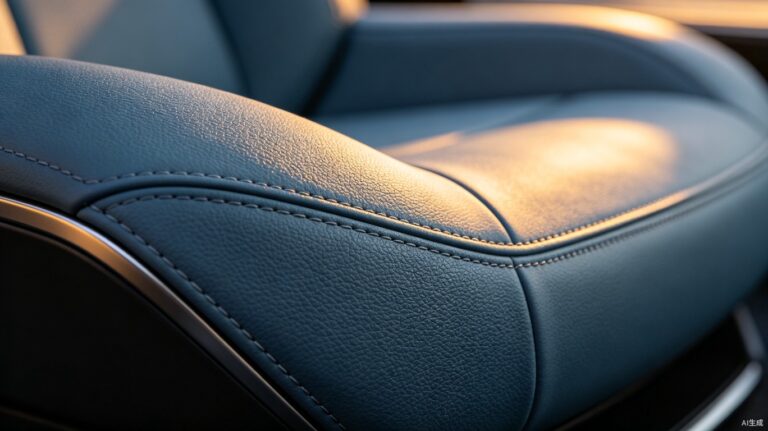
Microfiber leather is not the same material as standard PU leather. It uses an ultra-fine fiber substrate — individual filaments thinner than 0.7 denier — impregnated with polyurethane to create a three-dimensional structure that mimics the fiber density of genuine hide. This construction gives microfiber leather its superior tensile strength and tear resistance. It also makes the material more expensive to produce: the fiber spinning process, nonwoven web formation, and PU impregnation require more energy, more equipment, and more time than a simple knife-over-roll PU coating on polyester fabric.
The upfront cost difference is real: microfiber leather typically runs 15–25% more per meter than standard PU. For a sofa that uses 8 meters of material, that’s a material cost increase of roughly $30–50 per unit. On a 200-sofa order, the premium is $6,000–10,000. That number is what makes finance teams hesitate — and it’s also the number that disappears when you calculate year three.

Flexibility and bending testing — microfiber’s dense fiber core resists cracking where standard PU delaminates after repeated flexing.
The 5-Year TCO Breakdown: Three Materials Compared
The unit price is the first line of the cost spreadsheet. It is not the last. Here’s what happens when you extend the calculation across a five-year service period for a hotel lobby sofa environment:
| Cost Factor | Standard PU | Microfiber PU | Silicone Leather |
|---|---|---|---|
| Material cost/meter | $3–5 | $5–8 | $8–12 |
| Martindale cycles | 20K–40K | 100K–150K | 200K+ |
| Replacement cycle | Every 2–3 years | Every 5–7 years | Every 10+ years |
| Cleaning products | Specialty cleaners | Mild detergent | Bleach-safe |
| UV degradation onset | Year 1–2 | Year 3–4 | Year 10+ |
| 5-year total (200 sofas) | $48K–65K | $32K–42K | $24K–30K |
The table tells the story that the unit price hides. Standard PU sofas need replacement within 2–3 years — meaning the hotel buys 200 sofas, then replaces 200 sofas, then replaces them again within the 5-year window. Microfiber extends the replacement cycle to 5–7 years, meaning one replacement event instead of two. Silicone leather eliminates replacement entirely within the 5-year period. Understanding the full versus semi silicone leather distinction matters here: a semi-silicone microfiber hybrid may offer a middle ground on cost while extending service life beyond standard microfiber PU.

Production floor with finished leather rolls — the volume and consistency that determines whether your 200-sofa order ships on time.
Where a Microfiber Leather Sofa Actually Saves Money
The savings from microfiber leather don’t come from the material cost — they come from three places the initial quote never mentions:
1. Replacement frequency. A standard PU sofa in a hotel lobby shows visible wear — gloss loss at armrests, micro-cracks at seat edges — within 18 months. By month 30, the surface is delaminating. Microfiber leather’s dense fiber core resists the flexing and abrasion that destroy standard PU. With 100,000+ Martindale cycles, a microfiber leather sofa reaches the same wear threshold at year 5–7, not year 2–3. One replacement event instead of two saves $15K–20K on a 200-unit order.
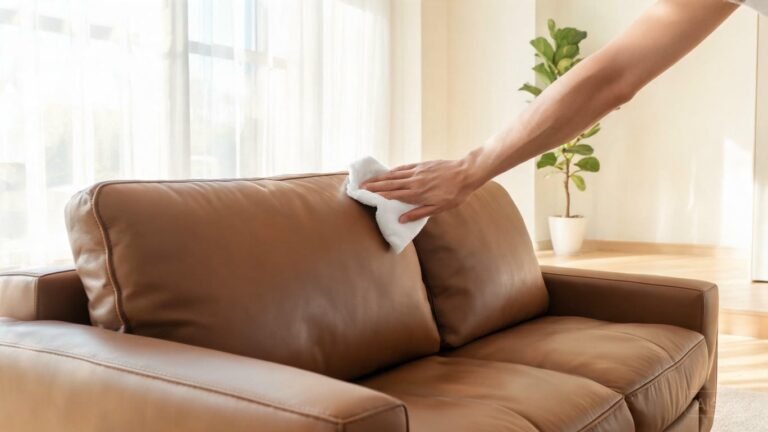
2. Cleaning chemical tolerance. Housekeeping teams clean with whatever is in the supply closet — usually alcohol wipes or quaternary ammonium sprays. Standard PU degrades under these chemicals within months: the surface becomes tacky, then brittle, then cracked. Microfiber PU tolerates mild detergents better than standard PU, extending the material’s usable life in environments with frequent cleaning. The cleaning cost differential over 5 years is modest per unit — but across 200 sofas, it adds up to $3K–5K in avoided premature replacement.
3. Labor and logistics. Replacing 200 sofas is not just a material cost — it’s labor to strip old upholstery, logistics to dispose of it, and operational disruption while rooms are out of service. One avoided replacement cycle saves an estimated $8K–12K in labor and logistics alone. This is the cost line item that never appears on a material spec sheet but always appears on the operations budget.
TCO verdict: Over 5 years, the microfiber leather sofa costs 30–35% less than the standard PU sofa — despite the 15–25% higher upfront material cost. The savings come from fewer replacement cycles, lower cleaning damage, and reduced labor disruption.

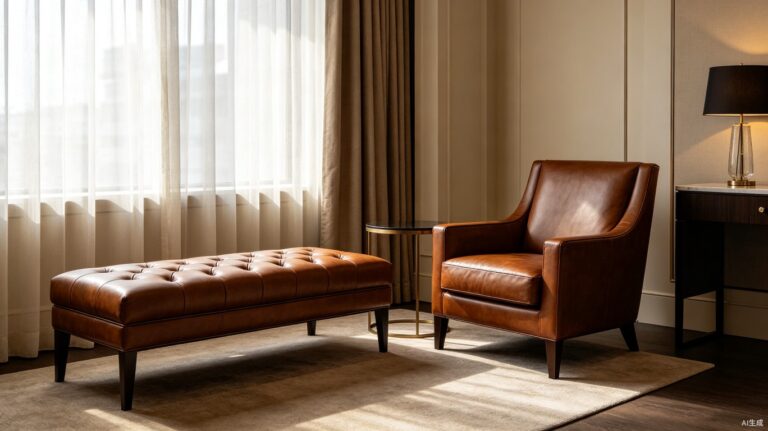
Microfiber leather in furniture application — the dense fiber structure that extends service life from 3 years to 7, but still hydrolyzes in humid environments.
The Silicone Upgrade: When TCO Demands More
Microfiber leather solves the abrasion problem that destroys standard PU. It does not solve the hydrolysis problem. In environments with > 60% average humidity — coastal properties, tropical climates, spa and pool areas — the PU impregnation in microfiber leather still absorbs water vapor and degrades over time. The fiber core lasts, but the PU binder breaks down, and the material delaminates.
This is where silicone leather enters the TCO calculation. In our Martindale testing, silicone-coated leather exceeds 200,000 cycles — 33% more than high-grade microfiber’s 150,000. More importantly, silicone is hydrolysis-proof: the polymer chemistry does not react with water vapor. A hydrolysis-resistant silicone leather sofa in a tropical hotel environment lasts 10+ years without delamination — compared to microfiber PU’s 5–7 years.
The silicone premium over microfiber is roughly 40–60% per meter. But the TCO math is the same: one replacement event avoided over 10 years pays for the premium. For environments where hydrolysis is not a factor (dry climates, indoor climate-controlled spaces), microfiber leather is the cost-optimal choice. For environments where humidity is the dominant failure mode, silicone is the only material that qualifies. Reviewing a silicone vs microfiber leather comparison before specification ensures the material matches the environment.
For the furniture sofa application segment, the decision framework is straightforward: dry environment + budget constraint → microfiber leather. Humid environment + 10-year horizon → silicone leather. Either way, both options outperform standard PU on TCO by 30% or more over a 5-year period.
The Number That Matters
A microfiber leather sofa costs more on day one and less on day 1,825. That’s the entire TCO argument in one sentence. The procurement teams who get this right don’t fight the upfront cost — they present the 5-year calculation to finance and let the numbers make the case. When the alternative is buying, replacing, and re-buying standard PU sofas, the microfiber premium pays for itself by year three.
And for environments where microfiber’s hydrolysis vulnerability is the limiting factor, silicone leather extends the same TCO logic to a 10-year horizon. The material you specify today determines the budget you defend tomorrow. According to market research valued at $2.84B in 2026, more buyers are catching on — but the ones who calculate TCO before specifying, not after replacing, are the ones who actually capture the savings.
About TOPSUN
TOPSUN supplies silicone and microfiber leather to furniture manufacturers who need upholstery material with verified abrasion data and full compliance documentation for sofa production.
200,000+ Martindale cycles verified by SGS | 10+ year service life projection | Zero VOC solvent-free coating process | Free A4 swatches shipped worldwide | Delta E ≤ 1.0 color accuracy