The auction floor in Fort Worth opens at seven. Bales of salted hides come off flatbeds and the paddles go up fast. Most winning bidders will never own a tannery within a thousand miles of that room. The hides leave Texas the same week, headed for ports on both coasts.
That floor is the first station on the leather USA map, and it explains a paradox buyers hit every quarter. America raises some of the world’s most sought-after hide stock and ships almost all of it away. Ninety-five percent of US leather and hide use ends up as exports. The finished goods then return as upholstery, bags and shoe uppers wearing a foreign tannery stamp.
Follow the loop end to end and three questions answer themselves. What leaves, what stayed behind, and what a US-based project should actually spec. Here is the data at each stop, and a decision tree at the last one.
The Leather USA Loop: Hides Out, Finished Goods Back In
The loop starts with sheer scale. The US cattle herd yields raw material far beyond what domestic processing can absorb. The Leather & Hide Council of America puts exports at 95% of all US leather and hide use. That makes the country a top supplier in the global industry, a position it has held for more than 150 years.
The destination list reads like a world tanning map. China, Mexico, Vietnam, Italy, South Korea, Thailand and Brazil top the importer table. Each country buys for a different reason. Volume for mass footwear. Consistency for Italian luxury goods. Proximity for Mexican assembly plants feeding the same US market the hides left.
The return leg is where the cost lands. A hide sold green in Texas is bought back as finished leather at a multiple of that price, freight included, with two customs crossings on its record. Every mile of that round trip gets paid by the end buyer, whether that buyer is a furniture mill in North Carolina or a transit authority in Chicago.
Why does the loop persist if the freight is so wasteful? Capacity, not quality. Tanning is chemical engineering with effluent permits attached, and US permitting tightened while global demand grew. The plants that could not fund the upgrades closed. Their orders crossed the ocean. That history sets up the next stop.
Two customs crossings also mean two chances for paperwork to fail. Species declarations, valuation disputes and tariff classification all attach to the loop. Buyers who skip them inherit the seller’s problem. That paperwork risk lands on the US buyer, not the exporter.
What Ships Out: Auction Floors, Grades and 70 Destination Countries
US hides ship because they win on the grading sheet. LHCA describes American hide as the industry’s gold standard for quality, consistency and reliable supply. The origins behind that supply run a full spectrum, from major packing houses to small family ranches and regenerative farms.
Overseas tanneries pay for that consistency because defects are priced into their own output. A plant cutting automotive hides cannot tolerate variable thickness the way a job shop can. Uniform American supply de-risks their line, and that de-risking is worth cents per square foot before the first chemical ever touches the skin.
US hides now reach more than 70 countries. The export culture that grew around those shipments shaped how American leather is graded, measured and traded. Domestic buyers inherit a market pointed outward. A furniture brand sourcing finished leather inside the US is usually buying from the tail of a chain that began on an auction floor.

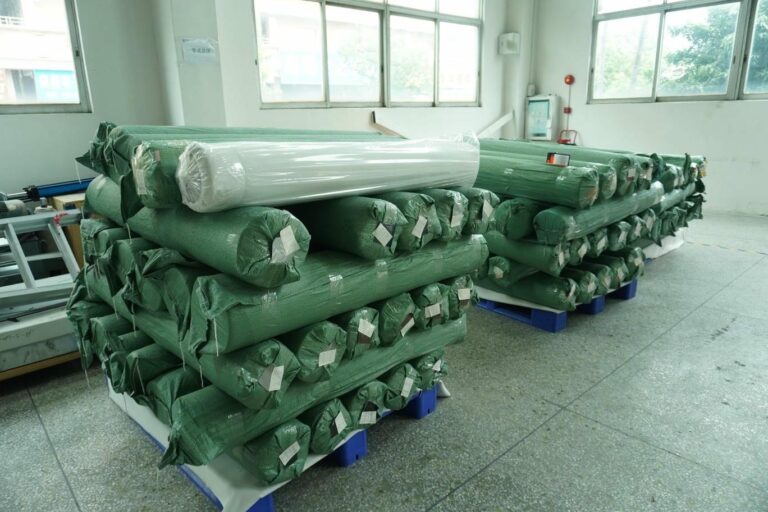
Rolls leave the finishing floor the way hides leave the auction: graded, wrapped and bound for a buyer who rarely meets the maker.
What Stayed Behind: A Tanning Base Measured in Hundreds of Plants
Domestic capacity tells the other half of the leather USA story. When the EPA last sized the sector for its effluent rulemaking, leather tanning and finishing employed about 12,700 people across roughly 110 facilities. That averages out to about 115 employees per plant. The snapshot dates to 1992, and the direction since has been one-way: consolidation, then shrinkage.
What survived specializes. The remaining US tanneries lean toward exotic skins, niche upholstery and oil-tanned work that overseas logistics handle poorly. Commodity volume does not survive on that base. If a project needs forty thousand meters of one repeatable spec, the domestic quote either never arrives or arrives with a lead time that kills the schedule.
Buyers feel this as a strange inversion. The country with the best hides has the thinnest shelf of finished leather. Every US spec that gets filled domestically competes against a landed cost from a tannery in Italy or Vietnam that shipped its first choice goods to the same market three years running.

Integrated volume lives where the coating line is, not where the herd is. Our three bases run that line at 6 million meters a year.
Watch: one line from silicone coating to finished roll, the single-factory traceability US buyers ask us for.
Where US Demand Lives: 38% of Global Spend and Three Buying Clusters
Demand in the US is too large to import around. Precedence Research sizes the global leather goods market at USD 528.24 billion for 2026, climbing to USD 874.80 billion by 2035 at a 5.78% CAGR. North America already held the largest regional share at 38% in 2025. Genuine leather keeps 54.1% of product type, so the import loop services a real and growing appetite.
Three clusters drive most US purchasing. Automotive interiors specify for abrasion cycles and cabin VOC limits. Contract furniture specifies for Martindale counts and flame standards. Aviation and transit specify for the same durability plus weight rules. Each cluster buys through a spec sheet, not a story. You can compare how each one is served on our applications overview.

Aviation is the strictest of the three clusters. Weight, flame and cycle specs all have to be on paper before a seat ever flies.
The automotive cluster deserves its own line. US OEM and aftermarket demand runs on interior durability programs, and the material that wins there sets the tone for consumer expectations everywhere else. Our automotive interior applications page lists the cycle and emission standards that cluster actually audits against.
Healthcare and education seating form a quieter fourth cluster. Their specs borrow from all three: cycle counts from furniture, VOC limits from automotive, flame rules from transit. US institutions buy that leather through the same import loop, often without knowing it. The loop reaches every seat in the building.
Buying Around the Loop: A Decision Tree for US-Based Projects
So how should a US buyer act on all this? Take the loop as fixed and run your project through four branches.
- Commodity volume on a hard delivery date? Buy from integrated manufacturers with published capacity. Domestic tannery job lots will not repeat the spec at forty thousand meters.
- Durability plus indoor air quality? Ask for ISO 12947-2 cycle counts and ISO 16000-6 emissions reports before you ask for price.
- Animal-welfare or chemical-restriction clause? Verify REACH and phthalate documentation, then ask whether the route needs a hide at all.
- None of the above? Any supplier works and price decides. Just do not call the result a performance spec.
Our own answer to that tree sits outside the loop entirely. TOPSUN converts silicone leather at three bases with 6 million meters of annual capacity and single-factory traceability from quartz-derived input to finished roll. A US buyer receives one declaration, one freight leg and EN71 and FDA-referenced documents on request. The material route is explained on our silicone leather introduction, and the numbers behind it are on the datasheet, not the brochure.
Does “American leather” mean the product was tanned in the USA?
Usually not. The phrase describes where the hide was raised, not where it was tanned. With 95% of US hide use exported for processing, most leather sold as American-origin was finished in Italy, China or Vietnam. Ask for the tannery name and country before you repeat the claim in your own listing.
Can a US project get volume leather without crossing the loop twice?
Only by changing the material route. Domestic tanning capacity is too thin for repeatable commodity specs, so the practical alternative is a hide-free sheet made on an integrated coating line. That is the gap silicone leather fills: one factory, one declaration, one freight leg to the US.
References
1. https://usleather.org/ — exports account for 95% of all US leather and hide use; top global supplier for 150+ years; gold standard on quality, consistency and reliable supply; hides reach 70+ countries with China, Mexico, Vietnam, Italy, South Korea, Thailand and Brazil as top importers ([2026])
2. https://www.govinfo.gov/content/pkg/FR-1996-07-… — EPA-era survey: US leather tanning and finishing employed ~12,700 people across 110 facilities (~115 per plant) in 1992
3. https://www.precedenceresearch.com/leather-good… — global leather goods market USD 528.24B (2026) → USD 874.80B (2035), CAGR 5.78%; North America largest regional share at 38% (2025); genuine leather segment 54.1% ([2026])