Choosing the wrong leather supply company costs more than the material price — it costs your production schedule, your quality reputation, and your warranty budget. B2B buyers who select suppliers based on Alibaba listings, website photography, and quoted prices are conducting no due diligence at all. The leather supply chain has specific risks — batch inconsistency, hidden outsourcing, expired certifications, and unverifiable production capacity — that generic supplier checklists miss. Here are eight verification steps that expose what a supplier’s website won’t show you, drawn from factory audit experience across 100+ supplier evaluations.
The Leather Supply Company Landscape: What You’re Actually Buying
When you contract a leather supply company, you’re not just buying material — you’re buying production capacity, quality consistency, regulatory compliance, and delivery reliability. The supplier landscape divides into three tiers, and knowing which tier you’re dealing with determines the verification steps that matter most:
- Trading companies: They don’t manufacture — they broker. Their “factory” photos are borrowed, their certifications are copied, and their quality control is non-existent. They add 15–30% margin and provide zero production oversight. Red flag: “We supply all types of leather for all applications.” Real manufacturers specialize.
- Small workshops: They genuinely manufacture but at limited scale (5,000–30,000 m²/month). Quality is artisanal but inconsistent. Lead times stretch under volume pressure. Suitable for small-batch or prototype orders; risky for production volumes.
- Industrial manufacturers: Facilities with 100,000+ m² floor space, automated production lines, in-house lab testing, and documented quality management systems. TOPSUN operates 60,000+ m² across three facilities with 500,000+ meter monthly capacity, 10+ automated lines, and 10+ in-house engineers. This tier delivers the consistency B2B volume orders require.

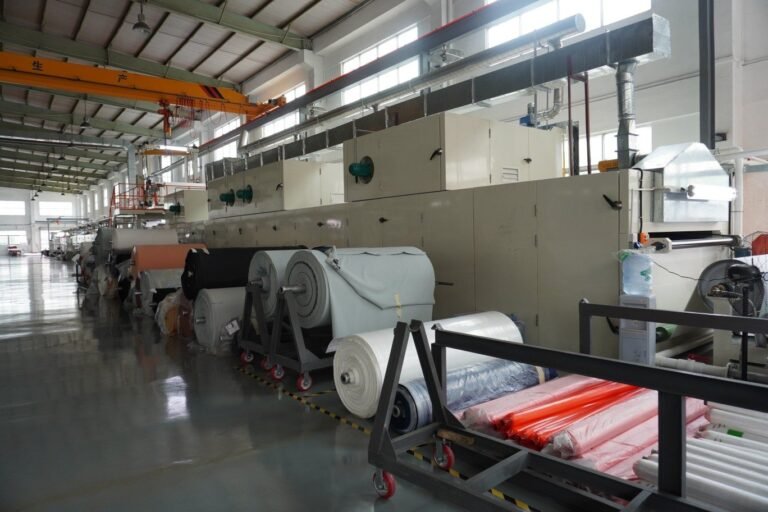
Factory aisle — production floor organization and inventory management indicate the supplier’s operational maturity
8 Verification Steps for Leather Supplier Auditing
Before placing a volume order with any leather supply company, complete these eight verification steps. Each step has a specific red flag that disqualifies the supplier — and a green flag that indicates reliable partnership potential.
- 1. Business license verification: Request the actual business license and verify the factory name matches the supplier’s website and Alibaba listing. Mismatch = trading company misrepresenting as manufacturer. Cross-reference with China Customs or Panjiva export records — no exports in 2+ years means they’re a new or inactive entity.
- 2. Production capacity audit: Request floor space, number of production lines, and monthly output in writing. Then verify during a factory visit — count machines, check production logs, and ask to see finished goods inventory. A supplier claiming 200,000 m²/month with 3 coating machines is lying.
- 3. Certification authenticity: Request original certification documents — not screenshots. Verify ISO 9001, REACH, RoHS, and application-specific certifications (FMVSS 302, EN 13733, ISO 10993) directly with the issuing body (SGS, Intertek, TÜV). Expired or Photoshopped certifications are common.
- 4. Batch consistency data: Request 12 months of anonymized quality reports showing tensile strength, tear strength, and elongation test data per batch. Red flag: >15% variance in tensile strength across batches. This indicates uncontrolled production processes.
- 5. In-house testing capability: Verify the supplier has in-house lab equipment for abrasion (Martindale), color fastness (ISO 105), tensile strength (ISO 3376), and UV resistance (ASTM G154). A supplier without in-house testing cannot ensure batch consistency — they discover problems after shipment, not before.
- 6. Sample approval process rigor: Evaluate the supplier’s tech pack process — do they request detailed specifications, offer multiple sample revisions, and provide a pre-production sample (PPS) that you must approve before mass cutting? A supplier who says “we can start production immediately” is skipping quality gates.
- 7. Defect rate and QC protocol: Request defect rate data and inspection protocol. Target: ≤2% defect rate in batch inspections. Ask what happens to rejected batches — a supplier with a documented rework or replacement process is managing quality; one who says “we never have defects” isn’t measuring.
- 8. Lead time and MOQ verification: Request lead time and MOQ in writing, then test it with a small trial order. Actual lead time vs claimed lead time is the single most reliable indicator of a supplier’s production management capability. TOPSUN: 7–15 day lead time, 500 meter MOQ — verified, not estimated.
| Step | What to Check | Red Flag | Green Flag |
|---|---|---|---|
| License | Business license vs. listing | Name mismatch | Export record verified |
| Capacity | Floor space + output | Claims exceed equipment | 500K+ m²/month, 10+ lines |
| Certifications | Original documents | Screenshots, expired | SGS/Intertek verified |
| Batch data | 12-month QC reports | >15% variance | Consistent ΔE ≤ 1.0 |
| In-house lab | Testing equipment | No lab on-site | Martindale, UV, tensile |
| Sample process | Tech pack + PPS | “Start immediately” | PPS approval required |
| Defect rate | QC inspection data | “Never have defects” | ≤2%, documented protocol |
| Lead time | Trial order test | 2× claimed time | 7–15 days, verified |

Supplier evaluation — factory audit documentation separates manufacturing partners from trading company intermediaries
Batch Consistency: The Metric Most Suppliers Can’t Verify
Batch consistency is the single most important — and most commonly unverifiable — metric when evaluating a leather supply company. It measures whether the material you receive in production batch #50 matches the sample you approved in batch #1. For B2B buyers assembling multi-piece installations where color matching is visible (furniture suites, vehicle interiors, yacht cabins), batch inconsistency is a warranty claim waiting to happen.
The verification method is straightforward: request 12 months of anonymized quality reports with tensile, tear, and elongation test data per batch. Calculate the variance. If tensile strength varies more than 15% across batches, the supplier’s production process is uncontrolled — and you’ll see visible color, texture, and performance differences between shipments. Most suppliers cannot produce this data because they don’t test every batch — they test when there’s a problem, which means problems are discovered after shipment.
TOPSUN tests every batch through a multi-stage quality control system covering raw material inspection, in-line coating monitoring, and finished-goods lab testing. Color accuracy is verified at Delta E ≤ 1.0 with Pantone matching. Batch-to-batch consistency is documented, not claimed. For more on our silicone leather quality control system, the testing protocols are publicly documented.
Batch consistency is the metric most leather supply companies cannot verify — because they don’t test every batch. If a supplier can’t produce 12 months of per-batch quality data, they’re shipping untested material and hoping for the best.

Rewinding and slitting line — final quality control stage where batch consistency is verified before shipment
Why Factory Visits Still Matter in 2026
Virtual factory tours and video calls are useful first filters, but they cannot replace an in-person audit of a leather supply company. The gap between what a supplier shows on camera and what exists on the production floor is where most sourcing failures originate. During a physical factory visit, verify three things that virtual tours cannot show:
- Equipment condition: Are machines maintained, clean, and operational? Worn rollers, leaking hydraulics, and makeshift repairs indicate cost-cutting that extends to quality control. Well-maintained equipment correlates with consistent output.
- Production log verification: Ask to see actual production logs — batch numbers, test results, defect records. If logs don’t exist or are incomplete, the supplier has no quality traceability. A factory that can’t trace its production can’t guarantee its quality.
- Finished goods inspection: Walk the finished goods warehouse. Check roll labels, verify quantities, and randomly select rolls for inspection. This is where overstated capacity claims are exposed — a warehouse holding 3 weeks of inventory doesn’t support 500,000 m²/month claims.

Coating workshop with overhead crane — industrial-scale production infrastructure that differentiates manufacturers from workshops
TOPSUN: A Verified Silicone Leather Supply Company
TOPSUN is a leather supply company that passes all eight verification steps — not through marketing claims, but through documented evidence. Here’s our verification profile for B2B buyers conducting supplier due diligence:
- Business license: Registered manufacturer in Dongguan, Guangdong, China. Export records verifiable through China Customs.
- Production capacity: 60,000+ m² floor space across three facilities (Dongguan, Yichang, Xiangyang). 10+ automated production lines. 500,000+ meters monthly output. 16,000 meters daily output.
- Certifications: ISO 10993-5 (SGS-CSTC), REACH, RoHS, FDA 21 CFR 177.2600, EN 13733 Class 4, FAR 25.853, FMVSS 302, ELV Directive. Original documents available on request — verified with issuing bodies.
- Batch consistency: Multi-stage QC system with per-batch testing. Delta E ≤ 1.0 color accuracy with Pantone matching. 12-month quality reports available for qualified buyers.
- In-house lab: Full testing capability — Martindale abrasion, UV resistance (ASTM G154), tensile strength (ISO 3376), color fastness (ISO 105), salt spray (ISO 9227).
- Lead time: 7–15 days for standard orders. 7–10 days for custom embossing. 500 meter MOQ. Free A4 swatches worldwide via DHL/FedEx.
- Defect rate: Documented QC protocol with ≤2% target. Rejected batches are reworked or replaced — not shipped.
For B2B buyers evaluating a vegan leather co or any leather supplier, the same eight-step framework applies. The verification process is the same regardless of material chemistry — what changes is the specific test data and certifications relevant to your application.

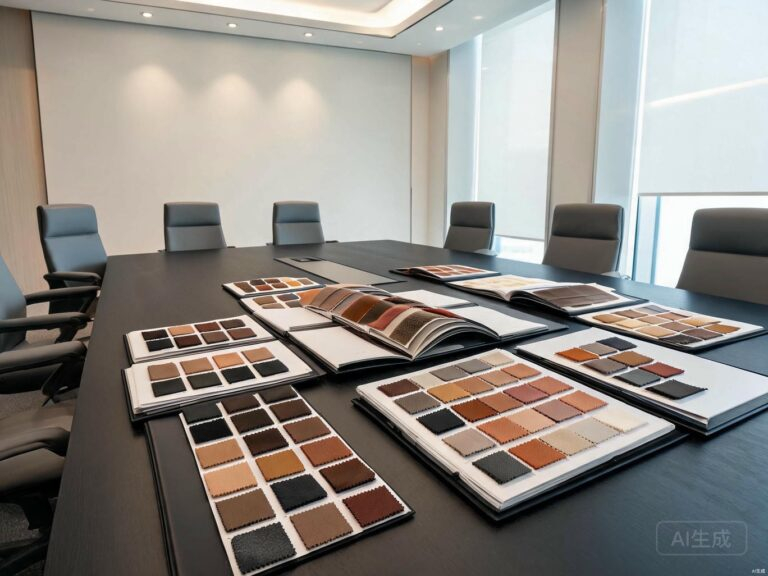
Free sample swatches — a reliable leather supply company provides material samples for independent testing before volume orders
Factory production capacity — 60,000+ m², 10+ automated lines, 500,000+ meters monthly: verify what a real leather supply company looks like
Frequently Asked Questions
How do I verify a leather supply company’s production capacity?
Verify production capacity through three methods: (1) Request floor space, number of production lines, and monthly output in writing — then verify during a factory visit by counting machines and checking production logs. (2) Request 12 months of production records showing actual output per month vs. claimed capacity. (3) Place a trial order at 50% of claimed monthly capacity and measure actual lead time — if the supplier can’t deliver on time at half capacity, their stated capacity is inflated. TOPSUN documents 500,000+ meters monthly capacity across 60,000+ m² and 10+ automated lines, with production records available for qualified buyers to verify.
What certifications should a leather supplier have?
A reliable leather supply company should hold: ISO 9001 (quality management), REACH (chemical compliance for EU market), RoHS (heavy metals), and application-specific certifications relevant to your product — FMVSS 302 (automotive fire safety), EN 13733 (furniture fire rating), ISO 10993-5 (biocompatibility for skin-contact/medical), FDA 21 CFR 177.2600 (food contact), and ELV Directive (automotive recyclability). Always request original certification documents — not screenshots — and verify with the issuing body (SGS, Intertek, TÜV). Expired or altered certifications are a common supplier red flag that indicates broader quality management deficiencies.
The Bottom Line for Leather Supply Company Selection
Selecting a leather supply company requires eight verification steps — business license, production capacity, certification authenticity, batch consistency data, in-house testing, sample process rigor, defect rate protocol, and lead time verification — completed before placing a volume order. Each step has specific red flags that disqualify suppliers and green flags that indicate reliable partnership. The most important metric — batch consistency — is also the one most suppliers cannot verify, because they don’t test every batch. TOPSUN passes all eight steps with documented evidence: 60,000+ m² factory, 500,000+ meter monthly capacity, SGS-verified certifications, per-batch quality testing, in-house laboratory, and 7–15 day verified lead times. For B2B buyers, the supplier evaluation process should be evidence-driven — and the evidence should come from lab reports and factory visits, not from website claims and quotation sheets.
Get Supplier Verification Checklist
About TOPSUN
TOPSUN is a silicone leather supply company operating 60,000+ m² across three manufacturing facilities in China, with 500,000+ meter monthly capacity, 10+ automated production lines, and SGS-verified quality testing on every batch. We provide B2B buyers with full factory audit documentation, certification originals, and per-batch quality reports — because supplier verification should be based on evidence, not claims.
60,000+ m² · 500K+ m²/month · 10+ automated lines · SGS/Intertek/FAA verified · 7–15 day lead time · 500m MOQ · Free worldwide samples