I run sourcing for a UK furniture brand. Before Brexit, one REACH registration covered the entire European market. Now I maintain two — one for UK REACH through the HSE, one for EU REACH through ECHA — and the duplicate testing, Letters of Access, and dossier submissions add 18–25% to our leather compliance overhead.
When procurement teams search for leather manufacturers in the UK, they’re usually looking for three things: proximity to market, LWG certification credibility (LWG is headquartered in the UK), and regulatory alignment. The irony is that post-Brexit regulatory divergence has made UK leather sourcing more complex, not less — and the compliance stack now determines whether your leather can actually ship.
I’ve spent the last 18 months redesigning our leather supply chain to navigate UK REACH, EU REACH, and LWG audit requirements simultaneously. The experience changed how I evaluate every leather manufacturer’s production capability — not just where they’re located, but whether their chemistry can survive the compliance stack.
Why LWG Being British Doesn’t Mean UK Leather Manufacturers Made Your Leather
The Leather Working Group was founded in the UK in 2005 and is still headquartered in Britain. That creates a natural assumption: if a leather manufacturer claims LWG certification, they must be a UK tannery. In reality, LWG audits facilities globally — from Brazil to Bangladesh to Vietnam. The UK headquarters tells you about the auditor’s address, not the leather’s origin.
LWG defines a leather manufacturer as “a company or other incorporated legal entity who takes raw hides or semi-processed leather to a part or fully finished state.” A UK-registered trading company that imports finished leather rolls from a tannery in Pakistan can list a UK address on their website, hold an LWG certificate for their supplier, and call themselves a “UK leather manufacturer” — without ever operating a tannery on British soil.

A real leather manufacturing facility — production lines, overhead cranes, and raw material handling. If your UK supplier can’t show this, they’re a trader, not a manufacturer.
The UK’s leather tanning industry has contracted significantly over the past two decades. Most genuine UK tanneries focus on specialty leathers (equestrian, heritage, luxury) at premium pricing. For B2B buyers sourcing contract-grade upholstery leather at volume, the “UK manufacturer” is frequently a distributor importing finished rolls and adding a UK invoice address.
UK REACH vs EU REACH: The Duplicate Compliance Burden for Leather Manufacturers
Since January 1, 2021, EU REACH ceased to have effect in Great Britain. UK REACH now applies separately, administered by the Health and Safety Executive (HSE). For leather manufacturers and importers, this means: if you supply leather to both UK and EU markets, you need two separate registrations — one through HSE for UK REACH, one through ECHA for EU REACH.
The practical impact on leather sourcing is significant. Chromium VI restrictions apply identically under both frameworks, but you must register separately. The UK government’s 2025 Environmental Improvement Plan aims to align more closely with EU regulatory decisions to reduce trade barriers — but as of 2026, the duplicate registration requirement remains in force.

Climate-controlled production environment — critical for meeting both UK REACH and EU REACH chemical substance requirements simultaneously.
For a UK furniture manufacturer like ours, the compliance stack now includes: UK REACH registration for imported leather, EU REACH registration for products exported to the EU, LWG audit documentation for brand sustainability claims, and from December 2026, EUDR traceability documentation for any leather derived from cattle hides entering the EU market. Each layer adds cost, lead time, and documentation overhead.
What LWG Leather Manufacturer Audit Actually Covers
LWG’s Leather Manufacturer Audit covers environmental performance, energy use, water discharge, air emissions, waste management, and chemical management at the tanning facility. It’s the most recognized sustainability audit in the global leather industry — and it’s genuinely rigorous. But it has specific boundaries that procurement teams should understand.

Quality inspection at an overseas leather manufacturer — LWG audits environmental performance, but procurement teams must verify production capability separately.
LWG audit does not verify: chemical compliance with REACH (that’s a separate regulatory requirement), product performance specifications (Martindale, flex resistance, color fastness), or end-product safety for skin contact. A tannery can hold LWG Gold and still produce leather that fails REACH restricted substance limits.
LWG also audits tanneries — not coating lines, not finishing facilities, and not synthetic leather manufacturers. If you’re sourcing silicone leather, PU leather, or PVC leather, LWG certification does not apply. The audit framework covers the animal-hide-to-finished-leather process, which means alternative materials need their own compliance pathway through REACH, RoHS, and ISO certifications.
The Cost of Compliance Stacking: UK Leather Manufacturers vs Overseas vs Silicone
The total cost of leather sourcing for UK B2B buyers is not just the FOB price per square meter. It’s the material cost plus the compliance overhead — registration fees, testing, Letters of Access, dossier preparation, and the lead time each compliance layer adds. Here’s how the three sourcing paths compare:
| Compliance Layer | UK Tannery | Overseas Tannery (Import) | Silicone Leather (TOPSUN) | Cost Impact |
|---|---|---|---|---|
| UK REACH Registration | Covered (domestic) | Required (importer responsibility) | N/A — no tanning chemicals | £2K–8K/registration |
| EU REACH (for EU export) | Required separately | Required (dual registration) | Compliant — no SVHC substances | £3K–12K/registration |
| LWG Audit | Applicable (tannery) | Applicable (tannery) | N/A — not animal leather | £5K–15K/audit cycle |
| EUDR Traceability | Required (cattle hide origin) | Required (supply chain mapping) | N/A — no animal origin | £1K–5K/documentation |
| Chromium VI Testing | Required (tanned leather) | Required (every batch) | N/A — no chromium used | £200–500/batch |
| Total Compliance Overhead | £11K–40K+/yr | £14K–45K+/yr | £0 (documentation only) | — |
Compliance cost estimates based on UK sourcing operations for mid-volume furniture brands (5,000–20,000 m²/year). Actual costs vary by substance volume and registration complexity.
The table shows why I restructured our supply chain. The UK tannery path has the lowest compliance gap (no import registration for UK market), but the highest material cost per square meter — UK tannery pricing for contract-grade leather runs £18–35/m². The overseas tannery path is cheaper on material (£6–12/m²) but carries the full compliance stack on top. Silicone leather eliminates the tanning-chemical compliance layers entirely because there’s no chromium, no azo dyes, and no animal-origin traceability requirement.
How TOPSUN Simplifies UK Leather Manufacturer Compliance
Silicone leather doesn’t eliminate all compliance — you still need REACH documentation for the silicone polymer itself, RoHS for heavy metals, and product-specific certifications for flame retardancy. But it removes the tanning-specific compliance layers that account for 60–70% of the documentation burden: chromium VI testing, LWG audit (not applicable), EUDR traceability (no animal origin), and azo dye restrictions (no azo dyes used).

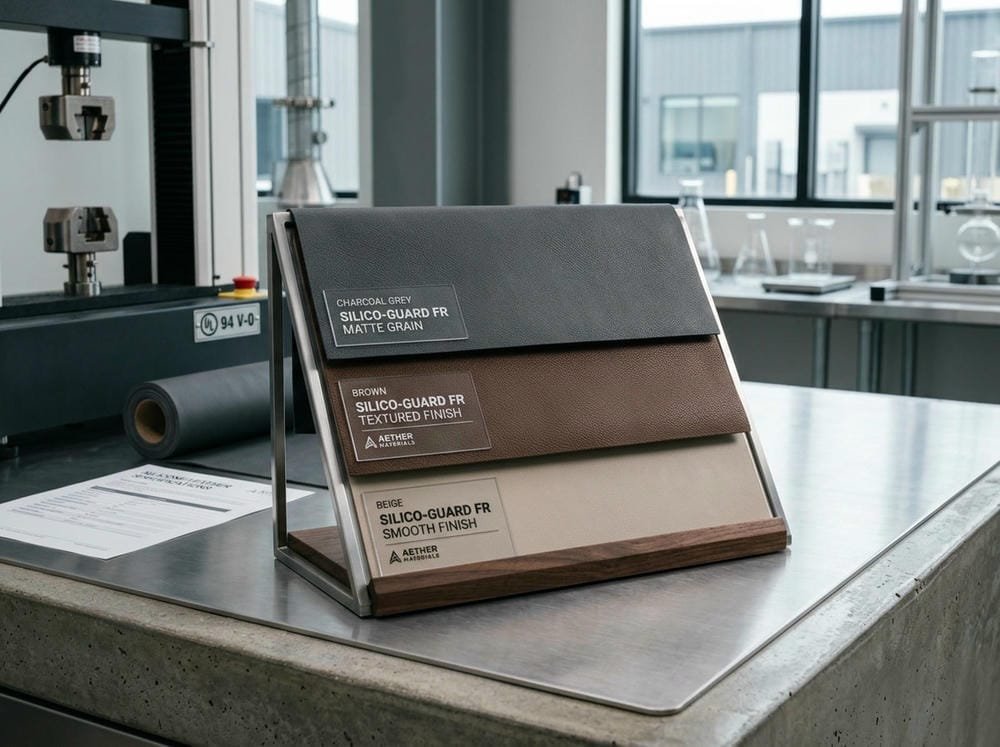
Free A4 swatches shipped to UK buyers for compliance verification and material testing before commitment.
TOPSUN provides full REACH compliance documentation — both EU REACH and UK REACH-compatible substance reports — with every shipment. The silicone coating chemistry is inert, non-toxic, and contains no SVHC (Substances of Very High Concern) candidates. ISO 10993-5 biocompatibility testing confirms no cytotoxicity, making it suitable for medical and childcare applications where chemical safety is non-negotiable.
TOPSUN’s export standards and certification framework — how silicone leather meets UK and EU compliance requirements simultaneously.
For UK furniture brands exporting to the EU, this means one compliance dossier covers both markets. No duplicate REACH registrations for tanning chemicals, no EUDR traceability documentation, no chromium VI batch testing. The eco-friendly silicone leather production process is solvent-free, which also simplifies indoor air quality compliance for GREENGUARD and BIFMA X7.1 certifications.
About TOPSUN
TOPSUN supplies silicone leather to B2B buyers in the UK who need upholstery materials that pass UK REACH, EU REACH, and LWG compliance frameworks without the tanning-chemical regulatory burden across automotive, furniture, and medical applications.
Full UK REACH and EU REACH compliance documentation provided with every shipment. Zero chromium, zero SVHC substances, zero animal-origin materials. Free A4 swatches shipped to UK addresses — HSE-compatible test reports and EUDR-exempt documentation included.
Leather Manufacturers UK: Frequently Asked Questions
Do leather manufacturers in the UK need both UK REACH and EU REACH?
If a UK leather manufacturer exports finished products to the EU, yes — they need UK REACH registration for the domestic market and EU REACH registration for the export market. Since Brexit, EU REACH registrations through ECHA are not recognized by the HSE, and UK REACH registrations are not recognized by ECHA. This means two separate registrations, two separate testing dossiers, and potentially two separate Letters of Access for the same chemical substances. Silicone leather bypasses this for tanning-specific chemicals because no chromium, azo dyes, or tanning agents are used in its production.
Is LWG certification enough to verify a UK leather manufacturer?
No. LWG certification verifies the environmental performance of a tanning facility — it does not verify chemical compliance with REACH, product performance specifications, or even whether the company is a genuine manufacturer versus a trader. A UK-registered company can hold an LWG certificate for an overseas supplier’s tannery and present themselves as a “UK leather manufacturer.” To verify genuine UK manufacturing, request: (1) the LWG audit certificate with the facility address, (2) environmental permits from the local UK authority, and (3) production facility photos or audit reports showing on-site tanning operations.
Simplify your UK leather compliance stack.