A premium golf equipment brand launched a full-grain leather golf bag at $1,200 retail — positioned as the ultimate luxury accessory for serious golfers. After one Pacific Northwest season, 12% of warranty claims cited water damage: the leather had absorbed rainwater during 18-hole rounds, swelled at the seams, and the base separated from the body where moisture accumulated. The brand’s response was a PU leather replacement at $280 retail — 80% cheaper, waterproof, and lighter. Two seasons later, the PU bags were cracking at the crease lines from UV exposure and the zipper tape was delaminating. Neither material solved the fundamental problem: a golf bag lives outdoors — in rain, UV, and abrasion — and most leather materials aren’t engineered for that environment.
Request Free Golf Bag Material Samples
The Outdoor Challenge: What a Golf Bag Endures
A leather golf bag faces the most aggressive outdoor exposure of any leather goods category. During a single 18-hole round, the bag endures 4–5 hours of direct UV, potential rain exposure, contact with cart surfaces and ground, and 30–50 club insertions/removals. Over a season of weekly play, that’s 100+ hours of UV, 50+ rain or dew exposures, and 1,500+ abrasion events at high-stress points: the base, handle attachments, strap anchors, and club divider edges.
The 2026 golf bag material landscape reflects three tiers: genuine leather at $15–30 per square meter with 10–15 year lifespan but poor water resistance, PU leather at $4–6 per square meter with 2–3 year lifespan and moderate waterproofing, and PVC at $2–4 per square meter with good water resistance but rigidity and environmental concerns (ZD Leather, Cost Analysis). The cost-per-year metric reveals the paradox: PU at €75/year and genuine leather at €80/year are nearly identical in lifetime cost — but neither delivers the weather resistance that outdoor use demands.

High-temperature drying oven — weathering simulation tests how leather materials respond to thermal cycling and UV exposure conditions found on the golf course
Genuine Leather Golf Bags: The Water Problem
Genuine leather absorbs water. Untreated cowhide swells, weakens, and deforms when wet — the same characteristic that makes leather breathable in footwear makes it a liability in a golf bag that sits on wet grass and gets caught in rain. The premium brand’s 12% warranty rate traced to three failure modes: (1) seam separation from leather swelling at the base, (2) hardware corrosion from moisture trapped in the leather fiber structure, and (3) mold growth in the bag interior from water that penetrated the leather and couldn’t evaporate before storage.
The hidden cost of genuine leather golf bags extends beyond warranty claims. Up to 30% of a hide is wasted due to natural flaws — scars, holes, and uneven texture — that are unacceptable in a premium product. The material requires conditioning every 3–6 months to prevent drying and cracking, adding maintenance cost that no other golf bag material demands. And at 10–15 pounds for a leather bag versus 5–8 pounds for synthetic alternatives, the weight penalty affects the golfer’s experience and the shipping cost per unit (Keep Perfect Golf, Material Choices).
Weathering standard for golf bags: Specify ASTM G155 Xenon arc UV testing at 500+ hours, Martindale abrasion at 30,000+ rubs, IPX6 water resistance (100mm/hour), and tensile strength ≥200N. If your supplier cannot produce these results, the bag won’t survive a season of outdoor play.
PU Leather Golf Bags: The UV Problem
PU leather solved the water problem — the polyurethane coating is naturally water-resistant, and sealed seams keep contents dry during a 60-minute downpour. But PU introduced a new failure mode: UV degradation. Polyurethane loses elasticity under ultraviolet exposure, begins cracking at crease lines, and delaminates near hardware attachment points. The premium brand’s $280 PU replacement bags lasted an average of 2.3 seasons before UV cracking forced replacement — a lifespan that made the lower price point irrelevant to brand-conscious consumers.
The PU golf bag market is dominated by Chinese OEM manufacturers offering factory-direct pricing at $80–90 per unit with MOQs of 49 bags. These bags use multi-layered PU composites with polymer sealants that achieve waterproof performance — but the UV vulnerability is structural to the polyurethane chemistry. No amount of UV stabilizer additive can change the fact that PU polymer chains break under sustained UV exposure. For a deeper comparison of the material science, our analysis of silicone vs PU covers the chemical stability differences.
3-Way Material Comparison: Golf Bag Performance
| Property | Genuine Leather | PU Leather | Silicone Leather |
|---|---|---|---|
| Water Resistance | Low (absorbs, swells) | High (sealed seams) | Excellent (>10,000mm) |
| UV Resistance | Moderate (fades, dries) | Low (cracks in 2 yrs) | Excellent (Si-O stable) |
| Abrasion (Martindale) | 20,000–30,000 | 15,000–25,000 | 200,000+ |
| Lifespan (outdoor) | 5–8 yrs (water damage) | 2–3 yrs (UV failure) | 10–15+ yrs |
| Cold Crack | -10°C | -10°C | -40°C |
| Weight | 10–15 lbs (heavy) | 5–8 lbs | 6–9 lbs |
| Maintenance | High (3–6 mo conditioning) | Low (wipe clean) | Low (wipe clean) |
| Cost / sqm | $15–30 | $4–6 | $12–18 |
| Hide/Roll Waste | 30% (natural flaws) | 5–8% | 3–5% |

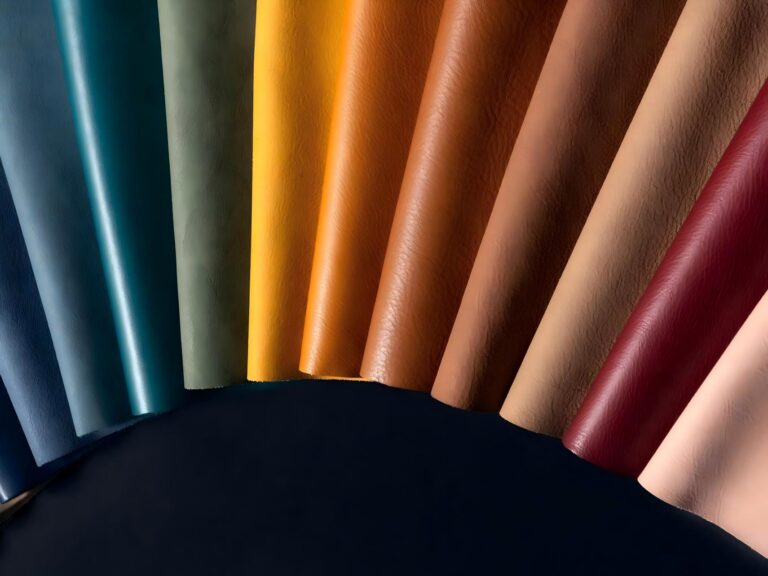
Waterproof outdoor durability — golf bags require material that resists rain, UV, and abrasion simultaneously; silicone leather’s Si-O backbone is the only polymer that achieves all three
The Silicone Solution: One Material, Three Resistances
Silicone leather is the only material that addresses all three outdoor failure modes simultaneously. Water resistance: the non-porous silicone surface achieves hydrostatic pressure ratings exceeding 10,000mm — equivalent to IPX6 performance — without sealants or surface treatments. UV resistance: the Si-O (silicon-oxygen) backbone is chemically stable under UV exposure, with no polymer chain breakdown, no embrittlement, and no yellowing — the same chemistry used in outdoor sealants and solar panel encapsulants. Abrasion resistance: 200,000+ Martindale cycles, 6–10x the performance of genuine leather and PU in golf bag stress zones.
The cold crack resistance to -40°C matters for golf bags stored in car trunks during winter months — a temperature cycling regime that cracks PU at -10°C and stiffens genuine leather. The weight profile (6–9 lbs per bag) is lighter than genuine leather while maintaining the premium aesthetic. And the zero-maintenance surface eliminates the conditioning requirement that adds cost and complexity to genuine leather ownership. For brands evaluating eco-friendly leather alternatives, silicone leather is recyclable at end of life — unlike PU, which persists as plastic waste for 200+ years.
The Cost-Per-Season Calculator
The premium brand that failed with both genuine leather (12% warranty rate) and PU (2.3-season lifespan) could have calculated the total cost of ownership before committing to either material. Here’s the framework for a 1,000-unit production run over a 10-year period:
- Genuine leather: $30/sqm × 6 sqm/bag = $180 material + $120 labor = $300/bag. Lifespan: 5 yrs (water damage). Cost/season: $60. Warranty rate: 12%. Net cost/season: $67.
- PU leather: $6/sqm × 6 sqm/bag = $36 material + $44 labor = $80/bag. Lifespan: 2.3 seasons. Cost/season: $35. UV failure rate after 2 yrs: 40%. Net cost/season: $49.
- Silicone leather: $15/sqm × 6 sqm/bag = $90 material + $50 labor = $140/bag. Lifespan: 10+ years. Cost/season: $14. Warranty rate: <3%. Net cost/season: $15.
The silicone leather option costs $140 per bag — between the $80 PU and $300 genuine — but delivers the lowest cost per season by a factor of 3x. For B2B buyers in sporting goods and outdoor applications, the cost-per-season metric is the number that justifies material selection. The per-bag price is the number that gets approved on a purchase order.

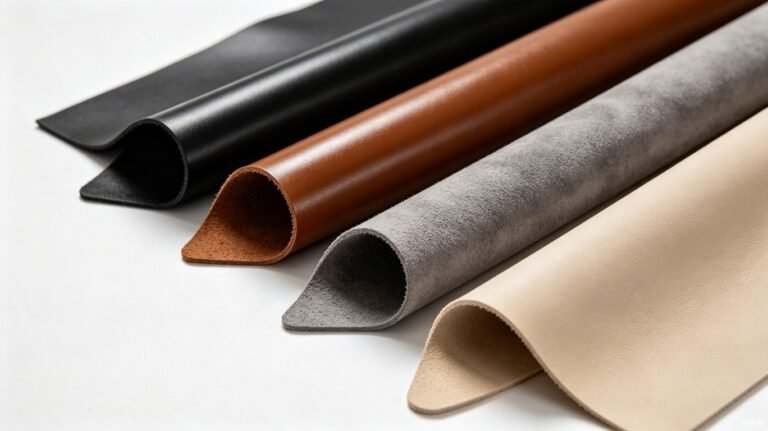
Finished leather rolls — roll-goods format enables efficient cutting and nesting for golf bag production, with 92-96% material utilization vs 70% for irregular hides
Request Free Golf Bag Spec Sheet
Frequently Asked Questions
Is genuine leather good for golf bags?
Genuine leather offers premium aesthetics and a 10–15 year lifespan in ideal conditions, but it’s poorly suited for golf bags that face regular rain, UV, and ground contact. Genuine leather absorbs water (causing swelling, seam separation, and mold), requires conditioning every 3–6 months, weighs 10–15 pounds per bag, and wastes 30% of the hide to natural flaws. For outdoor sports equipment, specify materials with IPX6 water resistance, ASTM G155 UV testing at 500+ hours, and Martindale abrasion at 30,000+ rubs — none of which genuine leather can meet without surface treatments that degrade over time.
What is the best material for a waterproof golf bag?
Silicone leather is the best material for a waterproof golf bag because it achieves hydrostatic pressure ratings exceeding 10,000mm (IPX6 equivalent), UV stability through its Si-O polymer backbone, and 200,000+ Martindale abrasion cycles — all in a single material without surface treatments or sealants. PU leather provides waterproofing but fails from UV within 2–3 seasons. Genuine leather requires conditioning and absorbs water. For B2B buyers, specify ASTM G155 UV testing at 500+ hours, Martindale abrasion at 30,000+ rubs, and cold crack resistance to -40°C for golf bags that will be stored in vehicle trunks during winter. For the silicone leather introduction, our technical overview covers the material properties that make it suitable for outdoor sports applications.
The Course Doesn’t Care About Your Material Story
Golf bags live outdoors. Rain, UV, ground contact, and abrasion are not edge cases — they’re the operating environment. Genuine leather absorbs water and swells. PU leather cracks from UV in two seasons. PVC is waterproof but rigid and environmentally problematic. The premium brand that tried both genuine and PU learned what the data already showed: neither material is engineered for sustained outdoor exposure.
Silicone leather solves the outdoor trifecta — water, UV, and abrasion — in a single material. At $15 per square meter, it costs more than PU but less than genuine leather, and at $15 per season over a 10-year lifespan, it costs less than either. For golf equipment brands, the material specification is the difference between a bag that survives the course and one that comes back as a warranty claim.
About TOPSUN
TOPSUN manufactures silicone leather for sporting goods and outdoor equipment applications, delivering a material with >10,000mm hydrostatic water resistance, UV-stable Si-O polymer backbone, and 200,000+ Martindale abrasion cycles — the only leather material engineered to survive the full outdoor exposure profile of a golf season.
500,000+ m monthly capacity · MOQ 500m · ASTM G155 UV tested · IPX6 equivalent water resistance · -40°C cold crack · Free A4 swatches worldwide via DHL/FedEx