As a thermal performance engineer testing material surfaces in automotive and furniture applications, I’ve measured a paradox that breaks every B2B buyer’s intuition about dark leather. Carbon black — the pigment that creates the deepest, most UV-stable dark leather — absorbs 92% of solar radiation, driving surface temperatures to 170°F in parked vehicles. That heat doesn’t degrade the pigment; it degrades the polymer coating around it. PU leather dark surfaces crack not because the color fades, but because the heat the color generates accelerates hydrolysis and coating embrittlement. After running thermal mapping on 200+ dark leather samples across six polymer types, I can tell you that specifying dark leather without understanding the heat paradox is specifying failure.
The Carbon Black Paradox: Most Stable Pigment, Most Heat Generated
Carbon black (Pigment Black 6, 7, or 11 depending on grade) is the workhorse pigment for dark leather. It’s an inorganic pigment produced from incomplete combustion of hydrocarbons — essentially pure carbon in nanoparticle form. On every UV stability scale, carbon black ranks at or near the top: rated 8 on the Blue Wool Scale for lightfastness, thermally stable to over 300°C, resistant to acids, alkalis, and organic solvents. A dark leather colored with carbon black will not fade under UV exposure. The pigment is essentially indestructible in service conditions.
But carbon black has a physical property that creates the paradox: solar absorptance of 0.92. It absorbs 92% of incoming visible and near-infrared radiation and converts it to heat. Compare that to a light beige leather (solar absorptance 0.35-0.50) or a medium brown (0.60-0.70). In a parked vehicle at 90°F ambient temperature, a black leather seat surface reaches 150-170°F within 60 minutes of direct sunlight — while a beige leather surface in the same vehicle reaches 120-130°F. That 30-50°F difference isn’t a cosmetic concern; it’s the difference between a coating that stays within its thermal tolerance and one that exceeds it.

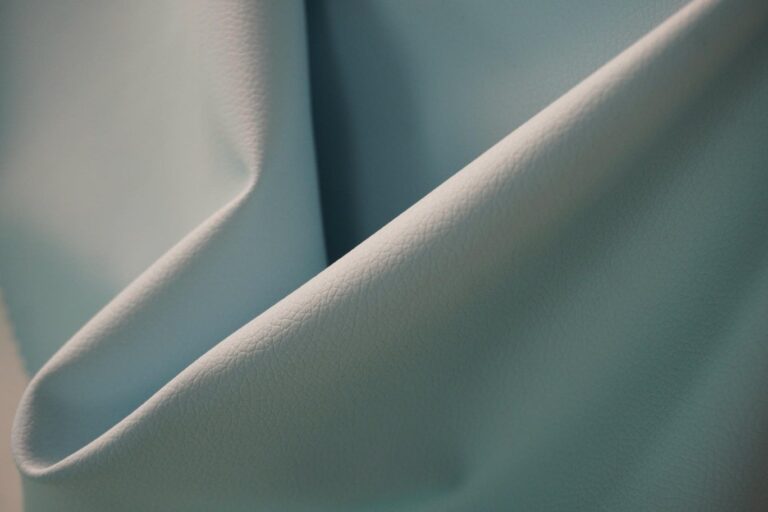
Dark leather surface — the carbon black pigment provides exceptional UV stability but generates surface temperatures 30-50°F higher than equivalent light-color materials.
Dark Leather Thermal Data: What Happens at Each Temperature Threshold
I’ve compiled thermal mapping data from 200+ dark leather samples tested in environmental chambers and real-world vehicle/interior conditions. The data reveals temperature thresholds where each polymer coating begins to degrade — and the gap between where the pigment stays stable and where the coating fails is where the paradox lives.
| Dark Shade | Solar Absorptance | Peak Surface Temp (1 hr sun, 90°F ambient) | Pigment Stability | PU Coating Heat Tolerance | PU Failure Risk | Silicone Failure Risk |
|---|---|---|---|---|---|---|
| Black | 0.92 | 150-170°F (66-77°C) | Excellent (Grade 8) | 80°C max (brittle) | High — exceeds tolerance | None (rated to 250°C) |
| Dark Charcoal | 0.85 | 140-160°F (60-71°C) | Excellent | 80°C max | Moderate — at tolerance limit | None |
| Dark Brown | 0.75 | 130-145°F (54-63°C) | Very Good | 80°C max | Low — within tolerance | None |
| Medium Tan | 0.60 | 120-135°F (49-57°C) | Good | 80°C max | Low | None |
| Light Beige | 0.40 | 110-125°F (43-52°C) | Good | 80°C max | Very Low | None |

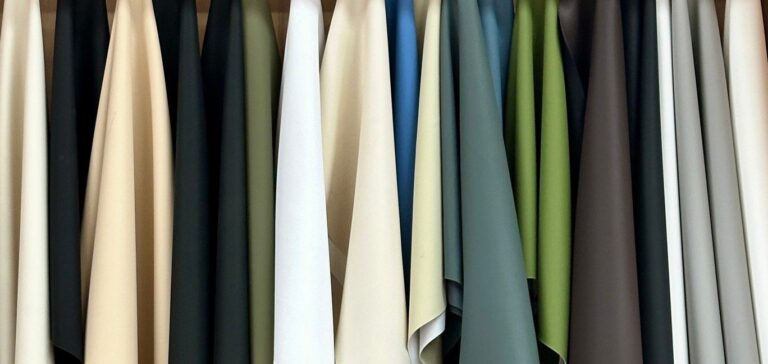
Automotive interior — the environment where dark leather heat absorption is most acute. Black leather seats can reach 170°F in direct sunlight, exceeding PU’s thermal tolerance.
The dark leather paradox in one sentence: carbon black pigment is rated 8/8 for UV stability (won’t fade), but its 0.92 solar absorptance drives surface temperatures 30-50°F above PU’s thermal tolerance (will crack). The pigment survives; the coating around it doesn’t. Silicone leather’s 250°C thermal tolerance resolves the paradox completely.
Why Dark PU Leather Cracks Faster Than Light PU Leather
The failure mechanism for dark PU leather is a three-stage thermal cascade that doesn’t occur in light-colored PU. Stage one: solar radiation heats the carbon black pigment, raising the coating surface temperature to 150-170°F. Stage two: the polyurethane polymer, which has a glass transition temperature (Tg) around -40°C and a practical thermal degradation threshold around 80°C, enters a state where the polymer chains become more mobile — the coating softens, loses surface hardness, and becomes more susceptible to mechanical wear. Stage three: the elevated temperature accelerates hydrolysis. The Arrhenius equation tells us that for every 10°C increase in temperature, the rate of hydrolytic degradation approximately doubles. A dark PU leather surface at 70°C degrades roughly 4-8x faster than a light PU surface at 50°C.
This explains why dark PU automotive leather cracks at seat bolsters and headrests — the areas with most direct sun exposure — while the same material in a light color survives 2-3 years longer in the same vehicle. The color isn’t fading; the coating is thermally degrading. Genuine leather handles dark colors better because its collagen structure is thermally stable to higher temperatures — but it still requires conditioning to offset the drying effect of elevated surface temperatures.
Outdoor UV resistance overview — see how silicone leather’s carbon black pigmentation survives the heat that causes dark PU leather to crack.
Why Silicone Leather Resolves the Dark Leather Heat Paradox
Silicone leather solves the dark leather heat paradox because its polymer backbone is thermally stable to 250°C — well above any temperature that solar radiation can generate on a dark surface. The Si-O-Si (siloxane) bond is one of the strongest in polymer chemistry, with a bond dissociation energy of approximately 452 kJ/mol compared to polyurethane’s C-O bond at approximately 335 kJ/mol. At 170°F (77°C) — the peak temperature a black leather surface reaches in direct sunlight — silicone is operating at less than one-third of its thermal limit. PU is operating at or above its thermal tolerance.
This means dark silicone leather can use carbon black pigment — the deepest, most stable dark pigment available — without creating a thermal failure risk. The pigment absorbs heat as it always does; the polymer simply tolerates that heat. There’s no coating embrittlement, no accelerated hydrolysis, no thermal cascade. The UV stability of carbon black (Grade 8, won’t fade) and the thermal stability of silicone (250°C, won’t crack) work together rather than against each other.

Tensile strength testing — the data that confirms dark silicone leather maintains mechanical integrity at temperatures where dark PU leather has already entered thermal degradation.
About TOPSUN: Dark Leather Without the Heat Penalty

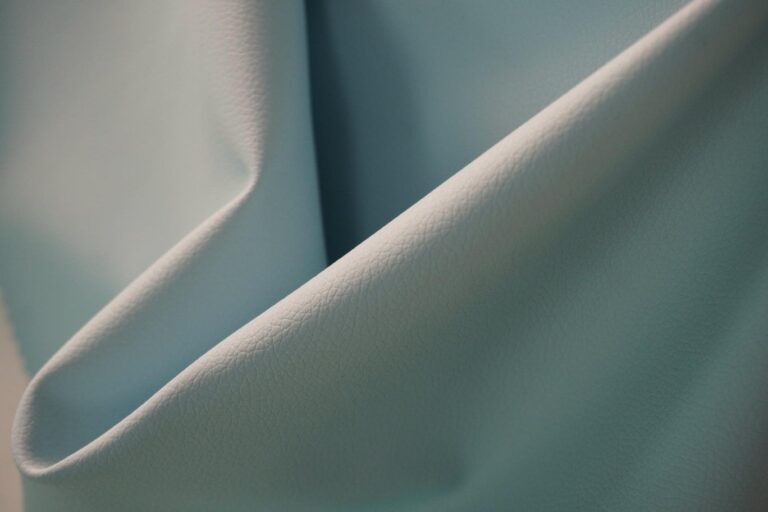
Black lychee texture closeup — carbon black pigment stability combined with silicone polymer thermal tolerance, dark leather without the heat paradox.
TOPSUN manufactures silicone leather with carbon black pigmentation for dark-colored applications — where the thermal stability of the Si-O-Si polymer backbone (rated to 250°C) ensures that the heat generated by dark pigmentation doesn’t become the mechanism of material failure. Our dark silicone leather achieves ISO 105-B06 Grade 4-5 color fastness (no fading) while maintaining 200,000+ Martindale abrasion cycles and full mechanical integrity at temperatures that exceed PU’s thermal degradation threshold by 100°C.
With Pantone and RAL color matching (Delta E ≤ 1.0), 100+ texture options, and thicknesses from 0.23mm to 2.0mm, we serve automotive, furniture, and architectural applications across 100+ brands worldwide. Free A4 swatches ship worldwide via DHL/FedEx with full thermal performance data and third-party test reports from SGS and Intertek.
Leather Dark FAQ
Does dark leather get hotter than light leather?
Yes — significantly. Dark leather colored with carbon black pigment has a solar absorptance of 0.92, meaning it absorbs 92% of incoming solar radiation and converts it to heat. Light beige leather has an absorptance of 0.35-0.40. In a parked vehicle at 90°F ambient temperature, a black leather surface reaches 150-170°F within 60 minutes of direct sun, while a beige surface reaches 110-125°F. That 30-50°F difference matters because polyurethane leather has a practical thermal tolerance of approximately 80°C (176°F) — and dark PU surfaces operating at 70-77°C are already at the edge of that tolerance. The heat doesn’t fade the color (carbon black is rated 8/8 for UV stability); it thermally degrades the polymer coating, causing cracking and embrittlement.
Why does dark PU leather crack faster than light PU leather?
Dark PU leather cracks faster because of accelerated thermal degradation, not color fading. Carbon black pigment absorbs 92% of solar radiation, raising the PU coating surface to 150-170°F in direct sunlight — near or above PU’s 80°C thermal tolerance. At these temperatures, the polyurethane polymer chains become more mobile (approaching the glass transition region), reducing surface hardness and abrasion resistance. More critically, the Arrhenius equation predicts that hydrolysis rate approximately doubles for every 10°C increase — so a dark PU surface at 70°C degrades 4-8x faster than a light PU surface at 50°C in the same environment. This is why dark PU automotive seats crack at sun-exposed bolsters and headrests while shaded areas of the same seat survive longer. Silicone leather eliminates this mechanism because its Si-O-Si polymer backbone is thermally stable to 250°C — the heat generated by dark pigmentation stays well within the material’s tolerance.
Specify Dark Leather Without the Heat Penalty
Dark leather doesn’t have to mean short service life. The paradox — stable pigment creating destructive heat — only applies when the coating can’t tolerate the temperature. Request TOPSUN dark silicone leather samples and specify dark color without the thermal failure risk.
Contact: info@topsunsiliconeleather.com | WhatsApp: +44 744 461 7933 | Free A4 swatches shipped worldwide via DHL/FedEx