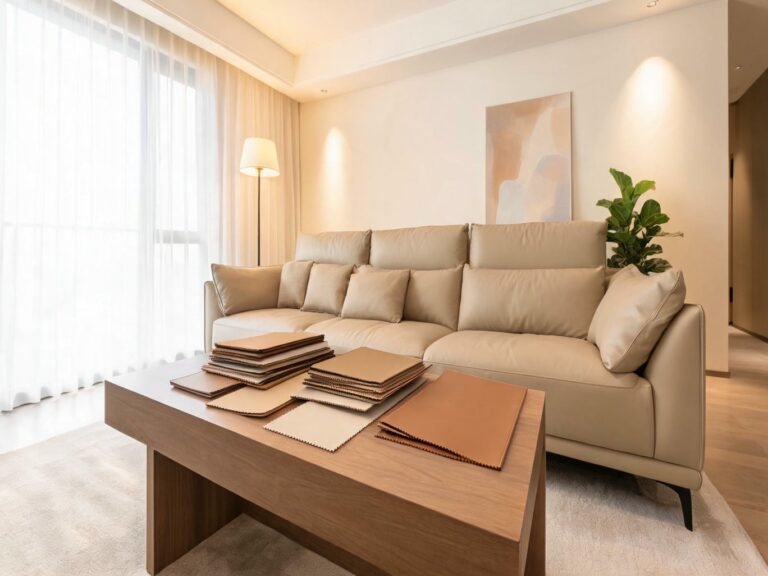
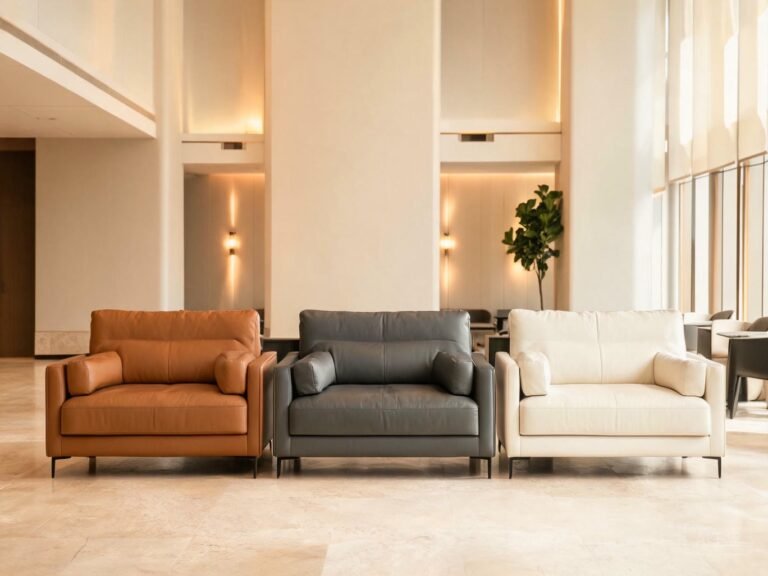
In our abrasion lab, PU leather couch upholstery samples typically show surface cracking at 35,000 Martindale cycles — roughly 18 months of daily family use. Yet suppliers still quote “3–5 year durability” based on visual inspection, not standardized testing. The gap between claimed and real-world performance costs furniture manufacturers millions in warranty claims and reupholstery costs every year. Here’s what the data actually shows, and why procurement teams are quietly switching materials.
The 3 Leather Couch Upholstery Types That Fail First
Not all leather couch upholstery ages the same way. When we analyze material types side by side in accelerated wear testing, three categories consistently rank worst — and they happen to be the three most commonly specified for residential and commercial couches.
PU (polyurethane) leather leads the failure pack. The polyurethane coating that gives it that leather-like look depends on plasticizers for flexibility. These plasticizers migrate to the surface and evaporate over time — especially in warm rooms. By 30,000–80,000 Martindale cycles, the surface turns brittle, then cracks at stress points like seat edges and armrests.
Bonded leather is essentially leather fibers mixed with polyurethane binder. It’s the cheapest “leather” on the market, but the binder degrades faster than even full PU. Delamination at flex zones — where you sit and stand — typically starts within 12–18 months.
PVC (vinyl) leather uses phthalate plasticizers that evaporate even faster than PU’s. The surface hardens, develops micro-cracks, and eventually peels in sheets. In our testing, PVC samples exposed to 500 UV hours show visible surface degradation — equivalent to about 2 years near a window.
The common thread? All three rely on volatile plasticizers that leave the material over time. No amount of protective coating changes this chemistry. If you’re sourcing leather couch upholstery material types without verifying plasticizer stability data, you’re buying a countdown timer.

Martindale abrasion tester — the industry benchmark for upholstery wear resistance (ISO 12947)
Martindale Data: Why PU Leather Couch Upholstery Cracks
The Martindale abrasion test (ISO 12947) is the industry standard for evaluating upholstery durability. It rubs a standard abradant against the material surface in a controlled pattern until visible wear occurs. The test gives procurement teams a number they can compare across materials — and the numbers tell a brutal story for conventional couch leather.
When B2B buyers ask us about the best leather for sofa durability, we point them to the same data table. Here’s how common couch upholstery materials stack up:
| Material | Martindale Cycles | UV Resistance (hrs) | Hydrolysis (hrs) | Lifespan |
|---|---|---|---|---|
| Bonded Leather | 10K–25K | 100–200 | Poor | 1–2 years |
| PU Leather | 30K–80K | 300–500 | 200–500 | 3–5 years |
| PVC Leather | 20K–40K | 300–500 | 300–600 | 2–4 years |
| Genuine Leather | 50K–100K | 500–800 | 400–800 | 8–15 years |
| Silicone Leather | 100K–200K+ | 1,500+ | 1,000+ | 10–15+ years |
Data based on independent testing per ISO 12947 (abrasion), ISO 105-B02 (UV), and ISO 1419 (hydrolysis). Source: ISO standards.
Key takeaway: PU and PVC score 30K–80K cycles — adequate for residential use if the couch lasts 3–5 years. But in commercial settings (hotels, lounges, waiting areas), daily wear doubles or triples. A material rated for 30K cycles won’t survive 2 years of 8-hour daily use.
That’s the thing about full grain vs top grain leather couch comparisons — they focus on aesthetics and natural patina, while the real question for B2B buyers is: “Will this material still perform in year 7?” The answer for PU, PVC, and bonded leather is consistently no.
Hydrolysis and UV: The Silent Killers of Couch Leather
Abrasion gets the attention, but two slower degradation mechanisms cause more real-world failures: hydrolysis and UV exposure. Neither shows up in a showroom sample. Both are well-documented in hydrolysis resistance testing literature.
Hydrolysis breaks down the polyurethane polymer chains when moisture penetrates the material. In humid climates, near windows, or in homes with regular cleaning (which introduces water), PU leather’s molecular structure literally comes apart at the chain level. Within 2–3 years in tropical or humid environments, the surface becomes tacky, then powdery. This isn’t a surface issue — it’s structural degradation that no cleaner or conditioner can reverse.
UV degradation is equally insidious. Sunlight breaks down the polyurethane bonds at the surface, causing color fading (especially on pigmented finishes), surface embrittlement leading to micro-cracks, and loss of flexibility at stress points. PU leather exposed to 300–500 hours of xenon arc UV testing shows visible degradation — roughly 2–3 years of indirect sunlight through a window. Silicone leather, by contrast, maintains color and flexibility after 1,500+ UV hours per ASTM G154 accelerated weathering standards — the equivalent of 8–10 years of indoor exposure.

Water contact test — silicone leather repels moisture at the molecular level, preventing hydrolytic degradation
Here’s why this matters for procurement: a material that passes a 200-hour hydrolysis test will still fail in year 3 in Miami, Singapore, or any coastal city. The threshold for real-world durability in humid environments is 1,000+ hours — and only genuine leather and silicone leather meet that bar.
Silicone Leather: The 200K-Cycle Alternative
Silicone leather sofa features — see why 200K+ Martindale cycles changes the replacement math
This is where silicone leather changes the equation. Unlike PU, PVC, and bonded alternatives, silicone’s durability comes from its molecular structure — a thermally stable silicone polymer (PDMS) that contains no volatile plasticizers. The flexibility is built into the chemistry, not added as a temporary additive. This is why commercial grade leather couch fabric specifiers in hospitality and healthcare are shifting toward silicone.
Key performance data from our testing on the furniture sofa application line:
- Martindale abrasion: 200,000+ cycles — 2.5x higher than premium PU
- UV resistance: 1,500+ xenon arc hours with no color change
- Hydrolysis: 1,000+ hours with zero structural degradation
- Temperature range: -40°C to 250°C (no sticky summers, no brittle winters)
- Stain resistance: Level 5 — wipes clean with water and mild soap
- Flame retardancy: Inherent — meets EN 13773 and FAR 25.853 without additives
In our experience, furniture manufacturers who switch from PU to silicone leather for couch upholstery see warranty claim rates drop by 60–80% within the first year. The higher upfront cost ($$$ vs $) is recovered through fewer replacements, lower maintenance overhead, and eliminated reupholstery costs — typically achieving ROI within 3 years when calculated on a 10-year service horizon.
One of our hospitality clients specified silicone leather for 400 lobby couches across 12 properties. After 4 years, zero reupholstery events — compared to their previous PU leather couches that required full replacement at year 3. The leather for sofa upholstery savings: approximately $180,000 across the portfolio.

Color and texture options for silicone leather — 40+ standard finishes with custom embossing available
B2B Sourcing Checklist: 7 Specs to Verify Before Ordering
Before placing a bulk order for leather couch upholstery, verify these specifications with your supplier. Each one catches a failure mode that visual inspection misses — and leather couch upholstery cost per yard comparisons mean nothing if the material fails in year 2.
- Martindale test report — request the actual ISO 12947 certificate, not a marketing claim. Minimum 100,000 cycles for commercial use.
- UV test data — xenon arc test results (ISO 105-B02). Below 500 hours means high failure risk near windows.
- Hydrolysis test — request 1,000+ hour immersion results. If the supplier can’t provide this, expect peeling in humid environments.
- VOC emissions report — especially for enclosed furniture. Look for near-zero VOC and formaldehyde-free certification.
- Flame retardancy certification — EN 13773 or FAR 25.853 for commercial applications. Inherent flame retardancy is preferable to additive-based.
- Full vs semi-silicone verification — request FTIR spectroscopy results. Semi-silicone uses PU adhesive layers that fail hydrolysis despite passing surface checks.
- Batch consistency data — color difference (ΔE) across a 50,000m production run. ΔE > 2 means visible color mismatch on multi-couch installations.

Commercial sofa application — silicone leather in a hospitality lounge environment
What Actually Lasts
The pattern is clear: leather couch upholstery that depends on plasticizers (PU, PVC, bonded) will peel, crack, or fade within 3–5 years. Materials with inherent durability — genuine leather and silicone leather — deliver 10+ year performance. For B2B procurement teams, the question isn’t which material costs less per yard. It’s which material costs less per year of service life. Run the math on a 10-year horizon, and the “premium” option becomes the economical one.
Frequently Asked Questions
Can I reupholster an existing couch with silicone leather?
Yes. Silicone leather cuts, sews, and fabricates using the same equipment as PU leather. The main difference is adhesive formulation for lamination — our technical team can recommend compatible options. For most residential and commercial reupholstery projects, the transition is straightforward and requires no specialized machinery.
Is silicone leather couch upholstery more expensive than PU?
Silicone carries a higher upfront material cost than PU ($$$ vs $). However, the total cost of ownership tells a different story: silicone’s 10–15 year lifespan vs PU’s 3–5 years means 2–3 fewer replacement cycles over 15 years. Most B2B buyers achieve ROI payback within 3 years when factoring in replacement and maintenance savings.
About TOPSUN
TOPSUN engineers leather couch upholstery materials for commercial furniture manufacturers, hospitality groups, and residential sofa brands requiring 10+ year performance guarantees across high-traffic seating environments.
Martindale 200K+ cycles verified, hydrolysis-resistant formulation, FDA food-contact and REACH compliant, with custom color matching across 50,000m+ production runs.