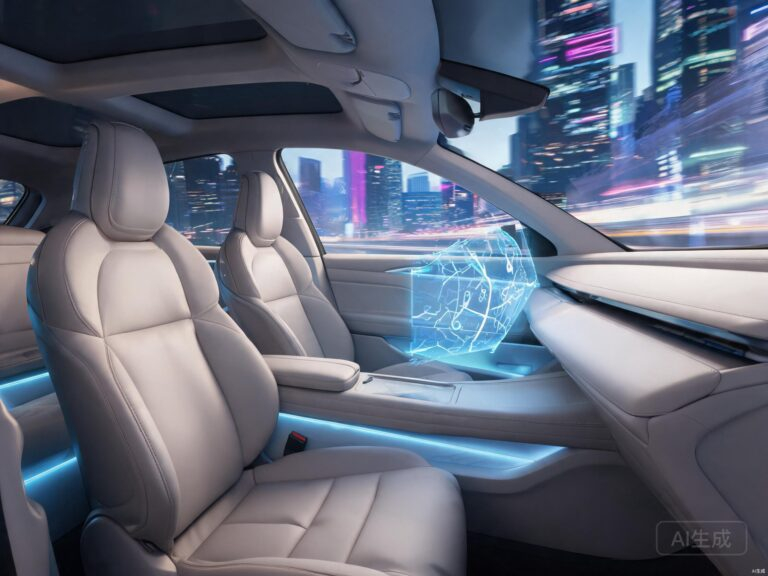
During a summer heat soak test at an OEM proving ground, the temperature at a vehicle’s roof interior can exceed 85°C — hot enough to soften the adhesive bonding headliner fabric to its substrate. Within hours, the fabric begins to delaminate, sagging into the cabin like a deflated parachute. This is why headliner fabric leather selection isn’t an aesthetic decision; it’s a thermal engineering problem that determines whether a vehicle interior survives its warranty period or generates costly field complaints. For automotive interior applications, the overhead surface is the harshest environment in the cabin — and the material specified for it must be engineered accordingly.
What Is Headliner Fabric Leather? Defining the Category
Headliner fabric leather refers to leather or synthetic leather materials engineered specifically for vehicle roof and ceiling applications. Unlike seat or door trim materials, headliner surfaces face a unique combination of thermal stress, UV exposure through glass, strict weight budgets, and acoustic damping requirements. The material sits directly above occupants — meaning any failure (sagging, delamination, discoloration) is immediately visible and cannot be hidden.
In practice, headliner fabric leather for automotive interiors is a composite structure: a face material (the visible leather or synthetic surface), a foam backing layer (typically 2–5mm polyurethane foam for tactile softness and acoustic absorption), and a rigid substrate (often fiberglass or polypropylene board). The face material is what buyers see and touch — and it’s where material chemistry determines long-term performance.

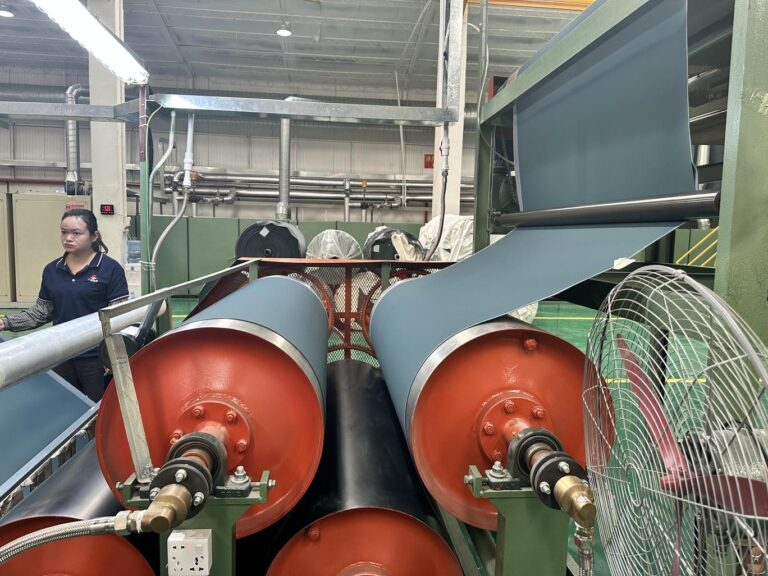
Base fabric substrate on conveyor line — the foundation layer before coating and lamination into headliner composite
Headliner Fabric vs Leather: Overhead Surface Trade-Offs
The choice between traditional fabric and leather for headliner surfaces reveals a fundamental engineering tension. Fabric headliners — typically polyester knit or nonwoven materials foam-backed to a substrate — dominate volume vehicle production because they’re lightweight (200–350 GSM) and inexpensive. Leather headliners, whether genuine or synthetic, appear in premium segments where perceived quality justifies the cost and weight penalty.
But what is headliner fabric made of at the chemistry level? Most production headliner fabrics use polyester (PET) fibers because of their dimensional stability and moderate heat resistance. The problem: polyester softens at 230–250°C but begins to degrade and yellow at prolonged exposures above 80°C — right in the range of summer roof temperatures. Synthetic leather headliners (PVC or PU coated) offer better aesthetics but introduce their own failure modes: plasticizer migration in PVC, hydrolysis in PU, and coating delamination under thermal cycling.

Silicone leather applied to automotive interior surfaces — including overhead trim where thermal stability is critical
| Material Type | Weight (GSM) | Max Service Temp | UV Stability | FMVSS 302 |
|---|---|---|---|---|
| Polyester fabric | 200–350 | 80°C | Moderate (yellows) | Pass |
| PVC leather | 400–600 | 65°C | Poor (plasticizer loss) | Pass |
| PU leather | 350–550 | 70°C | Moderate (hydrolysis) | Pass |
| Silicone leather | 300–500 | 200°C | Excellent | Pass |
The data makes the engineering trade-off clear. PVC and PU leather bring weight penalties of 100–250 GSM over fabric while offering worse thermal performance — they degrade at temperatures the roof routinely reaches. Silicone leather is the only synthetic that exceeds both fabric heat resistance and UV stability without the weight penalty of PVC. This is why OEMs evaluating silicone vs PU material comparisons for overhead applications increasingly favor silicone chemistry.
Five Engineering Challenges for Overhead Interior Materials
Automotive headliner fabric specifications exist because the overhead surface faces five simultaneous engineering challenges that no other interior component encounters in the same combination. Understanding these challenges is the prerequisite to specifying any headliner material — fabric, leather, or otherwise.
- Heat accumulation — The roof is the closest interior surface to the sun. In summer heat soak conditions, cabin air reaches 60–70°C while the headliner surface itself can hit 85–90°C. Materials that soften or degrade at these temperatures will delaminate from the substrate within 2–3 years.
- UV exposure through glass — Sunroofs, panoramic roofs, and windshields transmit UV radiation directly onto the headliner surface. Materials without UV stabilizers fade, yellow, and embrittle — particularly PVC, which loses plasticizers and cracks.
- Weight budget — OEMs allocate a strict mass budget for headliner assemblies (typically 3–6 kg total including substrate, foam, and face material). Every 100 GSM of face material weight adds approximately 0.3 kg to a typical sedan headliner — a significant figure when total vehicle weight reduction targets are measured in grams.
- Acoustic damping (NVH) — The headliner is a primary sound absorption surface. The foam backing and face material together must reduce cabin noise by 2–4 dB across the 200–2000 Hz frequency range. Dense, non-porous face materials like PVC reduce acoustic performance and require thicker foam compensation.
- Flammability compliance — FMVSS 302 requires that interior materials do not burn at a rate exceeding 102 mm per minute. Most headliner materials pass this threshold, but the margin matters: materials near the limit can fail after aging or contamination.

Lamination line where face material is bonded to foam backing — the critical step determining headliner delamination resistance
How Headliner Fabric Leather Is Tested: OEM Standards
OEMs don’t approve headliner materials based on datasheets alone. Every headliner fabric leather candidate must survive a battery of validation tests that simulate years of thermal cycling, UV exposure, and mechanical stress. These tests are non-negotiable gates in the OEM approval process — and they’re where most candidate materials fail.
- Thermal cycling — Materials are cycled between -40°C and 85°C for 500+ cycles (per OEM-specific protocols derived from SAE J1885). The test reveals delamination, dimensional change, and surface cracking. Materials with thermal expansion coefficient mismatches between face and substrate fail here.
- UV aging — Per ISO 4892-2, materials are exposed to xenon arc radiation for 1000+ hours. Color shift (ΔE) must stay below OEM thresholds (typically ≤3.0). PVC typically fails at 400–600 hours; silicone leather passes 1000+ hours with minimal shift.
- Taber abrasion — CS-10 abrasive wheels under 500g load for 500+ cycles. The face material must not expose substrate or show visible wear. This test simulates cleaning friction and incidental contact during assembly.
- FMVSS 302 flammability — The Federal Motor Vehicle Safety Standard 302 requires horizontal burn rate ≤ 102 mm/min. Materials are tested in their final composite form (face + foam + substrate), not just the face layer.
- Adhesion peel strength — After thermal aging, the face material is peeled from the foam backing at 180° at 300 mm/min. Minimum peel strength varies by OEM but typically ranges 15–30 N/50mm. Materials that lose adhesion after thermal cycling will delaminate in the field.
In our testing experience: Over 80% of headliner material candidates fail at the thermal cycling stage — not because the face material itself cracks, but because the bond between face and foam degrades. The adhesive layer is the weakest link. This is why our silicone leather headliner composites are validated as complete assemblies, not individual layers — the lamination chemistry must survive the same thermal envelope as the face material.

Water droplet beading test — moisture resistance is critical for headliner materials exposed to condensation from cabin humidity cycles
Silicone Leather as a Headliner Material Alternative
Silicone leather addresses every engineering challenge of overhead surfaces in a single material chemistry. Its thermal stability to 200°C far exceeds the 85–90°C peak roof temperature — meaning it will not soften, migrate, or delaminate under any realistic cabin condition. Its UV resistance comes from the fundamental polymer chemistry (silicon-oxygen backbone) rather than added stabilizers that deplete over time. And its weight, when thin-coated onto a fabric backing, falls within the 300–500 GSM range that OEM weight budgets can accommodate.
For headliner fabric replacement applications, silicone leather offers an additional advantage: it can be laminated directly to acoustic foam without adhesive intermediaries, because the silicone polymer bonds to polyurethane foam during curing. This eliminates the adhesive failure mode that causes most field delamination. The result is a lighter, more durable composite that passes all OEM validation tests — including FMVSS 302, thermal cycling, and UV aging — with wider margins than PVC or PU alternatives.
The silicone leather headliner application is still emerging in volume production, but early adopters in the EV space are driving adoption. Electric vehicles have larger glass roofs (no engine bay heat below), stricter weight targets, and higher customer expectations for interior air quality — all factors that favor silicone over traditional PVC or PU leather. For a deeper understanding of silicone leather’s properties, see our silicone leather introduction and our factory production capabilities.

Macro texture of lychee-pattern silicone leather — a surface finish option for premium headliner applications where tactile quality matters
Silicone leather for automotive interiors — production overview and application scenarios including overhead trim
Frequently Asked Questions
Can silicone leather be used as a headliner fabric replacement?
Yes. Silicone leather can replace traditional polyester headliner fabric when laminated to a foam backing and rigid substrate. Its thermal stability (200°C vs. fabric’s 80°C limit), UV resistance, and comparable weight (300–500 GSM) make it suitable for overhead applications where fabric would yellow or PVC would degrade. The key engineering requirement is ensuring the lamination adhesive (or direct silicone-to-foam bonding) survives the same thermal cycling validation as the face material.
What GSM range is typical for automotive headliner materials?
Production headliner face materials typically range from 200 GSM (lightweight polyester fabric) to 600 GSM (PVC leather with backing). The total headliner assembly — including foam backing and substrate — weighs 3–6 kg for a typical sedan. OEM weight reduction targets are pushing the industry toward thinner face materials: silicone leather at 300–400 GSM offers a middle ground between fabric lightness and leather aesthetics. Learn more about our automotive leather production capabilities.
About TOPSUN
TOPSUN manufactures silicone-coated leather composites engineered for automotive interior applications, including headliner, door trim, and seating surfaces where thermal stability and weight efficiency are non-negotiable.
Our headliner material validation capabilities include thermal cycling from -40°C to 85°C (500+ cycles), UV aging per ISO 4892-2 (1000+ hours), FMVSS 302 flammability compliance testing, Taber abrasion, and peel strength testing after thermal aging. We produce custom silicone leather headliner composites with integrated foam lamination — eliminating the adhesive failure mode that causes field delamination. For related thin-film leather production capabilities, contact our engineering team.