A fabric swatch costs $0 to $30. A full sample with air freight can top $780. And buyers who approve a cut from the actual production roll see 3.2 times fewer rejected deliveries. That last number frames every sampling decision this guide covers.
Sample money confuses buyers more than any other sourcing line. This guide walks the cost ladder from swatch to bulk, shows who pays at each stage, and lists the checks that make a sample worth its fee. The table below is the map.
| Sample Stage | Typical Fee | Usually Paid By | What It Proves |
|---|---|---|---|
| Swatch card | $0-30 | Factory | Color and texture only |
| Sample yardage, 1-2 yards | $10-50 per yard | Buyer | Drape, seams, shrinkage |
| Prototype or mock-up | $50-150 | Buyer | Real construction behavior |
| Lab dip, custom shade | $25-75 per round | Buyer | Shade accuracy, 1-3 rounds |
| Full unit sample | $200-800 | Buyer, deductible | The product as it ships |
| Air freight | $100-500 | Buyer, often split 50/50 | Speed, not quality |
What Fabric Samples Cost at Each Stage
The price you are quoted is a share of real production cost, not a markup. A full sample interrupts a running line. It consumes cutting time, material from stock, and a QC check. Those hours belong to a paid order otherwise.
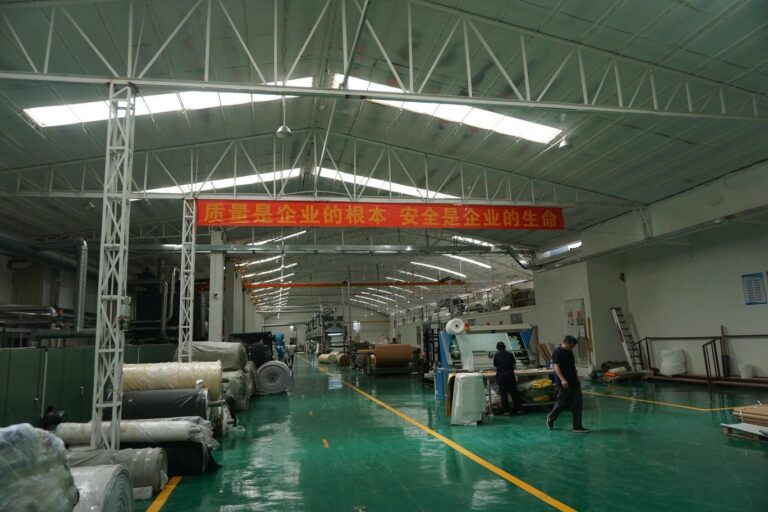
Small swatches sit at the bottom of the ladder. Mills supply swatch cards to factories at little cost, so most factories pass them on free. You pay courier fees only when speed matters. At our factory production floor, swatch sets run the same coating line as bulk rolls, which is why the card matches the lot.
The hidden lines are the ones that bite. Every revision round after the first sample triggers a new fee. Air quotes rarely include insurance, and some destinations charge duties on commercial samples. Ask for the door-to-door total, not the airport-to-airport rate.

A labeled swatch rack: the card carries SKU, shade, and grain, so the approval decision starts on paper.
The Three-Stage Ladder: Swatch, Yardage, Production Roll
Stage one is the swatch round. Order three to five candidates at once from different sources. A single swatch tells you almost nothing about the market, and one round of side-by-side cards beats three sequential orders.
Stage two is yardage. A 6-inch square cannot show how a fabric cuts, sews, or hangs at scale. One to two yards reveal drape, seam behavior, and shrinkage. A fabric that loses 5 percent in the wash leaves a custom panel short of the floor.
Stage three is the production-roll cut. Brands that demand a bulk hanger approval see 3.2 times fewer rejected deliveries. Shade and quality can drift between an approved sample and the actual lot, and this step catches the drift before the container ships.
Chemistry belongs on the same ladder. Confirm at swatch stage whether the roll is full silicone or a hybrid build, because the two age differently. Our full vs semi-silicone comparison lists the differences to verify.
Why verification at the sample stage pays back across the life of the program, in fewer replacements and fewer claims.
Who Pays, and How to Recover the Fee
Five payment models cover most cases. Factories pay for swatches and material cards. Buyers pay for full samples, usually with a deduction clause against the first bulk order. Split terms are common for repeat clients.
Put recovery in writing before you pay. The strongest clause reads: sample fee fully deducted from the first bulk order exceeding $5,000 FOB. The common version adds freight split 50/50. A weak 50 percent credit is still acceptable.
One wholesaler skipped the clause. He asked to deduct a $780 sample and freight from a $4,800 order, and the supplier declined the deal. He returned six months later, ordered 200 pieces, and paid for his samples without a word.
Combine options in one round. Two fabrics, two foam densities, and one hardware finish ride the same setup cost. Compare materials against each other instead of against memory.

Sample preparation at the bench: one setup serves several options when the round is planned as a set.
What to Check Before You Approve
Size first. A sample under 6 inches hides pattern repeat and drape. Ask for 6 by 6 inches or larger, and order a full yard when the repeat matters.
Light second. View every sample in daylight and again under evening lighting. A showroom ivory can read yellow at home. Labeling comes third. A serious supplier prints SKU, fiber content, manufacturer, and cleaning code on every card.
Numbers close the check. Upholstery samples should carry GSM above 300 and a Martindale rating of 15,000 rubs minimum. High-traffic programs need 25,000 or more. Cleanability belongs here too, and our cleaning and maintenance guide lists the chemistry to test on the card, not on the finished sofa.

A palette laid out for side-by-side review: the comparison baseline is the point of the swatch round.
Keep the approved sample for at least a year. It is your reference in any dispute over shade, weight, or finish.
Plan a Sample Round With Our Team
Sample money is not a cost line. It is the cheapest insurance policy in fabric sourcing, and the buyer who verifies twice pays once.
Request a Swatch Set With Test Data
About TOPSUN
TOPSUN treats sampling as the first step of production. Swatch sets, yardage cuts, and pre-production rolls all run the same line as bulk orders.
Every sample ships with its lot’s SGS test files, Pantone and RAL matching across 100+ textures, and published MOQ terms from 500 meters.
References
1. https://neveitaliafurniture.com/sample-costs-in… — Fabric swatches cost $0-30 and full samples $200-800 plus $100-500 air freight, and the standard recovery model deducts the sample fee from the first bulk order above $5,000 FOB.(2026)
2. https://beautifulwindowselgin.com/blogs/read-ou… — Brands that approve a bulk hanger sample cut from the production roll see 3.2 times lower rejection rates, and a small-project sampling budget runs $200-500.(2026)
3. https://smartbuy.alibaba.com/buyingguides/fabri… — Good samples measure at least 6 by 6 inches and carry SKU, fiber, manufacturer, and cleaning-code labels, so $10 spent on samples avoids a $300 mistake.