How many minutes does your cleaning crew lose to a single seat — blotting, scrubbing, apologizing — before someone admits the fabric was never the problem? Run the day backwards and the question answers itself. Morning coffee, lunchtime sauce, an afternoon pen attack and the evening disinfect wipe-down hit the same upholstery within eight hours, and “easy to clean” is either a documented property or a marketing vowel.
This walkthrough follows four real spill events across three material behaviors and shows what fabric easy to clean actually means once the tag is read.
| Stain Event | Code-W Woven | Code-S Microfiber | Silicone-Coated |
|---|---|---|---|
| Morning coffee | Blot fast; fiber holds residue | Water beads off; oils linger | Wipe, done — no absorption |
| Lunchtime tomato sauce | Detergent + cold water, blot | Solvent route; test hidden spot | Soap and water, single pass |
| Ballpoint ink | Often permanent | 70–91% IPA, edges inward | Dry cloth usually lifts it |
| Evening bleach wipe | Discolors, weakens weave | Not bleach-safe (Code S) | 10% bleach protocol, rinse |

The test site: commercial seating where eight hours writes the cleaning log for you.
What “Fabric Easy to Clean” Means by Cleaning Code
Every upholstered seat carries a tag, and the tag outranks the brochure. Code W tolerates water-based detergent; Code S demands solvent only — most microfiber lives here and leans on rubbing alcohol; Code WS accepts both; Code X means vacuum and nothing else. Guess wrong and the failure modes are expensive: water rings, shrinkage, or a stain driven deeper by scrubbing.
In the after-sales tickets we review, most “stain complaints” trace back to a tag nobody read. The universal technique is blotting with a barely damp white cloth — rubbing frays fibers and spreads the spill — which is why a surface that needs no blotting at all changes the economics of the cleaning crew’s day. That is the honest definition of what a non-absorbent surface changes: the tag stops being a warning and becomes a formality.

The property behind the promise: a surface that absorbs nothing cannot hold a stain.
Four Spills, One Seat: Testing Fabric Easy to Clean for Real
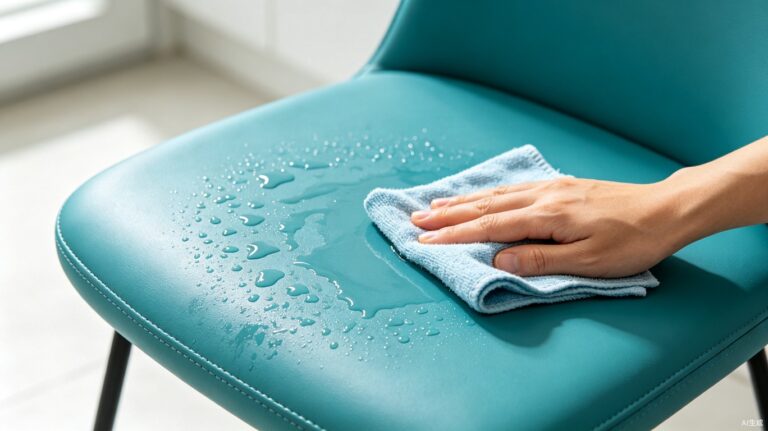
On our own test benches the day replays exactly as the table promises. Coffee on a silicone-coated sheet wipes off in under ten seconds and leaves nothing; on the woven control it takes blotting, detergent, a rinse and still leaves a shadow of tannin. Ballpoint ink — the stain every facility manager dreads — transfers off silicone with a dry cloth. The Code-S microfiber needs 70–91% isopropyl alcohol dabbed from the edges inward, and the Code-W woven usually keeps the ink for good.
The evening wipe-down separates the families most sharply: bleach-cleanable coated fabrics follow a documented 10% household bleach protocol with a prompt fresh-water rinse. Test protocols such as the ACT five-day cleaner-exposure cycle exist precisely because a single wipe proves nothing — compatibility is proven across repeated cycles, then judged against an untreated control.
Longevity matters here too, because a seat that hydrolyzes and gets replaced multiplies every cleaning hour it ever saved — the hydrolysis-resistance record is the warranty behind that arithmetic.
For high-abuse family rooms and pet zones, the same surface logic carries an extra requirement: claws and keychains. The pet-grade construction pairs the wipe-off chemistry with tear and scratch headroom, so the cleaning story survives the tenants who never read it.

Operator input shapes the spec: the crew’s actual chemical list belongs in the RFQ, not in the complaint log.
Stain resistance on camera: coffee, ink and sauce against a wipe-off surface.
The Judgment Table for the Next Purchase Order
| If Your Site Has… | Pick | Because |
|---|---|---|
| Careful users, dry rooms | Code-W woven | Lowest cost; cleaning is occasional |
| Oil-and-ink abuse, no bleach | Code-S microfiber | Solvent routine works if crews follow it |
| Disinfectant schedules, all-day traffic | Silicone-coated | Wipe-off surface + bleach protocol + rinse |
Fabric easy to clean is not a feeling — it is a code on a tag, a chemical list from the crew, and a surface that gives stains nothing to hold. Specify those three and the eight-hour day stops writing complaints.
Frequently Asked Questions
Does “easy clean” mean the cover is machine washable?
No. Easy-clean describes in-place cleaning — blotting, wiping or solvent work on the installed upholstery. Machine-washable is a separate claim that applies to loose covers, and most contract seating has none. Read the tag, not the adjective.
Is bleach safe on all easy-clean fabrics?
Only bleach-cleanable (BC) rated materials, and even then under protocol — typically a 10% household bleach solution with prompt rinsing in fresh water. On woven and microfiber fabrics bleach discolors or weakens fibers. If your disinfection schedule includes bleach, the material must be selected for it, not surprised by it.
About TOPSUN
TOPSUN operates three silicone leather plants in China with a combined 60,000+ m² of coating and finishing space, supplying commercial seating, healthcare, pet and baby-product programs in over 30 countries. Every order ships with operator-facing care documentation — wipe protocols, approved cleaner lists and stain-response steps written for cleaning crews rather than laboratories.
The same care card used by our factory QC team is available to your facilities staff on request.
References
1. https://ohsospotless.com/how-to-remove-stain-fr… — Cleaning codes W/S/WS/X decoded: blot-don’t-scrub technique and code-matched cleaners
2. https://hyphyn.com/performance/ — Commercial coated-fabric care: 10% bleach healthcare protocol, 50% IPA for difficult stains, ACT five-day cleaner-exposure test