Which of the different types of faux leather should be on your sample rack? Fifteen years running a sample room have taught me that most buyer confusion comes from names, not materials. Pleather, koskin, bicast, PU, vinyl: some of these words describe chemistry. Some describe a price tier, and a few describe products that still contain animal hide. Ask three suppliers to define the categories and you will get three overlapping answers.
This guide sorts every type by composition and hand feel. It also flags whether the type is truly animal-free. It closes with the order I use to sort a wall of samples into a shortlist.
The Different Types of Faux Leather at a Glance
Five families cover nearly everything sold as faux leather. PU-based products dominate with over 60% of the market. PVC-based vinyl holds about 25%, and microfiber PU is rising fastest among premium types. Silicone leather is the newest entrant, while bicast and bonded sit in a hybrid middle ground that still contains hide.
| Type | Surface chemistry | Animal content | Hand feel |
|---|---|---|---|
| PU leather | Polyurethane film | None | Soft, slightly plastic |
| PVC vinyl | Plasticized PVC | None | Firm, slightly sticky |
| Microfiber PU | PU in microfiber matrix | None | Softest, most hide-like |
| Silicone leather | Silicone polymer | None | Dry, silky, elastic |
| Bicast / bonded | PU film or glue + hide | Contains hide | Coated, stiff |

A sample wall sorts better by chemistry than by color: five families, one honest label each.
PU and Vinyl: The Two Volume Types
These two cover the overwhelming majority of orders. PU leather coats a fabric base with a polyurethane film. That keeps it soft, light, and easy to emboss in almost any grain. Vinyl uses plasticized PVC instead, which makes it stiffer but highly water-resistant and simple to disinfect. Neither contains a trace of animal material.
Their weaknesses differ in useful ways. PU’s film can hydrolyze in humid conditions, which is why the cheapest grades peel within a few years. Vinyl resists that failure mode but grows brittle in cold weather and carries chlorine chemistry that some markets restrict. My sample room keeps both in rotation because they rarely compete for the same job.
Microfiber and Silicone: The Premium Types
Microfiber PU builds the coating into a dense mat of ultra-fine fibers. The polymer is distributed through the structure instead of sitting on top of it. That is why it bends like hide and wears far longer than a film of the same thickness. Silicone leather replaces the polymer entirely with silicone chemistry. That surface shrugs off water, UV, and disinfectants without plasticizers of any kind.
Both types cost more per meter and both earn it in the right program. For a side-by-side of construction, the cross-sections on our silicone leather introduction page make the structural difference obvious within one glance.
One chemistry, many grains: how surface variety is created without changing what is underneath.
The Middle Ground: Bicast, Bonded, and Koskin
This is where listings get misleading. Bicast leather is a split animal hide with a PU film bonded on top. It is accurately described as coated hide, not as a fully synthetic type. Bonded leather is ground hide scraps mixed with adhesive onto a backing sheet. Furniture guides warn that it is not animal-free either way. Koskin is simply a trade name for a PU product made to look and feel like nubuck.
The practical trap is that “faux leather” describes the covering, not the whole article. A sofa can wear a genuinely synthetic covering yet still hide animal-derived fillings or bonded panels. Buyers who need a strict spec should name the layer, not the label, and put that language into the purchase order.
Rolls waiting for dispatch: every type ships the same way, but the spec sheet decides how they age.
How the Different Types of Faux Leather Feel in Hand
Texture reviews rank the families consistently. Microfiber leads for softness and flexibility, with a natural grain that reads as hide even under bright showroom light. PU follows with moderate comfort and a faintly plastic touch, and vinyl ranks last for feel, described as sticky and less comfortable. Silicone sits in its own category: it feels dry and silky rather than grabby, and it stays that way after cleaning.
Feel matters more than buyers admit, because it is the first thing their customers notice. Order swatches of all five families and run the same three checks on each. Try a hard fold, a fingernail drag, and thirty seconds in a closed fist. The rankings on paper rarely survive contact with an actual hand, which is exactly why sample rooms exist.

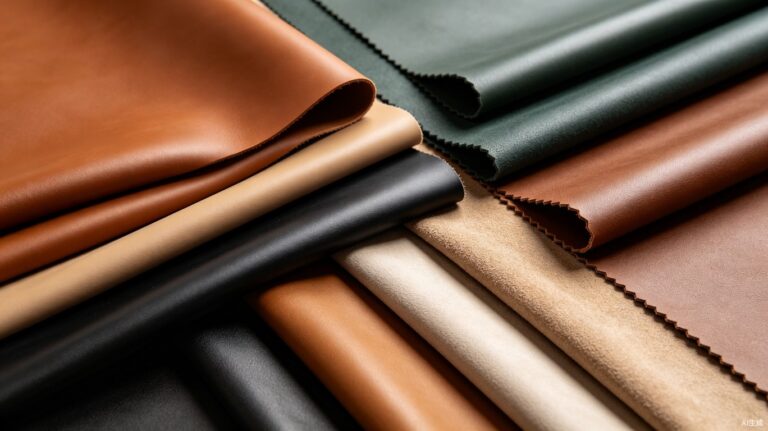
The rack settles what the catalog cannot: fold, drag, and squeeze before any purchase order.
Sort the Different Types of Faux Leather in This Order
After the wall is covered in swatches, this sequence turns it into a shortlist. It has survived fifteen years of trade fair hauls:
- Sort by chemistry first. Separate the fully synthetic types from anything containing hide, such as bicast or bonded.
- Sort by hand feel second. Fold, drag, and squeeze each swatch, then remove the ones that fail.
- Sort by program last. Match what remains to the end use, from our furniture and sofa applications to marine and fashion work.
The different types of faux leather are not interchangeable, and they were never meant to be. Chemistry decides lifespan, structure decides feel, and the label on the listing decides very little. Sort by those three truths, and the type you need picks itself. Suppliers who name every layer, as our full vs semi silicone leather comparison does, make the sorting easy.
About TOPSUN — We manufacture solvent-free silicone leather and supply it to furniture, automotive, and outdoor programs across 30+ countries. Our sample room ships full-family swatch sets, so buyers can compare silicone against PU, vinyl, and microfiber on the same desk. Every grade ships with its layer structure named in writing, backed by Martindale results above 200,000 cycles.
Is koskin real leather? No. Koskin is a trade name for a polyurethane material finished to imitate nubuck. It contains no animal hide, which also makes it vegan.
Which faux leather type feels most like real leather? Microfiber PU ranks highest in texture comparisons for softness, flexibility, and natural-looking grain. Silicone follows with a drier, silkier touch that stays consistent after cleaning.
References
- https://www.synthetic-leather.com/which-faux-le… — PU-based faux leather over 60% of market, PVC about 25%, microfiber rising; texture ranking: microfiber softest and most natural, PU moderate plastic-like, PVC sticky and least natural
- https://www.furnitureinstore.co.uk/blogs/sofa-t… — PU/PVC coatings animal-free; bicast = split hide with coating, not animal-free; bonded leather contains hide scraps; covering description does not cover the whole sofa incl. fillings