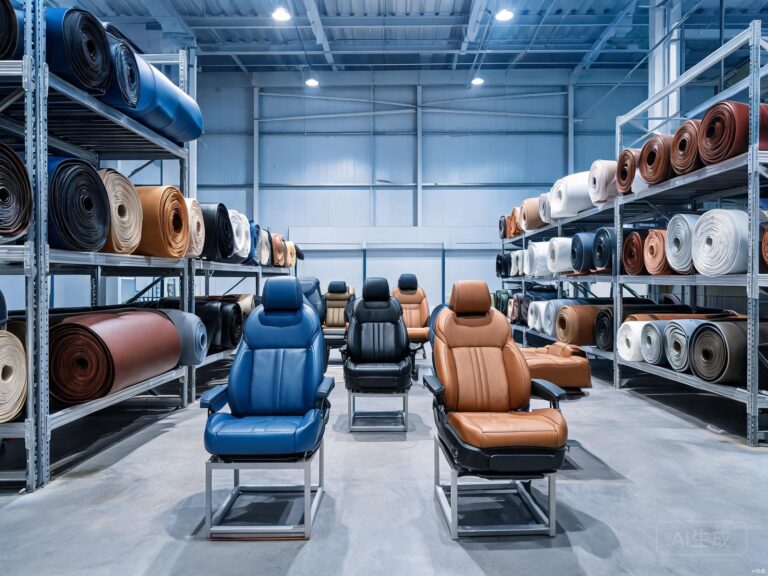
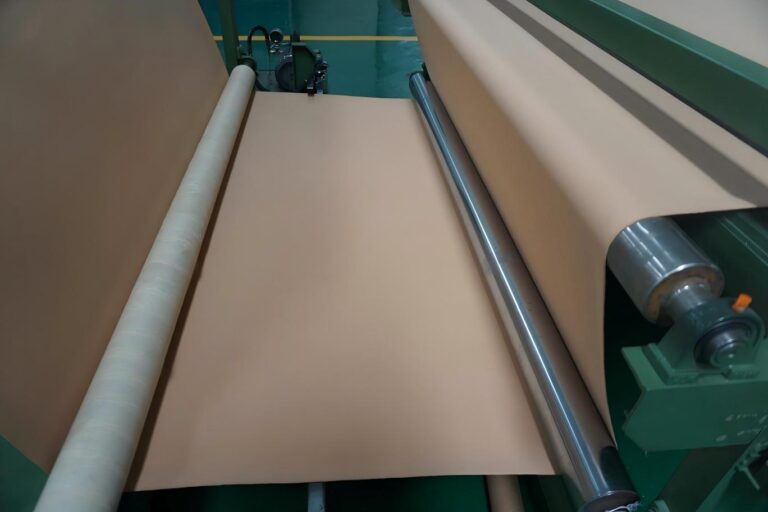
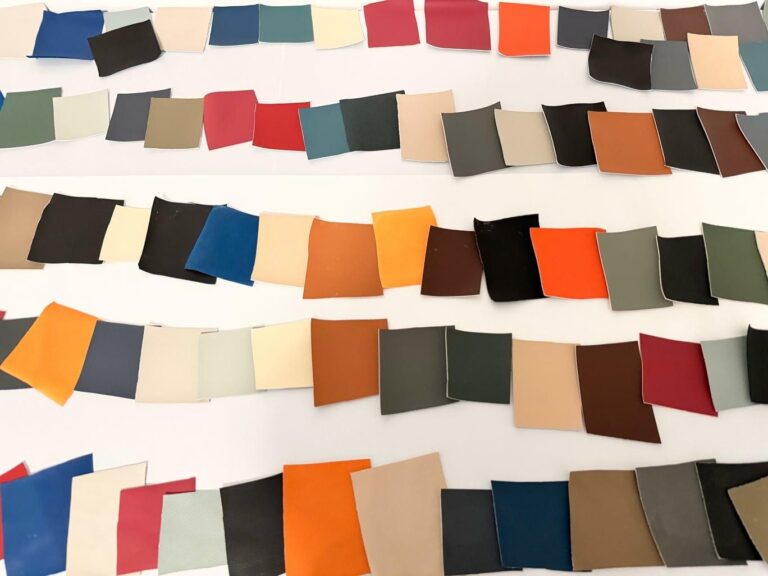
Custom leather wholesale sounds straightforward: specify color, texture, thickness, place a bulk order, and receive material that matches the approved sample. In practice, the gap between sample approval and production delivery is where most B2B orders fail. Colors shift between lab dips and production runs. Embossing rollers produced for the sample don’t translate to full-width production. MOQ negotiations reveal hidden tooling costs. Lead times stretch from 15 days to 45 without explanation. A structured custom leather wholesale process — one that documents every variable before money changes hands — separates buyers who receive what they specified from those who accept what arrives.
Step 1: Define Customization Scope Before Contacting Suppliers
The most expensive mistake in custom leather wholesale is requesting customization that the supplier cannot produce at scale. Before sending a single inquiry, define exactly what needs to be custom and what can use standard specs. Custom color with standard texture? Low complexity. Custom embossing with custom color on non-standard width? High complexity, higher MOQ, longer lead time. Suppliers quote based on the total customization burden — and a buyer who bundles six custom variables into one request will receive either a rejection or a quote priced to absorb risk the buyer didn’t intend to create.
Start with a specification sheet that lists each variable as “standard” or “custom.” This gives the supplier a clear scope and gives you a baseline for comparing quotes across multiple factories. TOPSUN’s custom leather program accepts color, texture, thickness, width, and pattern customization — but the buyer who understands which variables drive cost and lead time negotiates from a position of knowledge.
Step 2: Request Lab Dips, Not Color Swatches
A color swatch tells you what the color looks like. A lab dip tells you whether the factory can reproduce it in production. Lab dips are small-batch productions using the actual pigments, binders, and coating process that will run at full scale. Swatches are often hand-mixed samples that look correct but cannot be replicated when scaled to a 1,350mm-wide coating line running 500 meters per hour.
Specify Pantone or RAL reference numbers, then request lab dips — not color-matched swatches. Require Delta E ≤ 1.0 documentation between the lab dip and the reference standard. Without this metric, color approval is subjective, and the factory has no obligation to match a hand-sample that was never reproducible at production scale. The color customization process should produce measurable, documentable results — not visual approximations.

Color matching lab — Pantone reference alongside production lab dips. Delta E ≤ 1.0 is the difference between a match that holds across batches and one that drifts.
Step 3: Verify MOQ Structure and Hidden Tooling Costs
MOQ in custom leather wholesale is rarely a single number. It is a layered structure: a base MOQ for the material itself, an additional minimum for custom color, another for custom embossing, and often a one-time tooling charge for engraved rollers. A supplier quoting “500 meters MOQ” may mean 500 meters for standard material, 1,000 meters for custom color, and 1,500 meters for custom embossing — plus a tooling fee that wasn’t mentioned in the initial quote.
Request a full MOQ breakdown before placing any order. The table below maps customization types against their typical MOQ impact, lead time, tooling cost, and production risk:
| Customization | MOQ Impact | Lead Time | Tooling Cost | Production Risk |
|---|---|---|---|---|
| Custom color | Within base MOQ | 3–5 days for lab dip | None | Low — Delta E ≤ 1.0 |
| Custom embossing | +500m minimum | 7–10 days for roller | One-time engraving | Medium — roller alignment |
| Custom thickness | Within base MOQ | 5–7 days | None | Low — within calender range |
| Custom width | Within base MOQ | 3–5 days | None | Low — line-adjustable |
| Texture + color | +500m combined | 10–15 days | Roller + color matching | High — consistency |
| Custom pattern/print | +1,000m | 15–20 days | Screen/roller engraving | High — registration accuracy |
Step 4: Lock Production Specifications Before Sampling
The approved sample is not a guideline — it is a contract. Yet most custom leather wholesale disputes arise because the production specification was never documented in a way that both parties agreed to. Before approving any sample, ensure the following are written into the purchase order: coating chemistry (e.g., silicone-coated), substrate type and tex range, total thickness (±0.05mm tolerance), width (±10mm tolerance), color reference (Pantone/RAL with Delta E target), embossing pattern ID, Martindale abrasion minimum, and applicable certifications.
A sample approved without these specifications locked gives the supplier latitude to substitute materials, adjust formulations, or change production parameters between the sample run and the bulk order. The custom leather production guide outlines which specification variables must be documented before sample approval — and which can be left to the factory’s discretion without risk.

Custom texture samples — each embossing pattern requires its own engraved roller, and production-width results differ from hand-pressed proofs.
Step 5: Audit Batch Consistency and Color Matching
Batch consistency is the difference between a successful custom leather wholesale order and a quality rejection that delays production by weeks. Silicone-coated leather achieves Delta E ≤ 1.0 batch-to-batch because the solvent-free coating process produces uniform pigment dispersion. PU and PVC variants typically cannot — solvent evaporation rates, temperature fluctuations, and plasticizer migration create ±15–20% variation between batches.
Require batch-to-batch color documentation with every shipment. If the factory cannot provide spectrophotometer readings comparing each production batch to the approved standard, they have no quality control system capable of guaranteeing consistency. This is not a premium feature — it is a baseline requirement for any B2B order exceeding a single batch. Request free A4 swatches from the samples center to verify before committing to volume.

Finished custom-color rolls — batch consistency documentation should accompany every shipment, not just the sample approval.
Step 6: Manage Lead Time Expectations Across the Order Cycle
Lead time in custom leather wholesale has four phases, and each carries its own risk of delay. The lab dip phase (3–5 days) can stretch to two weeks if color matching requires multiple iterations. The roller engraving phase (7–10 days for custom embossing) depends on the engraving shop’s queue — which the leather factory does not control. The production phase (7–15 days) assumes the coating line has capacity. The quality control and packaging phase (2–3 days) is the only segment the factory fully controls internally.
Build buffer into your production schedule for each phase. A supplier quoting “15 days total” is quoting the best-case scenario where every external dependency aligns. Realistic planning assumes 20–25 days for custom color and texture orders — and fully bespoke orders can stretch to 60–75 days when new tooling and sampling cycles are involved [$TOPSUN](https://www.switts.com.sg/blog/moq-lead-time-for-custom-leather-products/). For more detail on TOPSUN’s production capacity and lead time structure, see the factory production overview — 500,000+ meters monthly capacity across 10+ automated lines with a standard 7–15 day lead time.
FAQ
How long does custom leather color matching take from sample to production?
Color matching typically takes 3–5 days for the initial lab dip, plus 1–2 days per revision cycle if the first dip doesn’t meet Delta E ≤ 1.0. Once approved, production runs in 7–15 days depending on order volume and line availability. The total cycle from color reference to delivery averages 15–20 days for custom color on standard texture, and 20–25 days when combined with custom embossing. Buyers should plan for at least one revision cycle in their schedule to avoid pressuring the factory into approving a substandard color match.
Custom Leather Wholesale: Process Over Price
The buyers who succeed at custom leather wholesale are not the ones who negotiate the lowest unit price. They are the ones who document every variable, request lab dips instead of swatches, verify MOQ structure before committing, lock production specs before sampling, audit batch consistency, and build realistic lead-time buffers. A structured sourcing framework costs nothing to implement and prevents the expensive failures — color drift, texture inconsistency, MOQ escalation, lead-time overruns — that destroy project margins. When the process is right, the price takes care of itself.