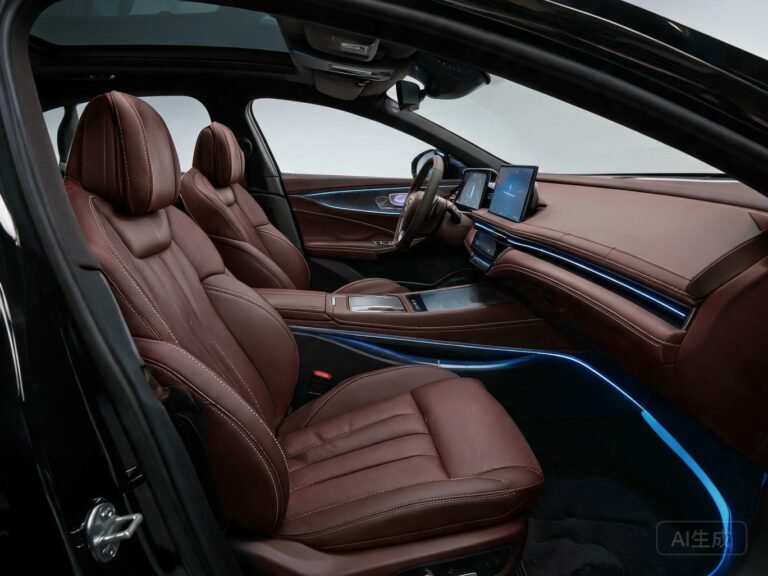
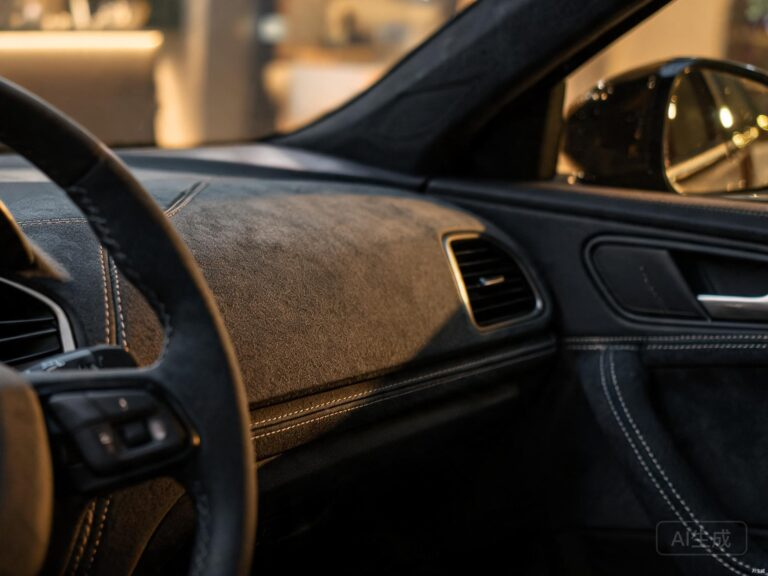
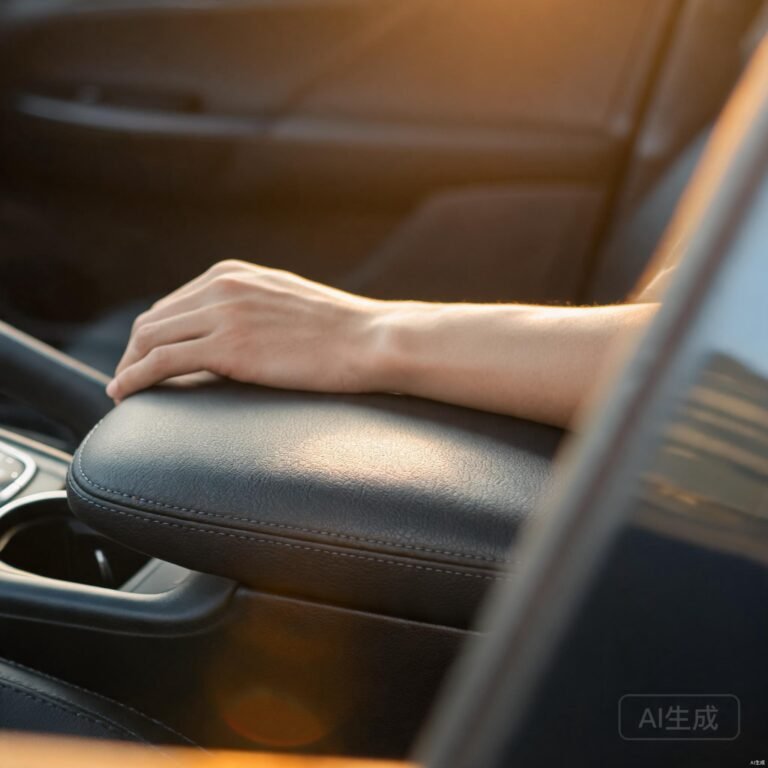
You slide into the driver’s seat. Your elbow drops onto the armrest. You do this fifty times a day. Now multiply that by three hundred days a year. The armrest sees more contact than the seat surface, yet most OEMs spec it with the same material. That is where warranty claims start.
Armrest cover leather faces a brutal cycle. Body oils, UV through side windows, heat from dashboards above, and constant mechanical wear. Seats get the glory in design reviews. Armrests get the calls from dealers.
Request Automotive Material Samples
Why Armrests Fail Before Seats Do
The physics are simple. An armrest concentrates load. A 75kg driver resting an elbow creates point pressure far higher than distributed seating load. Add rotation. Drivers pivot their forearm to reach controls. That twist applies shear stress at the surface layer.
Heat compounds the problem. Dashboard temperatures reach 105°C in summer parking. The armrest sits directly beneath. Standard PVC and PU formulations soften at 60-80°C. They deform under load. They harden again when cooled. That thermal cycling creates micro-cracks within months.
UV exposure hits armrests harder than seats too. Side windows transmit more UV than windshields with laminated interlayers. The result is color shift, surface chalking, and polymer chain scission on the door panel and center console armrests. We see this in warranty data. Armrest complaints outpace seat complaints by a factor of two in vehicles past year three.

Martindale abrasion testing simulates multi-year elbow contact cycles in compressed laboratory hours.
Heat Aging Tests That Predict Real-World Performance
OEMs need data they can trust. Accelerated aging tests compress years into weeks. The gold standard is 500 hours at 120°C per OEM specs. But not all materials behave the same after exposure.
We tested three common armrest cover materials side by side. Samples underwent identical heat aging protocols. Then we measured tensile retention, surface hardness change, and color shift. The results reveal why silicone leather earns Tier 1 approval.
| Test Parameter | Silicone Leather | PU Leather | PVC Leather |
|---|---|---|---|
| Tensile Retention After 120°C / 500h | ≥92% | 65-72% | 48-58% |
| Hardness Change (Shore A) | +2 | +12 | +18 |
| Color Shift (ΔE) | <0.8 | 2.5-4.2 | 3.8-6.1 |
| Surface Cracking (Visual Rating) | None | Moderate | Severe |
| Fogging Value (mg) | <2 | 5-12 | 8-18 |
The silicone leather sample retained 92% tensile strength. The PU sample cracked at fold lines. The PVC sample hardened and showed visible surface fissures. Fogging data matters too. Low fogging means no oily film on windshields. That is a customer satisfaction metric, not just a lab number.
For full test protocols and raw data sheets, see our technical data sheet page.

Scratch resistance testing evaluates surface integrity under point-load contact mimicking rings and keys.
Surface Feel Standards: From “Soft Touch” to Measurable Data
“Soft touch” is not a specification. It is a feeling. OEMs need numbers. We measure surface feel with three instruments. A durometer checks surface hardness. A friction tester quantifies grip coefficient. A thermal conductivity probe measures how “warm” the surface feels to skin contact.
Driver comfort depends on these numbers. An armrest that feels cold in winter and sticky in summer fails the user. Silicone leather maintains stable thermal properties across the automotive temperature range. The coefficient of friction stays within 0.35-0.45 whether the cabin is at -20°C or +60°C.
We also run VDA 270 odor testing. Automotive silicone leather must score Grade ≤3. TOPSUN formulations consistently hit Grade 2.5. That means no chemical smell when the customer opens the door on a hot day. Odor is a quality metric that warranty departments cannot fix with a service bulletin.
See how TOPSUN silicone leather performs under accelerated automotive aging protocols.
Armrest Cover Leather: TOPSUN Silicone for Automotive Applications
Our automotive-grade silicone leather is built for contact zones. The automotive interior range covers center console armrests, door panel rests, and dashboard grab handles. We supply in 1350-1800mm widths to minimize seams on large door panels.
A Tier 1 supplier in North America switched armrest material mid-program after field complaints. They moved to TOPSUN silicone leather. The change eliminated heat-deformation returns. Warranty data at 24 months showed zero armrest surface claims. That program expanded to three additional vehicle platforms.
Key specifications for armrest applications include:
- Martindale abrasion ≥200,000 cycles (elbow contact equivalent to 10+ years)
- Heat aging 120°C / 500h with <5% property loss
- UV resistance 1500+ hours QUV-A (no color shift, no gloss loss)
- Fogging <2mg per DIN 75201
- VOC <50μg C/g per VDA 278
- Flame retardancy FAR 25.853 and EN 13773 Class 4 available
We also support EV-specific requirements. Battery proximity zones need enhanced flame retardancy. Our Super Flame Retardant series meets OEM internal standards for high-voltage cabin architectures. Learn more about material selection in our car armrest material guide.

Automotive armrests demand materials that survive constant contact, thermal cycling, and UV exposure without degradation.
Conclusion: Specifying Armrest Cover Leather That Outlasts the Warranty
Armrests are high-stress zones hiding in plain sight. They fail first because they endure concentrated mechanical load, elevated thermal exposure, and aggressive UV. Specifying the same material for seats and armrests is a cost shortcut that shows up in warranty spend.
Silicone leather changes the equation. Heat aging retention above 90%. Abrasion life beyond 200,000 cycles. Fogging below 2mg. These are not marketing claims. They are test results from third-party labs and OEM validation programs.
The SAE publishes guidelines on interior material durability at sae.org. Their standards inform the test methods we use. For procurement teams ready to validate material performance, the data is available now.
Talk to Our Automotive Engineers
About TOPSUN
TOPSUN supplies armrest cover leather to automotive Tier 1 suppliers, with formulations engineered for low fogging (<2mg), heat resistance to 120°C dashboards, and UV stability exceeding 1500 hours. Our automotive silicone leather passes VDA 270 odor testing at Grade ≤3, meets OEM color-matching tolerances within ΔE<0.8, and is available with flame-retardant ratings for EV battery proximity zones.
Frequently Asked Questions
What temperature can armrest cover leather withstand?
TOPSUN silicone leather maintains structural integrity at continuous operating temperatures up to 120°C. Short-term exposure to 150°C does not cause deformation or surface cracking. This exceeds typical dashboard peak temperatures in parked vehicles.
How does silicone leather perform against body oils and lotions?
Silicone polymer is inherently resistant to oils, sebum, and cosmetic chemicals. Our automotive grade shows no staining or swelling after 72-hour contact with synthetic sebum per ISO 11640. Cleaning requires only a damp cloth with neutral detergent.
Can silicone leather match OEM color standards?
Yes. We color-match to OEM master samples with ΔE<0.8. Batch-to-batch consistency is controlled through in-line spectrophotometry at our production lines. Automotive customers receive a color match report with each shipment.
Is silicone leather suitable for electric vehicles?
Absolutely. Our Super Flame Retardant series meets enhanced cabin fire safety requirements for EV architectures. Low fogging and low VOC properties also support the stricter indoor air quality targets that EV manufacturers pursue.