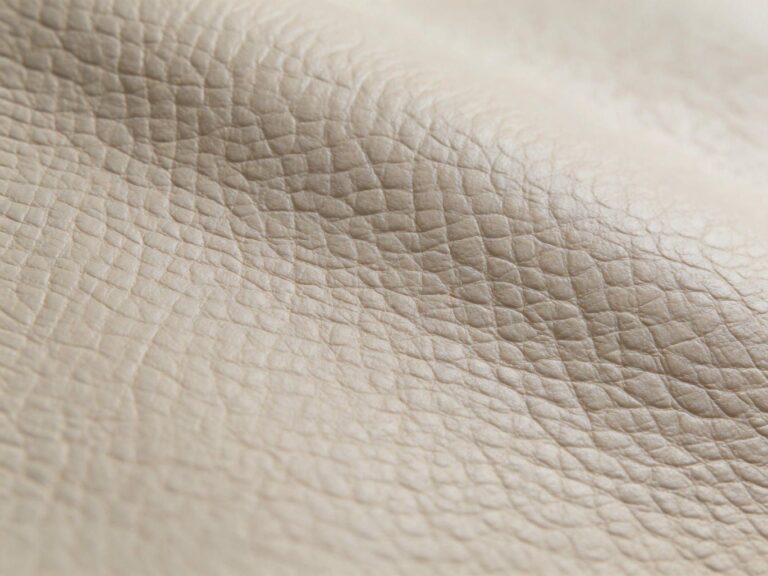
Thirty-eight point six billion dollars. That is what the global faux leather market is expected to be worth in 2026, on its way to roughly $64.5 billion by 2033. Yet the buyers spending that money still argue from the same five misunderstandings we hear on factory tours every month. This guide sets the record straight about faux leather with market data, material facts, and the care rules that decide whether a cover lasts three years or ten.
| Metric | 2026 | 2033 | Signal for buyers |
|---|---|---|---|
| Global market value | US$ 38.6B | US$ 64.5B | Demand keeps compounding at 7.6% CAGR |
| Leading region | North America | — | Labeling rules and cruelty-free demand lead |
| Fastest region | Asia Pacific | — | Capacity and new grades emerge here first |
What Faux Leather Actually Is (and Is Not)
Strip away the marketing names and the material is simple: a textile base coated or laminated with a polymer. Sellers attach labels like pleather, vegan leather, leatherette, or PU leather, but those words describe positioning, not chemistry. Two rolls sold as the same faux leather can carry completely different polymers, backings, and lifespans.
The coating family matters more than the label. PVC brings low cost and stiffness. PU drapes and breathes better. Microfiber pushes hand feel toward split leather. Silicone adds solvent-free chemistry and extreme-temperature tolerance. New-generation options are described on our silicone leather introduction page, including how the coating bonds to the substrate.

The same “faux” label can hide very different chemistries underneath.
The Faux Leather Market in Numbers
Growth is not spread evenly. North America leads on labeling regulation and cruelty-free preference, while Asia Pacific expands fastest on new capacity. Underneath both trends sits a quieter shift: regulators are pressuring leather tanning chemicals, and formulation technology has moved toward water-based and solvent-free PU systems. Suppliers who already run solvent-free lines hold a compliance advantage that widens every year.
We see the same momentum from the supply side. Sample requests now arrive with certification questions attached, and our solvent-free lines run near capacity for European clients. When we added eco-labeled grades to the factory swatch wall last year, documentation requests doubled compared with the standard display.
Certifications now influence sourcing decisions as much as price.
Five Myths About Faux Leather Worth Retiring
These are the objections and assumptions we correct most often with procurement teams. Each one costs money when left unexamined.
- “It’s all the same material.” A family of at least four chemistries sits behind one label, with lifespans from two years to fifteen.
- “It never lasts.” Budget PVC fails early as plasticizers migrate. Well-built PU reaches 3-5 years. Silicone holds 10-15 years in the same application.
- “Vegan automatically means eco-friendly.” Some PVC grades carry chlorine and plasticizer concerns. Solvent-free, REACH-compliant production is the meaningful eco signal.
- “Genuine leather is always better value.” Total cost depends on cleaning cycles, replacement frequency, and application. High-traffic programs often win with synthetics.
- “All grades clean the same way.” PU and PVC topcoats can dull under repeated alcohol wipes. Silicone tolerates hospital-grade disinfection at level 5 stain resistance.
Myth three deserves a closer look. We break down what genuinely makes a synthetic material greener on our eco-friendly silicone leather page, from solvent-free chemistry to third-party certifications.

Claims about lifespan and strength should end at a test bench like this one.

Modern embossing depth is one reason the old “faux looks fake” myth stopped being true.
Care Rules That Decide Lifespan
Care separates a three-year cover from a ten-year one. Routine cleaning needs only a damp cloth. Stubborn marks respond to mild soap on a soft cloth, and harsh chemicals or abrasive pads should stay far away. Prolonged direct sunlight degrades most polymer coatings, so position and shading matter for window-side furniture and vehicle cabins.
The cleaning product list is where chemistry shows again. Alcohol-heavy disinfectants can dull PU and PVC surfaces over repeated use. Silicone grades accept them without gloss change, which is why healthcare and food-service buyers keep converting. Our cleaning and maintenance guide lists safe methods by material type.

Texture samples before ordering prevent most post-installation surprises.
The Bottom Line on Faux Leather
Faux leather is a $38.6 billion market built on a family of materials, not one. Buyers who treat the label as a starting question, demand test data for the exact grade, and match cleaning chemistry to the coating will outperform the market’s averages. The five myths above are easy to retire once you see them in a spec sheet.
Is faux leather the same as vegan leather?
Not exactly. Vegan leather describes the absence of animal products, while faux leather describes imitation of leather. Most faux leather is vegan, but the term says nothing about the polymer used or its environmental footprint.
How long does good faux leather last?
Depends entirely on chemistry: budget PVC around 2-3 years, standard PU 3-5 years, and solvent-free silicone grades 10-15 years in comparable applications. Ask for the test data behind any lifespan claim.
References
- https://www.persistencemarketresearch.com/marke… — faux leather market US$38.6B (2026) to US$64.5B (2033), 7.6% CAGR; North America leads, Asia Pacific fastest
- https://moonsterleather.com/en-gb/blogs/news/wh… — faux leather definition: textile base with polymer coating; care with damp cloth and mild soap, avoid UV and harsh chemicals