Why does PVC fake leather still hold contract seating specifications when so many buyers complain about it? Why do fire engineers request it while sustainability teams reject it? And why do identical-looking rolls behave so differently after two winters? The answers all trace back to chlorine chemistry, and once you understand it, every strength and every failure of this material becomes predictable. Here is the specification-grade picture.
What Exactly Is PVC Fake Leather?
PVC fake leather is built on polyvinyl chloride resin, a dense polymer compounded with plasticizers and stabilizers, spread over a woven backing. The plasticizers are what make the difference. PVC on its own is rigid, like a pipe. Added plasticizers soften the polymer into a flexible gel layer that can be embossed, printed, and stitched like upholstery.
The result is a material with a distinct personality: heavier and less breathable than PU, but denser, more waterproof, and tougher against scuffs and chemicals. Nothing in the structure breathes, so heat and moisture stay on the sitter rather than passing through. That trade sits behind nearly every application decision involving PVC.
The Chlorine Chemistry Behind Its Fire Ratings
Fire performance is where PVC fake leather earns genuine respect. The chlorine in the polymer backbone makes the material inherently self-extinguishing. It does not need fire-retardant backcoatings or chemical treatments to pass the tests that PU must buy its way through. A correctly formulated PVC can achieve BS 5852 Crib 5 certification directly, which makes it one of the most readily certifiable upholstery materials available for commercial seating. Automotive FMVSS 302 compliance is similarly straightforward.
Compliance officers should still read the full report. PVC burns with hydrogen chloride smoke, which is toxic, and low-smoke formulations exist precisely because of that. Ask whether the certificate covers the specific compound and any foam layer in the composite, not just the face material.

Flame testing separates chemistry-driven performance from additive-driven claims.
Where PVC Fake Leather Earns Its Keep
Used within its comfort zone, PVC delivers real value. Industrial comparisons consistently rate it highest among faux leathers for abrasion resistance and chemical resistance. Dense surfaces shrug off scuffs from tools, shoes, and cleaning chemicals that would mark softer PU. Waterproofing is native to the polymer, not a coating, so spills bead and wipe without soaking.
That profile explains its strongholds. Booth seating in restaurants, industrial workshops, public transport interiors, and hospital side chairs all reward hard, wipeable, spark-resistant surfaces. Our own testing shows the same hierarchy from the other direction. Silicone surfaces pass 1,000-hour salt spray and alcohol-based disinfection routines. Yet a PVC surface rated for 200,000 Martindale cycles remains a legitimate choice where budget rules out both silicone and genuine hide. Buyers comparing exterior-grade options can review how each chemistry handles weather on our marine and outdoor applications page.

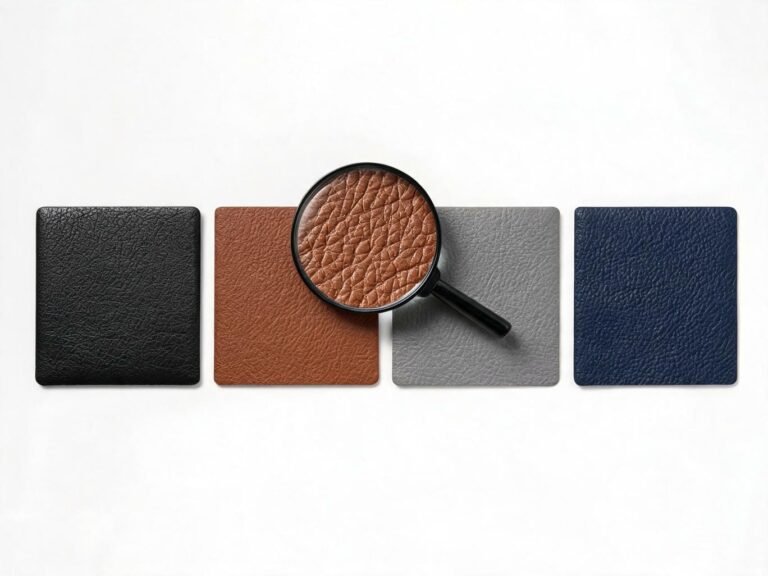
Scratch and scuff testing is where dense PVC surfaces consistently score high.
PVC Fake Leather in Automotive and Transport Programs
Transport interiors deserve their own note, because they concentrate every PVC trait at once. Fleet buses, delivery vans, and rail seating demand spark resistance, graffiti-resistant wipe-downs, and FMVSS 302 compliance, all on tight budgets. PVC fake leather answers all three at the lowest cost in the material market, which is why it survives in those specifications.
The compromises show up in cabin air and lifespan. Passenger cars hold occupants closer to the surface for longer periods than a bus seat does, so VOC contributions and plasticizer odor weigh more heavily. Private vehicles also carry owner expectations near the decade mark, past standard PVC service life. Fleet buyers who bridge that gap usually run PVC on high-wear surfaces and specify silicone or PU where occupants make long-term contact.
The Plasticizer Problem Nobody Can Spec Away
Now the structural flaw. Plasticizers are not chemically bonded to the PVC. They sit between the polymer chains, held by weak physical forces. Over time they leave the material through three doors at once: evaporation in heat, extraction by skin oils, and mechanical pumping as the surface flexes thousands of times a day.
As plasticizer content drops, the gel layer contracts. The surface stiffens, loses gloss, and then cracks along the primary flex lines, usually seat creases and bag folds. Industry experience puts visible wear at three to five years for standard grades. Low-migration plasticizer formulations stretch the timeline, but they manage the problem rather than eliminating it, and they cost more.
This is also a compliance issue, not only a durability one. Certain phthalate plasticizers are restricted under REACH and prop-65 style regulations, so the compound specification matters as much as the fire certificate. Request the plasticizer type in writing for any program shipping to Europe or North America.
Cold, UV, and the Cracking Calendar
Environment decides how fast the clock runs. Cold weather is the classic accelerant: plasticized PVC loses flexibility in freezing temperatures, so a seat that survives summer splits along the crease after the first hard winter. Outdoor use compounds the damage, because UV exposure and thermal cycling drive plasticizer loss faster than indoor service ever will.
Moisture attacks from a different direction. The vinyl face is waterproof, but trapped water at the edge can loosen the adhesive between the PVC layer and its fabric base, causing delamination from the back while the face still looks fine. Our climate chamber runs the counterfactual for humid programs. Silicone surfaces pass 14 weeks at 85°C and 85% relative humidity with no delamination or strength loss. That is why hydrolysis-prone and moisture-prone installations increasingly specify hydrolysis-resistant silicone leather instead.
Care Rules That Slow the Clock
Maintenance cannot stop plasticizer migration, but it can slow it. Keep surfaces clean with pH-neutral soap and water. Harsh solvents extract plasticizers faster, so they age the surface with every wipe. Position seating away from radiators and direct sun where the schedule allows, because heat is the main evaporation engine.
Inspection habits matter just as much. Check seams and creases quarterly for early stiffness, since stiffening precedes every visible crack. Rotate high-use cushions in modular furniture to spread the flex cycles. Full care guidance for all our surface chemistries lives on our cleaning and maintenance page.
The Compliance Scorecard for PVC Fake Leather
Judged strictly by regulation, PVC fake leather splits into clear passes and clear fails:
| Requirement | PVC result | Buyer note |
|---|---|---|
| BS 5852 Crib 5 (contract seating) | Pass by inherent chemistry | Confirm compound, not brochure |
| FMVSS 302 (automotive) | Pass, low cost | Smoke toxicity not covered |
| REACH / phthalate limits | Depends on plasticizer grade | Demand written plasticizer spec |
| VOC / interior air quality | Variable | Test per batch for cabins |
| End-of-life / recyclability | Weak | Non-biodegradable, hard to recycle |
The environmental line is the one shifting fastest. PVC is petroleum-based, difficult to recycle, and does not biodegrade, and chlorine chemistry complicates incineration. For consumer-facing brands with sustainability commitments, that row increasingly outweighs the fire rows.
Inside the Compound Sheet: Four Lines to Verify
Every PVC roll has a compound sheet behind it, and four lines decide your risk. Check the plasticizer family first, since phthalate status varies by chemistry. Check plasticizer loading second, because higher loading means softer hand today and faster migration tomorrow. Check the stabilizer package third, especially for programs with heat exposure. Check the fire certificate holder last: the certificate must name this compound, not a similar one from the same supplier.
Suppliers who answer those four lines without hesitation are managing their chemistry. Suppliers who deflect are reselling it. The distinction predicts your experience better than any sample does.
PVC vs PU vs Silicone: The Decision Table
Every comparison eventually needs a verdict table. Use this one:
| If your program needs | Choose | Why |
|---|---|---|
| Crib 5 seating at lowest cost | PVC fake leather | Inherent flame retardancy, high abrasion |
| Soft hand and breathability | PU | Flexible film, no plasticizer load |
| Humidity, UV, or 10-year service | Silicone leather | No plasticizers, halogen-free fire, 10-15 yr life |
| Childcare or medical contact | Silicone leather | Non-detect VOC, biocompatible grades |
Furniture buyers weighing the seating rows can see full-room material behavior on our furniture and sofa applications page.
Fire testing in our lab: how halogen-free silicone compares with halogenated surfaces.
Specify PVC Fake Leather With Eyes Open
PVC fake leather is neither the villain nor the bargain it is made out to be. It is a hard, waterproof, inherently flame-retardant surface wearing a three-to-five-year plasticizer clock. Specify it for short-cycle, high-abrasion, fire-regulated interiors and it will outperform its price. Specify it for humid, cold, or decade-long programs and it will fail exactly where the chemistry predicts.

Dense, glossy, and wipeable: PVC’s strengths and its stiffness are the same property.
One more habit completes the discipline. Re-test, rather than re-assume, every time the supplier changes a compound code. Fire behavior, plasticizer family, and surface hardness all live in the formulation, and formulations change quietly. A five-minute repeat test on each new lot protects every claim your specification makes.
Read the compound sheet, demand the plasticizer spec, and match the material to the clock. Those three habits turn a controversial material into a predictable one.
References
- https://www.kothea.com/2026/04/06/faux-leather-… — PVC: highest abrasion and chemical resistance, inherently suited to Crib 5 certification without backcoating; three structurally distinct faux leather types
- https://www.solamnileather.com/What-Is-the-Diff… — PVC = PVC resin + plasticizers over woven backing, denser and waterproof but non-breathable; plasticizer migration under UV and thermal cycling hardens and cracks the vinyl