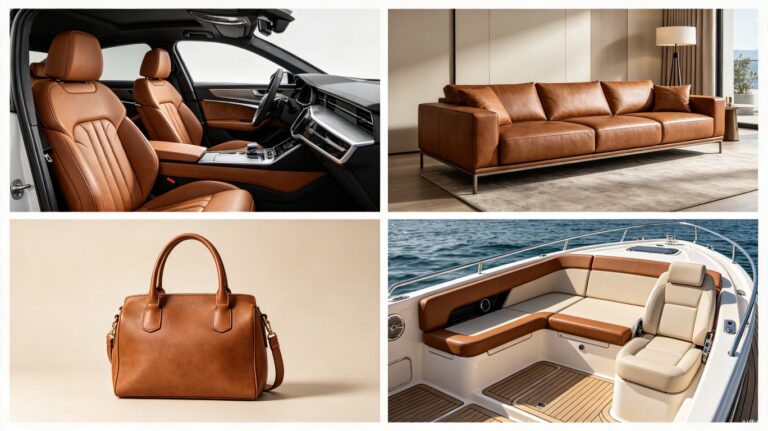
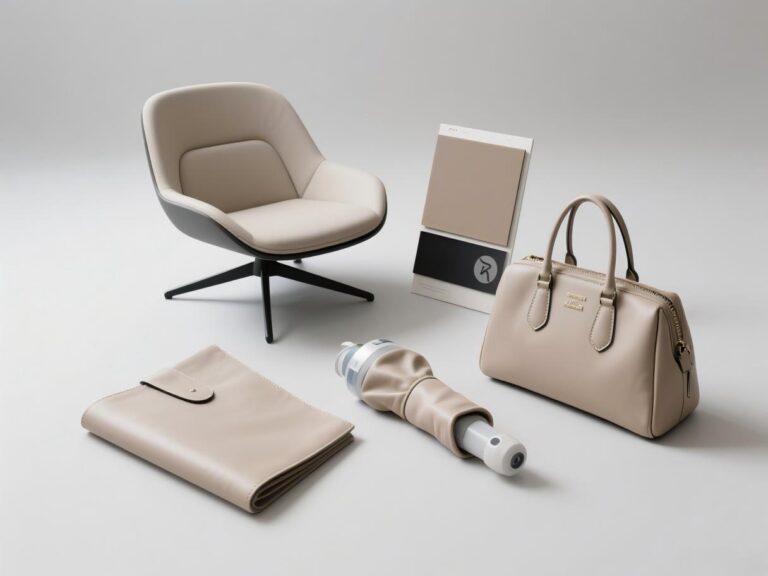
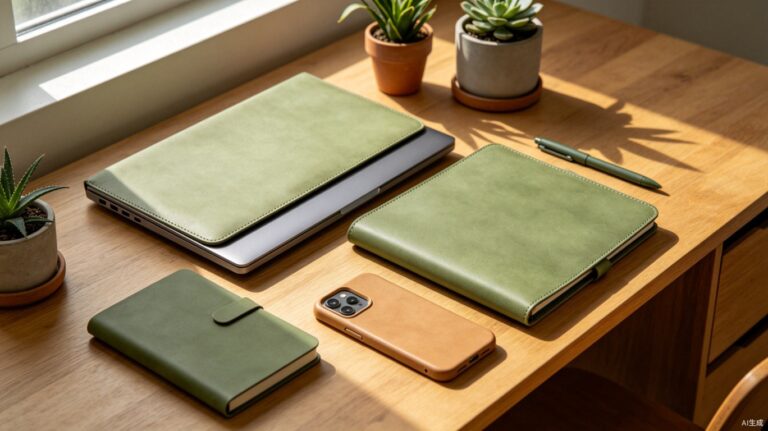
Eleven billion square meters. That is roughly how much synthetic leather the world produced for furniture alone in 2024, according to Global Info Research. Almost every square meter of it was sold as either faux leather or synthetic leather. The two labels sound interchangeable because, on the factory floor, they mostly are: both describe animal-free materials that imitate hide. Where buyers get hurt is assuming the labels also promise the same chemistry, the same lifespan, and the same test results.
This guide separates the terms from the specs. It maps the four material families behind both labels, shows where each one fails first, and closes with five checks our inspection team runs before any sample gets approved.
Faux Leather and Synthetic Leather: Same Thing, Different Labels
Start with definitions. Synthetic leather is the broader industry term: any manmade material engineered to look and feel like hide. Faux leather is the consumer-facing word for the same category, borrowed from fashion French. Neither term tells you the coating chemistry, which is exactly where quality lives.
The market splits the category into recognizable families. Published industry estimates put PU at roughly 30% of artificial leather share, PVC at about 25%, microfiber around 15%, and bio-based materials near 20%. The remaining slice covers specialty and footwear grades.
| Family | Approx. Share | Signature Strength | First Failure Mode |
|---|---|---|---|
| PU | ~30% | Softness, flexibility, tensile strength | Hydrolysis in 3-5 years |
| PVC | ~25% | Robust structure, low cost | Plasticizer loss, cold cracking |
| Microfiber | ~15% | Closest hand feel to hide | Coating wear on high-abrasion zones |
| Bio-based | ~20% | Sustainability narrative | Binder aging, inconsistent supply |
| Silicone | Emerging | No hydrolysis, near-zero VOC | None typical in 10-15 year window |

The coating line, not the label, decides how a material ages.
How Long Does Faux Leather Actually Last?
Industry comparisons commonly peg faux leather at about one third the lifespan of genuine hide. That average hides a wide spread. A PVC venue seat can fail in two years under daily flexing. A well-formulated PU sofa surface can pass five. Silicone materials we ship today carry a 10-15 year service expectation, verified in hydrolysis chambers at 85°C and 85% relative humidity.
Failure is chemistry, not bad luck. PU contains ester bonds that absorb water and snap. PVC loses plasticizer to heat and UV, then stiffens until the surface cracks. Microfiber bases are strong, but the PU topcoat still ages like any PU. When our inspectors open a returned sofa, the peeling almost always traces back to one of those two mechanisms. Cleaning and maintenance routines can slow the clock, but they cannot change the polymer.

Flex testing exposes coating weaknesses long before a customer seat does.
The Four Families: PU, PVC, Microfiber, Silicone
PU remains the volume leader because it drapes well and accepts embossing cleanly. It also has the highest tensile, tearing, and bursting strength among the common coatings, which is why footwear and luggage specify it. Its weakness is humidity: hydrolysis starts from the inside, so a seat can look perfect in month 30 and peel in month 40.
PVC trades softness for structure. It resists water and holds shape, which suits wall panels and low-stress upholstery. The plasticizer load that keeps it flexible is also the compliance headache: phthalate screening shows up in most retail audits now.
Microfiber faux leather improves the base, not the coating. A needle-punched microfiber substrate gives better drape and a tighter grain than woven fabric. For buyers who want the closest feel to hide, it is the strongest PU-family option. Silicone microfiber leather pushes the same logic further: microfiber substrate, silicone coating, and no ester bonds left to hydrolyze.
Side-by-side material comparison: abrasion, stain, and flex behavior across coating chemistries.
Silicone sits outside the traditional families and outside their failure curves. No plasticizers means nothing to lose to heat. No ester bonds means nothing to snap in humidity. The trade-offs are price and stiffness limits on ultra-thin applications. Where furniture programs need both longevity and compliance documentation, it has become our default recommendation. Buyers comparing full-silicone against hybrid builds can review full silicone vs semi-silicone leather to see where the cost line sits.

Same grain, many chemistries: lychee texture rolls in different coatings age very differently.
Where Faux Leather and Synthetic Leather Show Their Difference
The labels converge; the performance data does not. These five checks separate a spec-compliant material from a well-labeled one. Our quality team runs all five on incoming samples, and we encourage buyers to demand the same evidence from any supplier.
- Ask for the coating chemistry by name. PU, PVC, microfiber-PU, and silicone age differently; a spec sheet that says only “synthetic leather” is hiding the answer.
- Request hydrolysis data. Look for chamber hours and conditions, not just “tested for durability.”
- Count Martindale cycles. Furniture-grade should start at 50,000; contract grade at 200,000 under ISO 12947.
- Screen for plasticizers and VOC. Phthalate-free claims need a report; our own line tests non-detect for VOC under ISO 16000-6.
- Bend a corner 50 times. Ten seconds of manual flexing reveals more about coating adhesion than a page of marketing.
Order Faux Leather Alternative Samples

Upholstery is the proving ground: constant contact, body heat, and humidity expose weak coatings fastest.
Is faux leather the same as vegan leather?
They overlap but are not identical. Faux leather describes appearance; vegan leather describes content. Most faux materials are vegan, and most vegan leather is faux. Bio-based sheets blur the line, and some still use PU binders, so content claims deserve the same scrutiny as durability claims.
Can peeling faux leather be repaired?
Cosmetically, sometimes. Structurally, no. Once hydrolysis or plasticizer loss begins, the coating continues to fail from within. Repair compounds mask the surface for a season. Replacing the material is the only durable fix, which is why chemistry should be settled before the first sofa ships.
The Label Is the Start, Not the Spec
Faux leather and synthetic leather name a category, not a quality level. The families behind the labels differ in chemistry, in failure mode, and in how long they serve. PU bends well and hydrolyzes. PVC holds shape and sheds plasticizer. Microfiber upgrades the base. Silicone removes the failure mechanisms altogether. Specify the chemistry, demand the test reports, and the label stops mattering.
The furniture synthetic leather market is projected to grow from $10.73 billion in 2024 to $16.43 billion by 2031. More volume means more variety, and more variety means sharper questions at the sample stage. Request Test Reports for Your Program
About TOPSUN
TOPSUN supplies silicone-coated leather alternatives for furniture and upholstery programs replacing peeling PU and PVC.
Testing depth includes Martindale to 200,000 cycles, 14-week hydrolysis runs, and FTIR chemistry verification on every batch.