Every sourcing manager faces the same question each planning season: which products deserve the budget this year? The answer has shifted. Vegan leather demand is compounding at 11.4% a year, from $12.6 billion in 2026 to $26.8 billion by 2033. The best leather products to stock are the ones that pair that demand with a defensible margin.
This article ranks five product categories by margin, then shows why the material spec decides whether that margin survives a season of returns.
The Demand Picture Behind the Rankings
Two numbers frame the opportunity. First, the vegan leather market’s 11.4% CAGR, led by Asia Pacific at roughly 49% of revenue share. Second, the luxury leather goods segment: $67.7 billion in 2025, heading to $85.7 billion by 2035. Growth is not spread evenly. It concentrates in categories where a material upgrade is visible to the end customer and cheap to manufacture at scale.
Wholesale structure matters as much as demand. Across leather bags, B2B wholesale typically lands at 35-50% of retail. Categories below that band are volume plays. Categories above it are margin plays, and they are where the rankings below focus.
5 Best Leather Products for Margin in 2026
- Luxury leather phone cases ($50-150 wholesale): high margins and brand elevation for boutique and corporate-gift channels, with the 3C accessories segment still expanding.
- Leather footwear, especially loafers: a $25 factory price routinely becomes an $89 retail tag, and loafers hold year-round demand across casual and smart-casual segments.
- Handbags and totes: the dominant luxury segment, with women driving 59% of luxury leather goods purchases and wholesale ratios near the top of the 35-50% band.
- Automotive interior accessories: seat covers, dash trim and storage upgrades ride the EV interior refresh cycle and spec directly to factories rather than fighting retail shelf space.
- Small leather goods (wallets, cardholders): low unit cost, low shipping weight and constant gift-season demand make them the reliable filler line with steady markup.
Notice what the list does not say. It does not promise that every unit sells well. It says the margin headroom is there, which brings us to the catch.

Finished rolls staged for production: category demand becomes product only after the material spec holds.

Category choice sets the ceiling. Material choice decides how much of it you keep.
Why Material Choice Decides the Margin
Every margin calculation above assumes the product comes back as a reorder, not a refund. That is where material spec enters the P&L. A phone case that delaminates at the seam, or a car interior trim that fades in six months, converts a 250% markup into a support cost.
This is one reason the vegan segment keeps compounding. Materials have matured: current silicone and microfiber constructions pass 100,000+ Martindale cycles, hold Pantone and RAL matched colors across production runs, and carry solvent-free, low-VOC credentials that retail buyers increasingly ask for.
From our factory floor, the most durable product lines we see moving fastest share one trait. The spec sheet went out with the quotation, so returns never got a foothold. Buyers comparing eco-certified options can start with our eco-friendly silicone leather overview, and the silicone leather introduction explains the material science behind the numbers.

Automotive interiors: one of the five categories where factory-direct specs beat retail shelf competition.
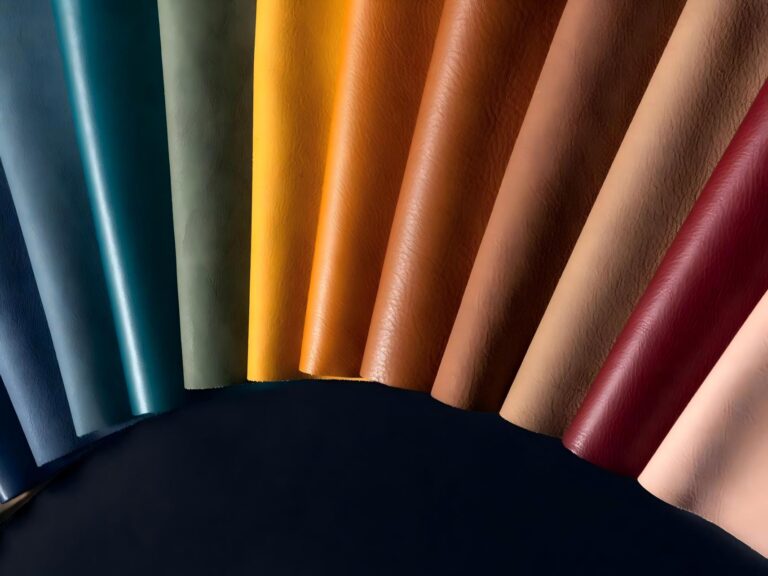
Market outlook: where leather-alternative demand is heading across fashion, automotive and furniture.
Your Next Steps Before Committing a Category
Run this check before any purchase order:
- Confirm the wholesale ratio for your channel, not the industry average.
- Ask for the material’s test data with the sample, including abrasion and flex cycles.
- Check eco credentials against your target market’s rules; certifications now move retail listings.
- Order one pilot run and track return reasons before scaling the category.
The best leather products of 2026 will not be chosen by taste alone. They will be the categories where demand growth, wholesale margin and a test-backed material spec all line up. Verify all three before ordering, and keep the margin the others only quote.
About TOPSUN
TOPSUN supplies full-silicone leather for the product categories above, from 3C accessories and fashion goods to automotive interiors, with 100+ textures and Pantone/RAL custom colors.
500,000 m monthly capacity, 500 m MOQ, 7-15 day delivery, and SGS test reports with every order.
Which leather product category has the highest margin?
Leather footwear and luxury phone cases typically lead, with factory-to-retail markups around 250% where branding and craftsmanship hold up. Handbags follow close behind on a 35-50% wholesale-to-retail ratio.
Is vegan leather a safe category to stock in 2026?
Demand data says yes: 11.4% annual growth through 2033. Vet the material instead of the category. Verified abrasion cycles and eco certifications separate lines that reorder from lines that get returned.
References
1. https://www.grandviewresearch.com/industry-anal… — Vegan leather market $11.6B (2025) to $26.8B by 2033, CAGR 11.4%; Asia Pacific 48.8% revenue share
2. https://wincheershoes.com/wholesale-leather-sho… — $25 factory price to $89 retail (256% markup); loafers $90-130 retail with year-round demand
3. https://seller.alibaba.com/blogs/2026/southeast… — Luxury leather goods $67.7B (2025) to $85.7B by 2035; leather phone cases $50-150 wholesale; women 59% of luxury purchases